
The Business Case for Playable AI Prototypes

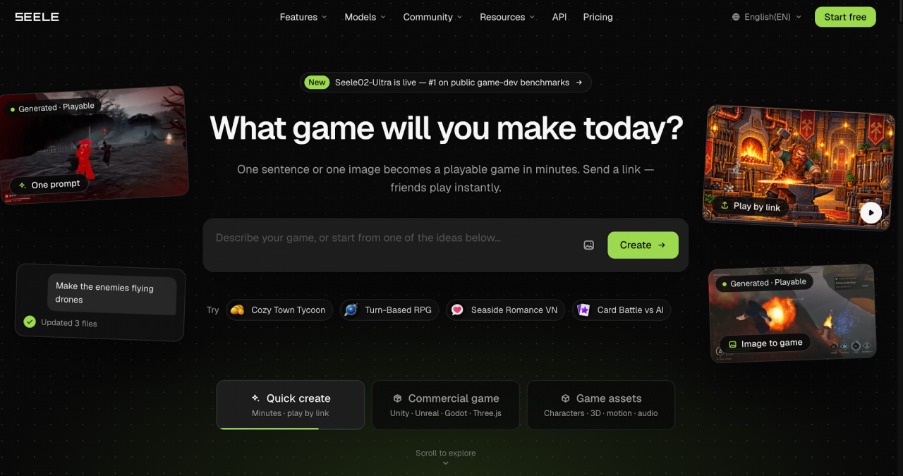
A startup can spend weeks describing an interactive product before anyone can try it. The cost is not simply development time. It is the risk of making decisions about an experience nobody has yet played. SEELE AI gives teams a faster route to a first test by connecting game creation, 3D assets, image-based interaction, and video in one creative workspace.
For a product team, speed matters when it improves learning. A rough playable build can reveal whether an idea is clear, engaging, and worth another round of investment. SEELE AI helps bring that conversation forward, while leaving final product choices to the people building it.
The value of an earlier test
A team might want to demonstrate an educational simulation, a branded game, or a virtual product experience. Before funding a full build, it can use SEELE AI to make a small version that exposes the main interaction. That version may show that the intended mechanic is confusing or that a simpler one works better. Either finding is useful. The team has learned from behavior rather than from opinions about a slide deck.
A connected content pipeline
SeeleAgent can help assemble a browser-playable first game from a prompt, image, or project file. SeeleAgent, also a 3d model generator, creates 3D models that can be edited and exported, giving teams a way to revise props and environments through text to 3d and image to 3d generation. Image to Game turns a visual reference into an interactive study. Seele TV supports short dramas, commercial videos, and game CG animation, so a team can introduce the same world to an audience in video form. These capabilities are most persuasive together because the idea does not have to be translated from scratch for every output.
For teams testing a new mechanic, SEELE also works as an free ai game maker that turns an early concept into something people can play and discuss.
What an investor or manager should ask
The right test is not whether a generated preview looks impressive. Ask whether people understand the objective, whether the assets can be changed, whether the output can be inspected, and whether the team can continue production on its intended platform. Review rights, code, dependencies, and performance before release. SEELE AI can lower the cost of reaching a meaningful first answer; teams still own quality and commercial decisions.
How to begin
Start with one idea that you can explain in a sentence. Decide what the first version should teach you. If the question is about gameplay, begin with SeeleAgent. If a visual reference is doing most of the creative work, try Image to Game. If the project needs a particular object, use SeeleAgent to make and revise it. When the concept is clear enough to show others, Seele TV can help create a short presentation. Then ask someone unfamiliar with the idea to try it and watch what they actually do.
The first output is a draft. Treat it like any other production material: inspect the code and dependencies, review the assets, check usage rights, and test the experience on the intended platform. Feedback should guide the next version. A creator who keeps the experiment small can learn more from one honest play session than from a long list of untested features.
Why the connected approach matters
A game concept does not live in one file. It moves through design, art, interaction, and presentation. SEELE AI keeps those activities close enough that the idea can develop without losing its identity. The creator can work with a playable build, adjust a 3D object, test a visual reference, and make a short video as related parts of one project. That continuity gives small teams more room to experiment and helps larger teams discuss concrete results earlier.
None of these tools makes taste or judgment automatic. The best results still come from a clear idea, careful editing, and attention to the people who will play or watch. SEELE AI is useful because it brings the first test within reach and makes the next revision easier to imagine. The less time spent waiting for a first version, the more time a team can spend deciding what is worth making.
From first test to finished direction
A good prototype earns its next round by showing where the experience has energy. The team can keep the mechanic that players understand, replace an object that distracts from the scene, or cut a feature that adds work without adding meaning. This kind of editing is where a rough AI output becomes a project with a point of view. SEELE AI supports the early material; the creator supplies the judgment that shapes it.
That process also makes collaboration easier. A designer can point to a scene rather than describe it, a developer can inspect a behavior rather than guess at it, and a marketing team can see which part of the experience deserves a trailer. The project becomes easier to discuss because everyone has the same starting artifact in front of them.
Try SEELE AI
Have a game idea, a picture, or a project you want to do interactive? Visit SEELE and try it with one small concept. See what you can play, edit, and share, then make the next version your own.





Comment