
Australians Are Keeping WordPress and Letting the Developer Go

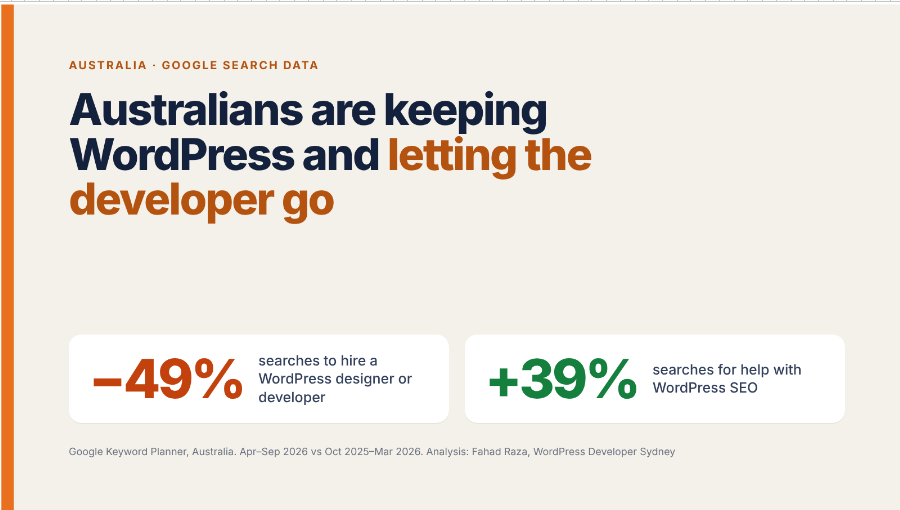
Searches to hire a WordPress developer in Australia have halved in six months. Searches for help running WordPress yourself are climbing. Here is what the data shows, and where do-it-yourself sites tend to go wrong.
WordPress is still the platform behind many Australian small business websites. What has changed is who looks after them.
I analysed 12 months of Google search data for Australia, from October 2025 to September 2026, across 914 WordPress-related search terms. I compared the six months from April to September 2026 with the six months before. Searches to hire a WordPress designer or developer fell 49%. Searches for help with WordPress SEO rose 39%.
Interest in WordPress itself held up far better. Searches for the word “wordpress” on its own fell 10%. Australians are not leaving the platform. They are taking the work in-house.
What the numbers show
The search terms that grew are the ones people type when they are running a site themselves. Searches for “wordpress seo plugins” rose from 2,030 to 4,750 between the two periods. Searches for “yoast seo wordpress”, the plugin many owners use to set page titles and descriptions, more than doubled. Searches for “wordpress cms” rose 98%, a sign of people learning how the platform works from the inside.
Plugin searches rose 29% and WordPress hosting searches rose 16%. The terms that fell were the ones that end in hiring someone: developer, designer, agency, company and services. Searches for “wordpress developer” alone fell 59%.
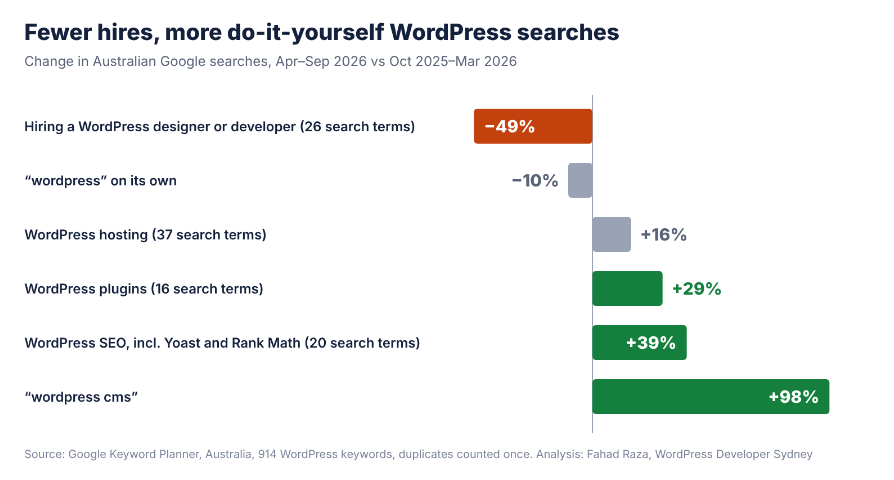
Change in Australian Google searches, April to September 2026 vs October 2025 to March 2026. Source: Google Keyword Planner.
Owners are doing their own SEO
The clearest change is in search engine optimisation. Six months ago, an owner who wanted better Google rankings would often search for someone to do it. Now more of them are searching for the plugin and doing it themselves.
I understand why. A plugin costs little or nothing, and the settings look simple. But a plugin can only write the title and description you give it. It can’t tell you which services deserve their own page, which suburbs to name, or why a competitor with a worse-looking site outranks you.
What owners are not searching for
The more telling numbers are the small ones. Between April and September 2026, Australians searched for WordPress security terms about 580 times. Over the same months they searched for WordPress SEO terms 13,340 times, roughly 23 times as often.
Searches about WordPress speed, caching and performance fell 13% between the two periods, even as do-it-yourself searches rose.
In my experience, those are the two areas where a self-managed site gets into trouble. A plugin left out of date for a few months, a theme nobody updates, or a hosting plan with no backups can take a site offline. A site that takes eight seconds to load on a phone loses visitors before they see a single word. Neither problem shows up in an SEO plugin’s score.
Running WordPress yourself: a checklist
None of this means owners should not manage their own site. Many do it well. If you are running WordPress yourself, these are the checks I would make every month:
- Update WordPress, your theme and every plugin, and delete plugins you no longer use.
- Confirm your host keeps daily backups, and that you know how to restore one.
- Test your homepage and a service page in Google PageSpeed Insights on mobile. Aim for under three seconds.
- Send a test enquiry through your contact form to make sure it still arrives.
- Check Google Search Console for pages that have dropped out of the index.
- Make sure every service you sell has its own page, with the suburbs you serve named on it.
If any of those checks fails and you can’t work out why, that is usually the point to bring in help, for that one job rather than a whole rebuild.
How I looked at the data
The figures come from Google Keyword Planner estimates of monthly searches in Australia for 914 WordPress-related terms, from October 2025 to September 2026. I grouped the terms by what the searcher was trying to do, counted Google’s close-variant duplicates once, and compared April to September 2026 with October 2025 to March 2026 to smooth out single-month swings. Keyword Planner rounds its estimates, so the figures show the direction and size of changes in search interest, not exact counts.
About the author
Fahad Raza has built websites since 2005 and runs WordPress Developer Sydney, an independent WordPress development service in North Sydney. Before that he co-founded RightClick, a digital agency that grew to 20 staff, and spent 8.5 years as Country SEO Specialist for IKEA Australia and New Zealand.







Comment