
Multi-Reference Guidance Vs Single-Prompt Synthesis In Visual Prototyping


Enterprise digital product teams struggle with geometric drift when scaling synthetic visuals across sprint decks. Deploying an anchored creative ecosystem like AIGenTools enables visual designers to preserve core structural landmarks through multi-reference guidance.
When design organizations prototype next-generation hardware concepts, digital interfaces, or marketing touchpoints, visual continuity dictates whether an exploratory concept feels viable or amateurish. Relying exclusively on open-ended text descriptions or isolated single-frame image conversions routinely triggers unforced architectural errors. Neural networks misinterpret ambiguous descriptive phrases, spontaneously widening hardware bezels, shifting component parting lines, or mutating human facial features across consecutive generations. Instead of accelerating delivery timelines, unconstrained generative engines force technical artists into prolonged retouching cycles where manual repair work cannibalizes the velocity gains promised by artificial intelligence.
Why Single-Prompt Diffusion Breaks Down In Production Workflows
The technical vulnerability inherent in conventional diffusion workflows stems from how neural architectures calculate latent pixel distributions. In a standard single-pass translation, an initial reference image is partially dissolved into Gaussian noise before an iterative denoiser reconstructs visual features based on text embeddings. If the denoising strength is dialed down to prevent structural distortion, the output clings rigidly to the source color palette and ambient lighting, delivering little more than a superficial stylistic filter. Conversely, when creative directors demand sweeping aesthetic transformations—such as converting a rough studio mockup into a polished commercial rendering—elevating the noise threshold causes the network to discard crucial topological anchors.
The Hidden Cost Of Unconstrained Latent Hallucination
Without geometric constraints firmly locked in place, generative models interpolate unseen dimensions from their underlying training weights rather than respecting client specifications. A solitary front-facing camera capture provides zero empirical data regarding how side chamfers reflect dynamic rim lighting or how internal display bezels align with casing edges. When encountering complex lighting prompts, diffusion algorithms bridge informational gaps by hallucinating standard aesthetic tropes, homogenizing unique industrial design signatures into generic, rounded product archetypes that fail rigorous brand compliance audits.
Reconciling Asset Consistency Across Multi-Member Teams
This structural variance introduces severe operational friction when distributed product design teams collaborate on multi-surface campaigns. A senior visual designer might achieve acceptable physical fidelity on an initial landing page hero asset, yet junior teammates executing secondary feature tiles produce noticeable aesthetic divergence. Asset number one preserves eighty-five percent of the hardware silhouette, asset number two introduces distorted corner radiuses, and asset number three alters button placement entirely. Merging these conflicting visual assets into executive slide decks or partner showcases reveals jarring continuity errors that immediately undermine design authority.
Architecting A Multi-Angle Reference Shield For Visual Assets
Overcoming geometric instability requires feeding generative pipelines sufficient spatial data before computing the first latent denoising step. Rather than gambling project deliverables on a single reference frame, production-grade workflows establish multi-angle reference arrays that triangulate essential physical landmarks across three-dimensional space. By supplying congruent perspective views, design teams ensure that spatial cross-attention layers recognize the subject as an unalterable physical entity rather than disposable pixel clusters.
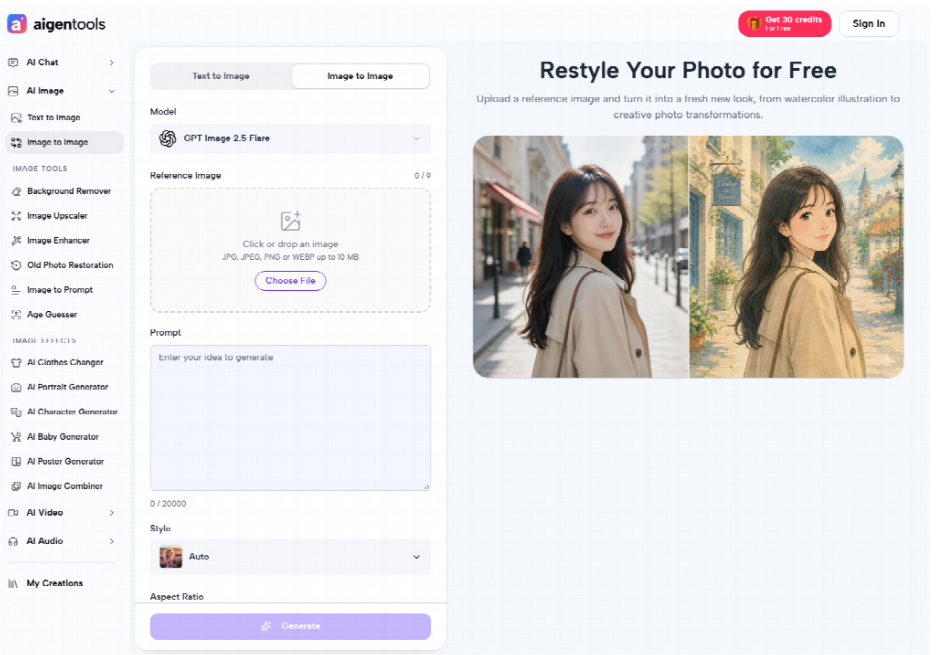
Within the studio environment of an AI image to image generator, creative leads deploy dedicated upload panels accommodating up to 9 reference image slots (0 / 9). The interface accepts high-resolution assets in JPG, JPEG, PNG, or WEBP formats up to 10 MB each, giving teams the bandwidth necessary to ingest comprehensive physical documentation. Across the AIGenTools workspace, ingesting frontal orthographic views, forty-five-degree perspective captures, and macro detail frames simultaneously creates an empirical geometric anchor that prevents structural degradation during aggressive aesthetic restyling.
Prototyping Strategy
Reference Depth
Likeness Preservation
Production Revision Overhead
Single-Prompt Text Synthesis
Zero visual references; relies entirely on lexical descriptions
Low: Essential hardware contours frequently dissolve
High: Demands exhaustive manual clean-up in raster editors
Single-Frame Denoising Pass
Single 2D capture subject to aggressive latent noise
Moderate: Vulnerable to perspective warp and lighting drift
Medium: Unstable keep-rate across complex multi-shot decks
Multi-Reference Guidance Array
Up to 9 synchronized captures (front, profile, detail)
High: Spatial cross-attention locks core physical dimensions
Low: Predictable rendering fidelity ready for executive review
This multi-reference methodology fundamentally alters the economics of rapid concept prototyping. Instead of dedicating days to modeling fully articulated 3D CAD geometry for preliminary concept pitches, design teams can validate physical form factors using physical foam mockups or clay prototypes photographed from multiple angles. Inside AIGenTools, the multi-reference shield locks the physical dimensions in place while the diffusion engine rapidly tests diverse finish materials, metallic anodizations, and glass treatments in seconds.
Model Routing And Prompt Boundaries For Commercial Delivery
Visual fidelity depends equally on selecting the appropriate neural model for the specific creative brief at hand. Enterprise studios deploy AIGenTools to access specialized computational engines side by side rather than attempting to force a single generalized algorithm across contradictory design tasks. The platform routes generative tasks across dedicated model profiles, ensuring technical alignment with distinct commercial deliverables.
When prototyping human-centric technology products where natural talent likeness and skin texture integrity remain paramount, creative directors select Nano Banana Pro. This architecture specializes in anatomical preservation, protecting facial bone structures and delicate epidermal nuances from artificial smoothing. Conversely, when marketing collateral demands readable in-image interface typography or intricate infographic layouts, teams route the task through GPT Image 2 or 2.5, which excels at linguistic instruction following. For conceptual moodboards and stylized storyboards, Seedream 5.0 Pro renders expressive painterly textures, while Seedream 4.5 delivers rapid low-latency drafts for early brainstorm sessions.
Separating Identity Locks From Atmospheric Directives
With an extensive prompt limit accommodating up to 20,000 characters, users possess immense linguistic latitude to steer environmental aesthetics, lighting conditions, and camera optics. However, disciplined technical teams avoid unstructured narrative rambling. High-performing prompt architectures enforce strict separation between immutable subject definitions and variable background cues. The command begins with concise geometric anchoring clauses that explicitly forbid alterations to primary contours, followed by targeted modifiers detailing lighting temperature, studio reflections, and atmospheric depth.
Locking Output Ratios And Resolution Parameters
Commercial publishing pipelines require precise aspect ratio discipline across disparate digital touchpoints. The configuration cluster allows technical artists to toggle between Auto or lock output to 21:9 cinematic ultrawide, 16:9 widescreen presentation formats, 3:2 and 4:3 editorial crops, 1:1 square tiles, or 9:16 vertical video ratios. Standardizing these framing dimensions directly inside the generative interface eliminates post-generation cropping passes that might otherwise compromise compositional balance.
Systematic Verification Protocol Before Publishing To Production
Integrating generative tools into enterprise production queues necessitates rigorous quality auditing protocols. Before any synthesized rendering enters corporate design repositories or client presentations, visual leads execute systematic side-by-side inspections against certified reference packages.

Inspectors evaluate three indispensable topological checkpoints: interface edge alignment, material transition seams, and perspective shadow coherence. When reviewing consumer hardware renders, designers verify that glass display surfaces curve naturally into metallic housing rails without pixel melting or blurred boundary artifacts. Furthermore, reviewers confirm that ambient occlusion shadows accurately reflect the simulated studio light sources rather than inheriting conflicting shadow directions from disparate reference images.
Technical teams benefit from transparent operational assurances that safeguard project timelines and computational resources. The platform delivers watermark-free high-definition downloads across all account tiers, ensuring that preliminary concept reviews maintain uncompromised professional presentation. Additionally, if an unexpected system failure or network timeout interrupts a complex multi-file rendering job, failed generations automatically refund wallet credits back to the organization account. This automated failsafe protects departmental creative budgets, allowing teams to iterate fearlessly without financial anxiety.
Strategic Implications For Digital Product Teams
Transitioning from unguided text-to-image synthesis to structured multi-reference visual generation represents a pivotal evolution in modern product development. By grounding neural generative engines in multi-angle photographic baselines, enterprise creative departments successfully eliminate subject drift while preserving brand geometry across iterative production cycles.
Deploying AIGenTools provides design organizations with the architectural stability, model flexibility, and multi-file reference capacity required to scale high-velocity visual experimentation. Moving beyond volatile prompt experimentation empowers digital product teams to explore bold visual frontiers with complete confidence that their core design identity will remain uncompromised.





Comment