
Every Milliwatt Counts: Inside the Battery Engineering of Meta’s AI Glasses

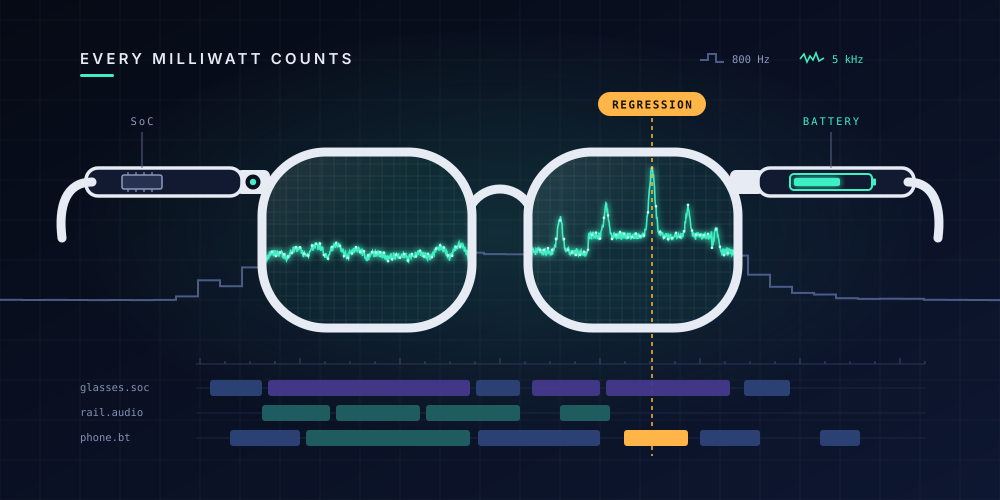
The battery in a pair of Meta’s AI glasses lives inside a temple arm, in roughly a fifth to a tenth of the space a phone battery gets. There is no thermal headroom — the device is touching your face — and no tolerance for the mobile developer’s favourite habit of shipping first and optimising later. On a device this small, a wasted milliwatt is not an abstraction; it is a call that drops an hour earlier, a podcast that doesn’t finish.
Dmitrii Volykhin has spent the past four years on the unglamorous side of that problem. A tech lead in developer tooling and performance engineering for Meta’s wearables — a lineup that runs from its AI glasses to the Orion AR glasses — he designed and led the development of Power CI, the testing infrastructure that catches battery regressions before users ever feel them. In episode 87 of the Meta Tech Podcast, where Meta brought him on to explain how battery life on wearables is actually won, his answer was consistent to the point of stubbornness: it is won by measuring, on real hardware, all the time. His lessons travel well beyond glasses — to anyone building for hardware where power is the scarcest resource.
Emulators Lie, So Build a Farm
Meta runs thousands of glasses tests on emulators, and Volykhin is quick to say what emulators are good for: comparing two versions of code against the same baseline. What they cannot do is tell you the truth about power. Real consumption only shows up on real hardware, which is why power testing at Meta runs in device farms — labs holding hundreds of physical glasses, where robotic arms close temple arms, USB hubs cut charging mid-test, and every device is wiped and reflashed between runs. Getting a clean power measurement out of that zoo — a healthy device, a precise start and stop, charging fully disconnected — is itself an engineering discipline, and one Volykhin is now working to unify across Meta’s many hardware variants.
Capacity is the permanent constraint. With hundreds of use cases, nothing like all of them can run on every code change, so the tests are tiered. The non-negotiables — suspend and idle power — run on every diff: close the arms and the glasses must sleep; leave them on a desk and they must slip into a power-saving state. Everything else gets merged, scheduled and promoted as the risk warrants; an area that keeps regressing earns a slot on higher-precision monitoring. The payoff of this triage is speed — a regression flagged within a day of the code that caused it is usually fixed fast, while the ones that linger go flaky and expensive. The tests themselves run through Jest, the framework Facebook open-sourced, carrying layers of internal tooling on top. “It’s never enough to build more tooling,” Volykhin said.
One Trace to Rule the Investigation
The second half of the discipline is resolution. Every development board carries an onboard power monitor sampling 800 times per second across a handful of rails — enough for the basics, blind to the interesting failures. For cameras, audio systems and each new microphone Meta experiments with, Volykhin’s team built an advanced power monitor that samples at 5,000 times per second and up and reads every rail on the board, so a regression too small for the standard instrument has nowhere to hide. The quieter revolution is where the data goes: everything lands in a single Perfetto trace, which Volykhin calls one source of truth. An engineer can investigate a regression with nothing else — often by running SQL queries against the trace, which AI tools now write in seconds. Measurement that used to require specialised lab equipment became something any engineer runs in CI.
The approach earned its keep on a stubborn case: glasses paired with an iPhone drained faster on long calls than glasses paired with Android, and the regression resisted analysis for almost a year. The team ran through every tool it had, then built new ones on top for this single investigation. The fix bought roughly 30 extra minutes of battery on long iPhone calls. “You can have a call with your mom 30 minutes longer,” said Volykhin, who wears prescription AI glasses himself and counts calls among his favourite features.
Trust the Trace, Not the Agent — or Yourself
AI now opens many of these investigations: agents comb the reports, point at a suspect diff or a team working nearby, and occasionally argue with each other — Volykhin calls it a battle of AI agents. He is unsentimental about the shift. The engineer’s job has moved towards verification, because agents hallucinate; one confidently blamed audio in a test that never played a sound. What keeps them useful is the same infrastructure that keeps humans honest — they reason over the traces and metrics his tooling produces, and get pushed back towards the real cause when they wander.
The human version of that failure mode is the one Volykhin warns about most. Engineers trust their mental models, he said, but real hardware misbehaves across subsystem lines — audio affecting parts of the glasses nobody expected, a single data point flattering a wrong hypothesis. His advice to anyone building wearables is the whole philosophy in one line: “Measure, measure again, and maybe a third time too.”
It would be easy to file all this under Meta’s resources — the farms, the robotic arms, the custom monitors. But strip those away and what remains is one engineer’s argument, made over four years and now embedded across Meta’s wearable lineup: that on power-starved devices, measurement infrastructure is not plumbing but a product in its own right, worth designing with the same ambition as the features it protects. It is an argument Volykhin has been making longer than he has been making glasses last — through a decade of distributed-systems work before Meta, and now from conference stages and podcast microphones where the wearables industry is starting to listen.







Comment