
I Asked AI Who I Am. It Described Someone Else. Here’s Why That Happens

By Ben Yeoh, Digital Performance Architect, Kuala Lumpur
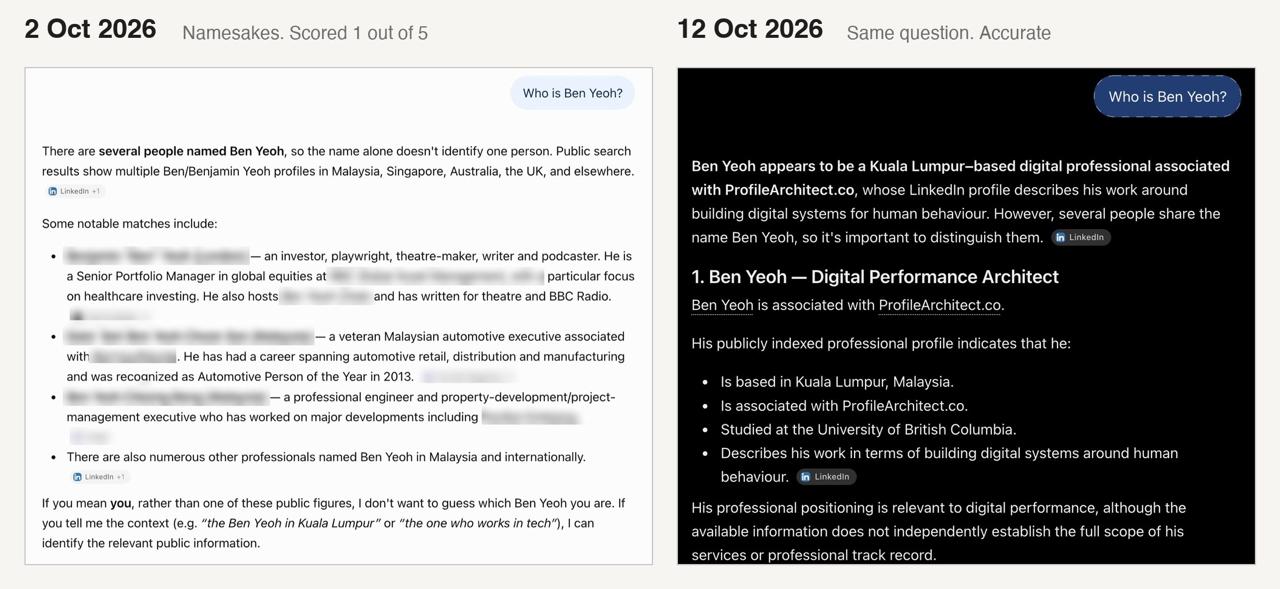
I’ve worked in search since 2010, so I assumed AI assistants knew who I was. On 2 October 2026, the day I launched my personal site, I tested that. I asked ChatGPT, Gemini and Perplexity 30 questions about myself and my field. All three answered at least one question about me with facts about someone else.
Gemini answered “Who is Ben Yeoh?” with a different Ben Yeoh, a car-industry executive. Perplexity’s answer was about another one entirely, an investor in London. ChatGPT listed three namesakes and declined to guess. Across all the answers, four different people with my name appeared.
Ten days later I asked ChatGPT again. This time it described me: based in Kuala Lumpur, Digital Performance Architect, associated with ProfileArchitect. On my 1-to-5 accuracy score it went from 1 to accurate. I’ve published every question, score and screenshot, including the unflattering ones, in my 30-question study.
Why do AI assistants mix up people with the same name?
An AI assistant doesn’t know who is asking. It resolves a name to the person with the strongest and most consistent evidence. If one namesake has a Wikipedia page and years of news coverage, the model defaults to them, and everyone else with that name gets merged in or left out.
Three things make it worse:
- Thin sources you own. If your only detailed bio is a LinkedIn profile, the model has little to anchor on.
- Inconsistent facts. A different title, city or company on each site looks like a different person.
- No distinguishing details. Without a middle name, local name, city or distinctive career facts, two people with the same name look identical.
What changed in ten days?
I can’t prove which change did it, and one improved answer is a signal, not a result. But the pattern is instructive. The October 12 answer cited LinkedIn, not a press article. Between the two runs, I made every profile I control state the same facts in the same words: Ben Yeoh (Yeoh Beng Hin), Kuala Lumpur, Digital Performance Architect, HRD Corp accredited trainer, founder of ProfileArchitect.
Language models learn who someone is from text, not from links. Consistency gave the model one clear version of me to pick.
It’s not fixed yet, though. The same day, ChatGPT answered “What does benyeoh.com offer?” with details about a namesake. On 17 questions about my field that didn’t mention my name, my own site was cited in at most two answers per run. A new site has no track record, so assistants lean on older pages. Most executives start in the same place.
What can an executive check in 15 minutes?
- Open a private browser window and ask ChatGPT, Gemini and Perplexity: “Who is [your full name]?”
- Write down every wrong fact and every source each assistant cites.
- Search your name with your city and company to see which namesakes compete with you.
- Make sure one page you own states your full name, current role, city and career history in plain text.
If an answer is wrong, fix the source before you try to fix the answer. Correct your own page first, then make every other profile repeat the same facts. Assistants update slowly, so save today’s answer and test again in a month.
The takeaway
Nobody can guarantee what an AI assistant will say about them. You can measure what it says today, strengthen the sources it relies on, and test again. I’m re-running the same 30 questions in early December 2026 and will publish the comparison.
Boards, investors and clients are already asking AI about the people they’re about to meet. That answer is now part of due diligence, and most executives have never read theirs.
Ben Yeoh (Yeoh Beng Hin) is a Kuala Lumpur-based Digital Performance Architect and HRD Corp accredited trainer. He spent 18 years in corporate training and performance coaching before founding ProfileArchitect, which audits and builds AI-ready profiles for executives across Asia-Pacific. More at benyeoh.com.







Comment