
iAsk.ai’s Road to One Billion Searches


Since launching in 2023, iAsk has grown from an AI answer engine into a platform for search, visual questions, guided learning and generated video explanations.
iAsk celebrates one billion searches, according to Ai Search Inc. Graphic supplied by iAsk.
iAsk.ai has surpassed one billion searches, according to Ai Search Inc., reaching a milestone that traces the company’s development from an AI answer engine launched in 2023 to a broader search and learning platform. The company announced the total on November 2, 2026, one week after introducing its Search-to-Video feature.
The starting point remains simple: people can ask AI anything in everyday language. Around that question, iAsk has built ways to read an explanation, examine sources, ask a follow-up, submit an image or request a tutorial video. The billion-search announcement brings that product development into focus alongside the growth in usage.
The milestones along the way
In December 2023, less than a year after launch, Ai Search Inc. reported that iAsk had handled one million searches in a single day. By March 2025, the company was announcing more than half a billion searches in total. It reported passing 750 million in June 2026.
The latest announcement takes that running total beyond one billion. These are searches accumulated over the life of the service. Together, the announcements chart the platform’s progress across three years in which the company has also expanded what users can do after receiving an answer.
One of those developments was unlimited follow-up questions, which iAsk had introduced by its June 2026 announcement. At the time, the company said nearly 56% of users asked more than one question per session. Follow-ups gave those exchanges a place to continue, with users able to narrow a subject or ask for more context.
Building around the next question
A written response is still central to iAsk. Source citations give readers a route to the material behind an explanation, while a follow-up can focus on a term, assumption or example that needs more attention. Someone researching a new subject can develop the inquiry as their understanding grows.
Image-based questions extend the starting point beyond typed text. A photograph of a worksheet or a diagram can provide context that would be awkward to reproduce in a search field. The user can begin with the material in front of them, then explore it through the same question-and-answer format.
Education has become another part of that development. iAsk’s AI homework helper includes Guide Me, which prompts a learner through a problem and asks them to attempt intermediate steps. The approach gives a student somewhere to work through the reasoning, as well as somewhere to ask for an explanation.
These features connect within a single task. A learner can bring in an image of a question, work through a step and ask for clarification when an explanation is unclear. A researcher can begin with a broad question, examine a cited source and return with something more specific.
The platform also supports work with existing source material. Its AI document analysis tool lets users bring in a file and ask about its contents. Alongside open-ended search, this gives people a way to explore the report or paper they are already reading.
From written answers to generated video
On October 26, 2026, iAsk announced Search-to-Video, adding generated tutorials to its search experience. Users request a tutorial when submitting a question. Once ready, the video can be played from the result page alongside the written answer. The company says the feature is available to everyone.
The launch demonstration follows a question about how black holes form. It shows the request, excerpts from the generated tutorial and the result within iAsk. That makes the newest addition concrete: the question supplies the subject for a video explanation, while the written response remains available to read and explore.
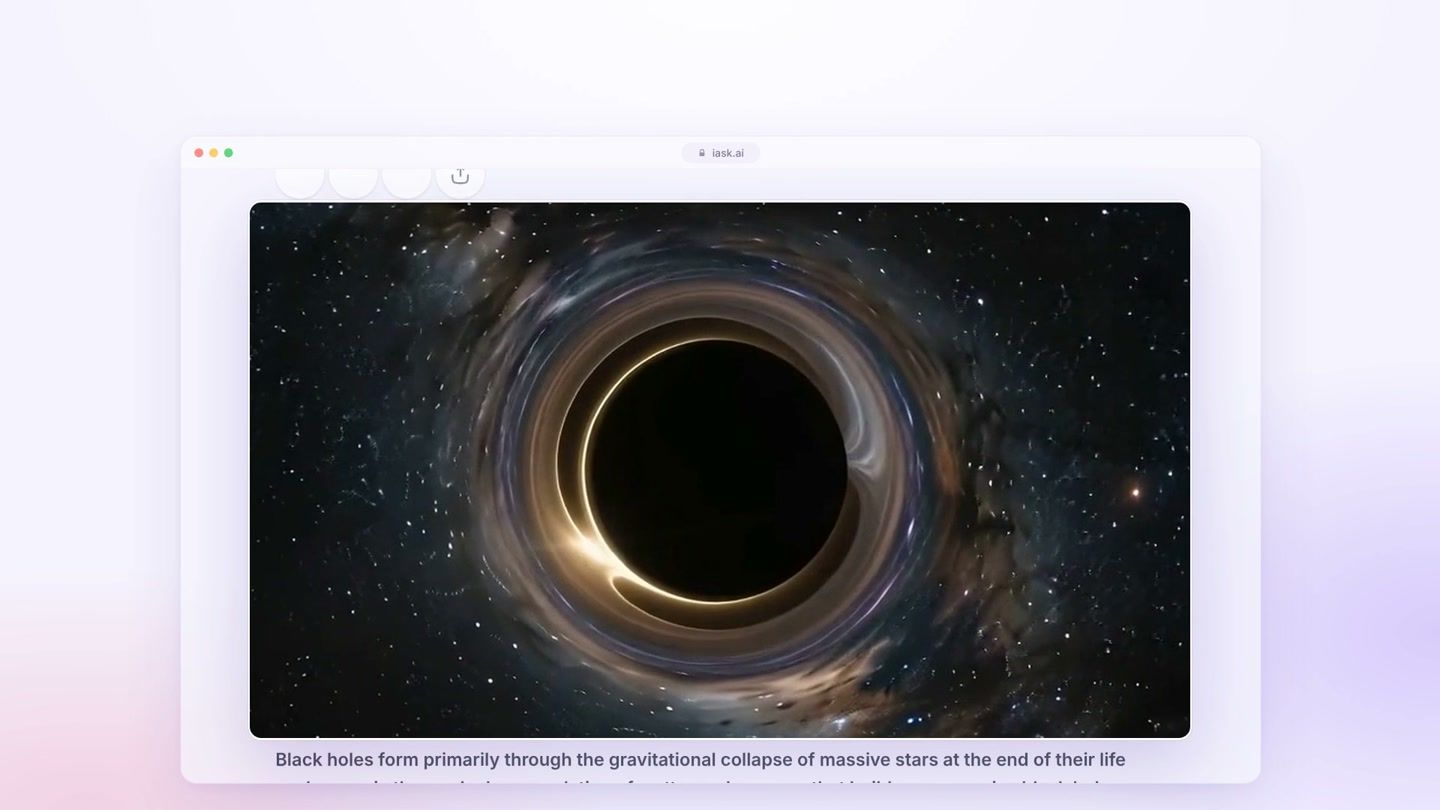
Still from iAsk’s edited Search-to-Video launch demonstration, showing a generated black-hole explainer within the product. Image supplied by iAsk.
The one-billion-search milestone arrives with those options already part of the platform. iAsk’s development now spans how a question enters the service, how an explanation is presented and how the user continues. The interface still begins with a question; the experience around it has become considerably broader.







Comment