
All You Need to Know about the Soap – History & Facts

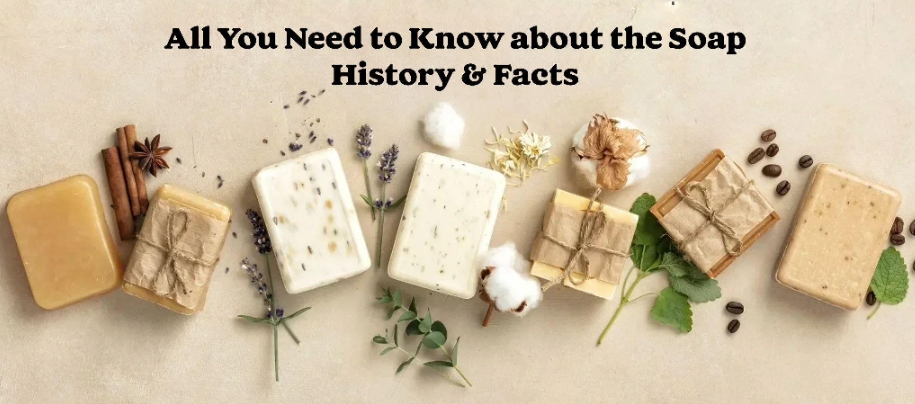
May I ask about the first product you use daily whenever you get up? Despite the exception of cell phones, I guess it is the soap. Unfortunately, many people don’t know all about soap even if it is their daily use product. The barter of soap you scrub many times is one of the most ancient products. Today, I will take you to the ancient times and explore the history of soap. Not only history, I will also mention some facts you may not have heard before.
With the right knowledge about soap, you will experience a great difference in perception about it. Plus, you can also make the right choice about the usage of soaps.
Let’s start with the history of soaps!
The History of Soaps
Soap is one of the most ancient consumer products that appeared in ancient civilizations. Therefore, the early soap was more ash, wood, or fat than the soap you see today. However, the early soaps were more a combination of fats and ash. Many historians believe that certain kinds of fats and ash were the main ingredients for cleanliness. Later, it started getting its real shape with time.
Babylonians were the first who mademake a soap to use in medicines. The word “Sapo” was used for soap in Rome. Then, Romans and Greeks contributed to the production of soaps. They used some more advanced techniques to produce a batter batter of the soap. Even the components of soaps used by the Romans were different of Babylonians. The Romans used ashes and tallow to create a more refined soap.
In the Middle Ages, the use of soap declined in Europe due to the lack of understanding of its benefits. As trade routes expanded during the Renaissance, soap regained its popularity. Soap for cleanliness and freshness was used by everyone until the Industrial Revolution in the 18th and 19th centuries. The Industrial Revolution of the 18th and 19th centuries brought about another revolutionary shift in soap production.
At the end of the 19th century, companies like Procter & Gamble and Lever Brothers were instrumental in making soap a product for mass consumption. In the 1930s, an innovative soap-making process known as the ‘continuous process’ was introduced by Procter & Gamble. This was when vegetable oils were the primary components of soap.
Today, custom soap boxes have become the royal houses for modern soaps. But most people still use traditional soaps such as Africa’s black soap, which has fewer chemicals than liquid soap.
History of Soaps – Timeline
- 2800 BCE: The earliest recorded soap-like substances were produced by ancient Babylonians from fats, wood ash, and water.
- 200 BCE – 200 CE: Tallow and plant ashes are added to soap-making by Romans and Greeks; this combination improves the process. The word “soap” comes from the Celtic word sapo.
- Middle Ages: As a result of ignorance about its advantages, soap production declined in Europe.
- Renaissance: As the network of trade routes was extended, soap regained its popularity in Europe. New ingredients and new knowledge are introduced into Europe.
- 18th-19th centuries: The discovery of the chemical nature of soap helped launch mass production by way of the Industrial Revolution. Procter & Gamble and Lever Brothers are central players in the soap commercialization.
- Late 19th century: Procter & Gamble introduces the “continuous process” for soap production. Lever Brothers pioneers soap made from vegetable oils instead of animal fats.
- World War I and II: Increased demand for soap during wartime led to the widespread promotion of hygiene.
- Mid-20th century: Synthetic detergents were introduced in mid-20th century. Detergents offer improved cleaning properties and are more effective in hard water.
- Present Day: A wide variety of soaps and detergents are available, catering to different needs and preferences. The soap industry continues to evolve with advancements in formulations, scents, and packaging.
Who Invented Soap?
The Babylonians were the first who invented soap in 2800 B.C. with wood ash and fats. They discovered a way to clean body parts with already existing materials of ash and fats. So, they laid the foundation for the ancient art of soap-making. However, liquid soap did not come until the 19th century.
When was the Soap Invented?
Many Archeologists have found soap-like materials that belong to the ancient times of 2800 BC. So, the Babylonians invented the soap in 2800 BC. However, it was a French chemist who took a major step toward large-scale soap production in 1791. He used different chemicals like soda and salt to create a modern soap. On the other hand, William Shepphard invented the liquid in 1865. All these kinds of soaps were used for body cleaning and bathing.
African Black Soap Side Effects
Traditional ingredients like plant ashes are the main ingredients of African black soap. So, it is rough and hard as compared to other modern soaps. If your skin is very much sensitive then it can be allergic to any soap, including African black soap. Similarly, it may also cause burning and stinging to your body if you use it frequently.
The Benefit of African Black Soap?
African Black soap is the natural production in the age of chemicals. So, it can bring an improved skin tone and texture with natural antibacterial and exfoliating properties. Additionally, it is also beneficial in reducing inflammation and wrinkles in the body.
Difference Between Hand Soap and Body Wash
Body wash and hand soap have different chemicals in them. A body wash makes more foam because it is used for many sensitive parts. On the other hand, hand soap is less foamy because of fewer emollients used in its production.
Conclusion
The history of the soap goes back to the ancient Babylonian times. From ash to fat, different materials were used as soap in 2800 BC. Today, two forms of soap are available to have better hygiene and cleaning. I have drawn the complete timeline of the soap history to help you know all about a block of soap. It is really a mind-blowing revolution of turning ash into soap in the history of soap-making.







Comment