
The Small Connection That Makes Modern Electronics Work Better

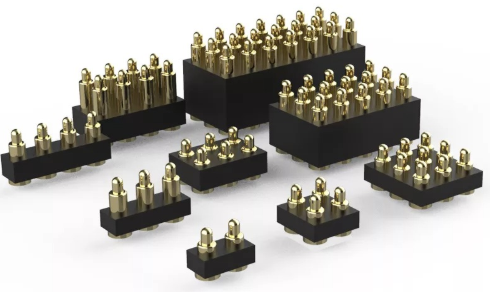
Most people never think about the tiny contacts inside their electronic devices until something stops working. A smartwatch refuses to charge, a docking station loses its connection, or a testing machine produces inconsistent results. These seemingly minor problems reveal why Pogo Pin Connector Solutions by QH Industrial deserve attention from product designers and electronics manufacturers. A reliable connection might seem like a small detail, but it can make the difference between a product people enjoy using and one that constantly causes frustration.
Why Such a Small Component Matters
Imagine placing your wireless earbuds into their charging case. You expect them to start charging without having to adjust their position several times. That simple experience depends on electrical contacts working exactly as intended.
Pogo pins are often used to make these connections possible. Unlike a fixed metal contact, a pogo pin contains a spring that allows its tip to move when pressure is applied.
The movement is slight, but it serves an important purpose. It helps the contact maintain pressure against another conductive surface, even when there are small differences in positioning.
This makes pogo pins useful in products that are connected and disconnected regularly.
They are not complicated components, yet their contribution to everyday convenience is easy to underestimate.
What Actually Happens Inside a Pogo Pin?
The construction is straightforward. Most pogo pins have a metal barrel, a movable plunger, and an internal spring.
When the pin touches its mating surface, the plunger moves inward. The spring pushes back, helping maintain electrical contact.
Once the pressure is removed, the plunger returns toward its original position.
That is the basic principle behind the technology.
What makes the design interesting is how manufacturers can adapt it. Different applications require different dimensions, spring forces, electrical ratings, and surface finishes.
A connector intended for a compact wearable device will not necessarily have the same specifications as one used in industrial testing equipment.
Choosing correctly matters more than simply finding a pin that looks suitable.
Charging Should Not Feel Like a Chore
Think about the devices you charge throughout the week. Phones, headphones, fitness trackers, portable instruments, and various household accessories all depend on dependable electrical connections.
Traditional charging ports work well in many situations, but they are not always the most convenient option.
Some products benefit from charging docks that allow users to place a device into position without inserting a plug.
Pogo pins can make this arrangement possible.
When the device sits correctly against the charging contacts, the spring loaded pins establish the connection needed to transfer power.
For someone charging a smartwatch every evening, this can make the process noticeably easier.
Of course, the design still needs careful attention. Dirty contacts, poor alignment, or unsuitable electrical specifications can interfere with performance.
Convenience works best when it is supported by thoughtful engineering.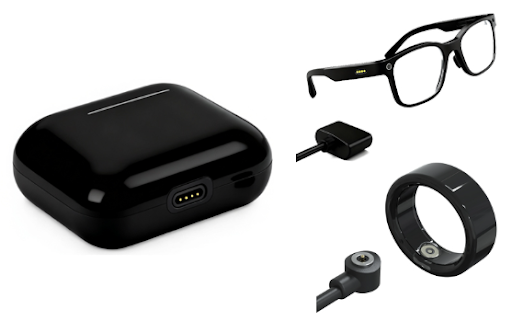
Magnetic charging glasses, rings, and earphones. Image: QH Industrial
The Challenge of Making Electronics Smaller
Electronic products keep getting more compact, but customers rarely want fewer features.
A fitness tracker, for example, may contain sensors, a battery, wireless components, and a display within a remarkably small housing.
Engineers must decide where every component belongs.
Large connectors can become a problem when internal space is limited. They may complicate assembly or restrict how other components are arranged.
Compact spring loaded contacts offer another option.
Their relatively small dimensions can help designers create efficient internal layouts without introducing unnecessarily bulky connection mechanisms.
This does not mean pogo pins are suitable for every product. Their value depends on the electrical and mechanical requirements of the particular design.
Still, they give engineers another practical choice when space becomes a challenge.
Not Just for Smartwatches and Earbuds
Consumer electronics provide familiar examples, but pogo pin connectors have a much broader role.
Consider a factory that produces electronic circuit boards. Before those boards are installed in finished products, they often need electrical testing.
A testing fixture may use spring loaded pins to touch specific points on a board temporarily.
This allows equipment to check electrical characteristics without permanently attaching wires to every testing location.
The same basic technology can appear in industrial instruments, portable medical equipment, telecommunications devices, and specialized charging systems.
Each environment introduces different demands.
A testing fixture may experience thousands of repeated contact cycles. A portable device may face occasional drops or movement. Industrial equipment could operate around dust, vibration, or changing temperatures.
These differences influence which connector specifications are appropriate.
Why Cheap Materials Can Become Expensive Problems
It is tempting to judge a connector by its size and price, especially when ordering large quantities.
But a component that costs very little can create expensive problems if it performs poorly.
Contact resistance, spring durability, and corrosion resistance all influence how reliably a pogo pin works.
Manufacturers commonly use conductive metal alloys for the contact components. Surface plating, including nickel or gold in suitable designs, can help provide the required contact characteristics.
The spring also needs the right mechanical properties.
If it loses force too quickly, the connector may no longer maintain adequate pressure against its mating surface.
That can lead to intermittent connections or inconsistent performance.
For manufacturers, reviewing material specifications and expected service life is therefore an important part of selecting components.
Why One Connector Design Cannot Fit Every Product
A connector that performs well inside a small charging dock might be unsuitable for a larger industrial device.
The required current could be different. So could the available space, mounting method, or expected number of contact cycles.
This is where customization becomes useful.
Engineers may need particular pin lengths, contact arrangements, spring forces, or plating options.
Instead of adapting the entire product around a poorly matched connector, they can investigate designs that better suit the application.
When considering Pogo Pin Connector Solutions by QH Industrial, manufacturers should begin by identifying their actual operating requirements.
Technical drawings, samples, and practical tests can help determine whether a particular configuration is appropriate.
The most effective choice is usually the one that meets the product’s needs without adding unnecessary complexity.
Good Connections Begin Before Production
Connector selection should not be left until the final stages of product development.
The amount of compression, the alignment of mating surfaces, and the chosen installation method can all affect performance.
For example, a pin that is compressed beyond its recommended travel may experience unnecessary mechanical stress.
Insufficient compression, meanwhile, may prevent the connector from maintaining suitable contact pressure.
These details are easier to address while engineers are still refining the design.
Testing samples under realistic operating conditions can also reveal problems that are not obvious from drawings alone.
It is better to discover an alignment issue during development than after thousands of products have been manufactured.
A Detail Worth Getting Right
A well designed electronic product should feel dependable without requiring the user to understand what happens inside it.
That experience often comes down to careful decisions about components that remain completely hidden.
Pogo pins are a good example. Their spring loaded construction can support convenient charging, compact layouts, and repeated electrical connections across many different applications.
They are not a universal answer to every connectivity problem, and their performance depends on choosing suitable materials, dimensions, and electrical specifications.
For manufacturers exploring connector options, taking time to read more about pogo pin technology can lead to better informed design decisions.
After all, customers may never notice a well chosen connector. They will certainly notice when a connection fails.






Comment