
Crossword Clue Solver: How to Finish Finnish Crosswords Faster

You know the feeling. The coffee is still warm, the puzzle page is open and you’ve filled in most of the grid with a sense of quiet pride. Then you hit one corner that just won’t move. Three empty squares, one stubborn clue and a growing suspicion that the answer is something you’ve known your whole life but can’t quite reach.
Crosswords have a way of humbling everyone. Even people who solve them daily get stuck, and that’s part of what makes them fun. Still, there’s a difference between a satisfying challenge and an hour of staring at the same box. This guide covers how Finnish crosswords work, how to decode the most common clue types and when a little outside help makes sense.
The Popularity of Crosswords in Finland
The modern crossword is just over a century old. It was created by a journalist named Arthur Wynne, who published a diamond shaped “word cross” in a New York newspaper in 1913. His story is told in this Biography profile of Arthur Wynne, and it’s a good reminder that one small idea can spread across the whole world.
In Finland, crosswords, or ristikot, found a very comfortable home. Walk into any kiosk or supermarket and you’ll find shelves of puzzle magazines. Many newspapers carry a weekly puzzle, and plenty of families have a grandparent who has quietly solved one every morning for decades.
Finnish puzzles often follow the Nordic arrow style, where the clues sit inside the grid itself and small arrows point to where each answer goes. Picture clues are also common, which gives the puzzles a playful, almost game-like feel. Unlike the cryptic crosswords popular in Britain, Finnish ristikot tend to rely on direct definitions, wordplay and general knowledge rather than complex riddles.
That makes them approachable for beginners, but it doesn’t make them easy. Finnish has a huge vocabulary, a lot of compound words and many short words that puzzle makers love to reuse. Getting quick at them takes practice.
Common Clue Types and How to Decode Them
Once you start noticing patterns, you’ll find that most clues fall into a handful of categories. Recognising the type is often half the battle.
Synonym clues
These are the most common. The clue is simply another word with the same meaning as the answer. If the clue says “big” and you need five letters, you’re looking for a word that means big. The challenge is that there are often several options, so the crossing letters decide which one fits.
Fill-in-the-blank clues
Here, the clue is a phrase or saying with one word missing. These are usually the easiest place to start, because familiar expressions tend to pop into your head without much effort. Always solve these first and use them to unlock harder sections.
Abbreviation clues
Short answers of two or three letters are often abbreviations, chemical symbols or country codes. Puzzle makers love these because they fill awkward gaps in the grid. If the answer is very short and the clue feels technical, think in terms of shortened forms.
Picture clues
Many Finnish puzzles include small drawings instead of written clues. These seem simple, but they can be sneaky. A picture of a dog might want “koira”, but it might also want a specific breed or a related word. Look at the letter count before you commit.
General knowledge clues
Place names, famous people, rivers and historical events show up regularly. These are the ones that tend to stop people cold, because you either know the answer or you don’t. They’re also where a little research can save a lot of frustration.
Smart Habits for Faster Solving
Speed in crosswords isn’t really about thinking faster. It’s about wasting less time. A few habits make a noticeable difference.
- Do a quick first pass. Read through every clue once and fill in only the ones you’re sure about. Don’t stop to wrestle with anything difficult yet.
- Work outward from confirmed letters. Every correct answer gives you letters in crossing words. A word with two or three known letters is far easier to crack than a blank one.
- Write lightly when unsure. If you’re solving on paper, pencil in guesses softly. If you’re solving on a screen, keep a mental note of which answers are confirmed and which are hopeful.
- Use Finnish word patterns. Finnish rarely mixes back vowels (a, o, u) with front vowels (ä, ö, y) in simple words. If your crossing letters break that rule, one of your answers is probably wrong.
- Take a break. It sounds too simple to work, but stepping away for five minutes often makes a stubborn answer obvious when you return.
When to Use an Online Clue Helper
Some people feel that looking up an answer ruins the puzzle. Others see it as a perfectly normal part of solving. The truth sits somewhere in the middle.
If you’ve spent twenty minutes on a single clue and it’s blocking an entire corner of the grid, getting help on that one answer lets you finish the rest of the puzzle yourself. That’s a far better outcome than giving up and throwing the page away.
For Finnish puzzles specifically, a dedicated clue tool is much more useful than a general search engine. Searching the web for a short Finnish clue often returns pages that have nothing to do with crosswords. A purpose-built helper understands that you’re looking for a word of a certain length that matches a certain hint.
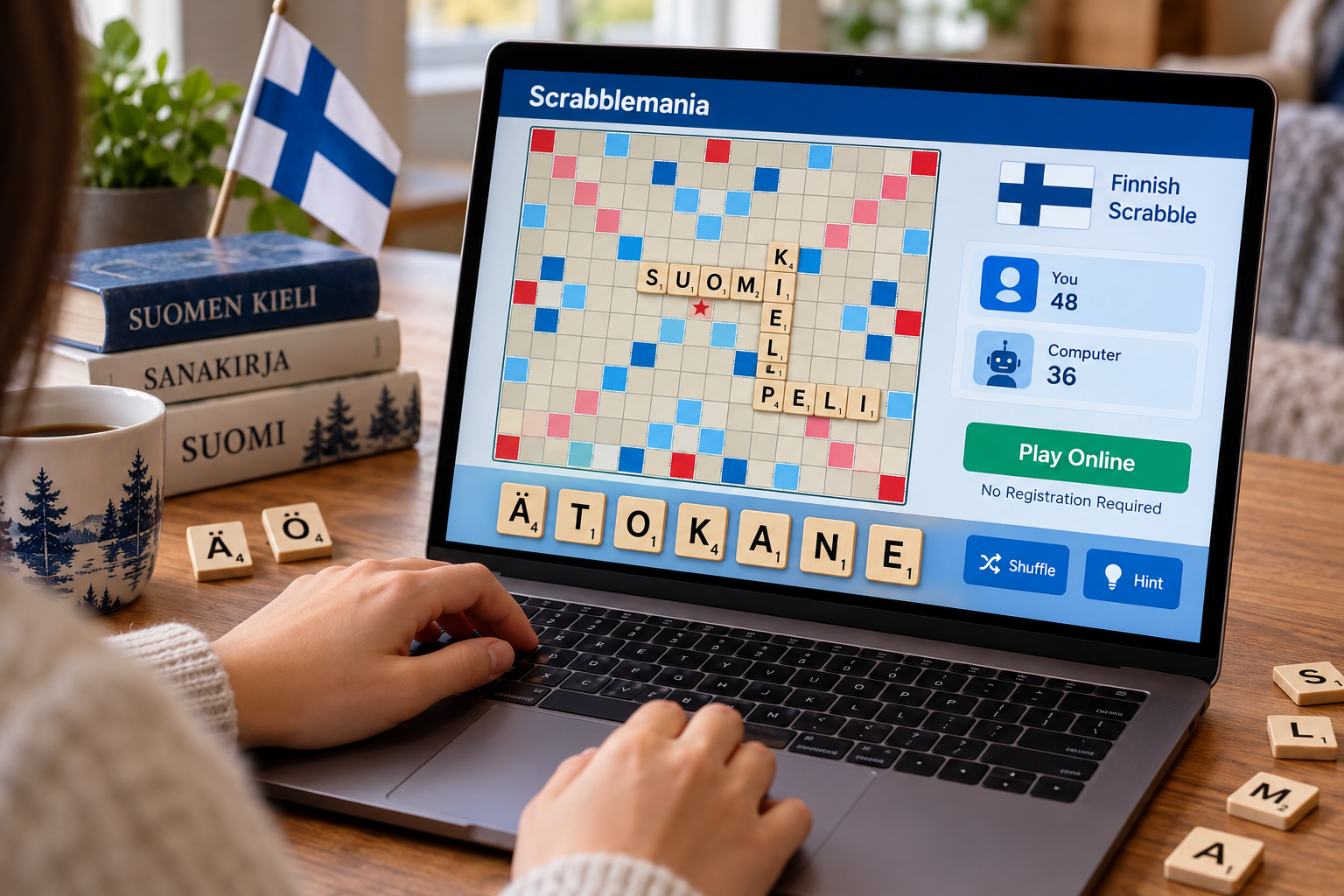
One handy option is scrabblemania.fi, a free Finnish site that offers answers to crossword clues alongside its Scrabble game. You type in the clue, and it suggests matching words without making you sign up or download anything. Because the same site also has a word finder and online Scrabble, it’s a nice place to spend time if you enjoy word puzzles in general.
The best way to use any clue helper is sparingly. Look up the answer you truly can’t find, then go back to solving on your own. You’ll still feel the satisfaction of completing the grid, and you’ll probably remember that tricky word next time.
Building Vocabulary Through Daily Crosswords
Regular solvers often say their vocabulary has grown without them noticing. That’s not surprising. Crosswords expose you to words you’d rarely use in conversation, and they make you recall those words actively instead of just reading them.
There’s also some interesting research around puzzles and the brain. A study led by researchers at Columbia University compared crossword puzzles with computerised brain games in older adults with mild memory problems. The crossword group showed better results over the course of the trial. You can read a summary in this Columbia Psychiatry article on crosswords and memory. It’s one study, not a miracle cure, but it does suggest that the daily puzzle habit has value beyond simple entertainment.
To get the most out of crosswords as a learning tool, try these simple steps:
- Keep a small list of new words. When you learn an answer you didn’t know, jot it down. Reviewing the list once a week helps it stick.
- Notice repeated answers. Puzzle makers reuse certain short words often. Once you learn them, you’ll fill them in almost automatically.
- Mix difficulty levels. Easy puzzles build confidence and speed. Harder ones stretch your knowledge. Switching between them keeps things interesting.
- Solve with someone else. Two people bring different vocabularies to the table. Solving together is also a lot more fun than you might expect.
Conclusion
Finnish crosswords are a small daily pleasure for many people, and getting faster at them is mostly a matter of habit. Learn to recognise clue types, work from the letters you know and pay attention to how Finnish words are built. When you hit a wall, there’s no shame in getting help with a single clue so you can finish the rest yourself.
Over time, the corners that used to stop you will start falling into place more quickly. And that moment when the last square fills in still feels just as good as it did the very first time.






Comment