
YPMFG Direct Precision CNC Machining | Cut Manufacturing Costs by Up to 30%

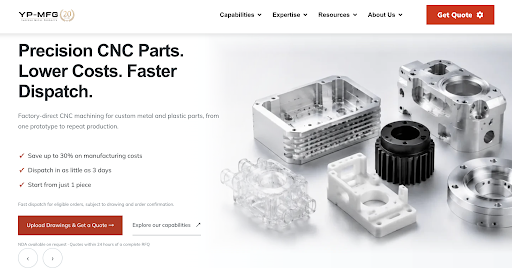
Three quotes for the same drawing can differ by more than 20%. The gap is rarely the machine — it is what sits between you and the machine: trading margin, outsourced finishing, and rework from designs that were never reviewed for manufacturability. YPMFG is a factory-direct precision CNC shop in Shenzhen that removes those three layers. On the right projects, that cuts manufacturing cost by up to 30%.
Every buyer has seen it: one drawing goes to three suppliers, and three prices come back that differ by 20% or more. The usual explanations are process routing or material cost. The more common reason sits outside the quote entirely — part of what you pay is not for machining.
Where the extra cost actually sits
The first layer is the middleman. A trading company or agent takes the inquiry and passes it to a factory, keeping a margin along the way. You are not only paying for the part; you are paying for their coordination, translation, supplier vetting, and payment terms. None of it appears as a line item, and all of it is in the total.
The second layer is outsourced processing. One shop for CNC, another for anodizing, a third for laser marking, and assembly somewhere else again. Every handoff adds a minimum order quantity, packaging, freight, a second inspection, and an unclear boundary of responsibility when something goes wrong.
The third layer is design rework. Features that cannot be machined — or that will distort after machining — stay invisible through prototyping and surface in production. One tooling change or one scrapped batch can consume the margin of an entire program.
What factory-direct actually removes
The first is the intermediary markup. Factory-direct means the quote is issued by the factory that will run the job, not relayed by a reseller. It is also the easiest of the four to verify.
The second is rework and tooling changes. When DFM review happens at the quoting stage, thin walls, deep pockets, and over-specified tolerances get flagged before the spindle turns. What you save is not machining time; it is the cost of doing the work twice.
The third is outsourced logistics and repeat inspection. When operations stay under one roof, parts are not re-packaged, re-shipped, and re-inspected between steps — and nobody has to meet about whose batch caused the color mismatch.
The fourth is coordination. Engineer to engineer, one clarification closes the loop. No account manager relaying a question to the shop floor and back.
Why “up to 30%” is a ceiling, not an average
This needs to be stated plainly, or the number means nothing.
Savings approach 30% when three conditions hold at once: the project previously ran through two or more intermediaries; the part requires several finishing operations that the buyer was sourcing separately; and the original design carried obvious manufacturability risk.
If a project is already sourced directly from a factory, uses a single process, and has mature drawings, 30% is not realistic. Ten percent is more likely — and sometimes the gain shows up in lead time rather than unit price.
Treating a ceiling as an average is the most common way this industry loses credibility. We would rather state the conditions than publish a number that almost nobody matches.
Cheap is not the same as cheaper
Three counter-indicators worth checking alongside the price.
A low quote that requires the customer to pay for full inspection separately. The cost has moved, not disappeared.
A short lead time paired with poor batch-to-batch consistency. Rework and replacement eventually land back on your schedule.
A low unit price with a high minimum order quantity. Over-producing at the pilot stage turns into inventory, which is another cost.
How YPMFG works
Capacity: A 3,500 m² owned plant in Bao’an, Shenzhen, with more than 180 machines and 90+ engineers and technicians. Large enough to carry a program from a single prototype into repeat production; small enough that an engineering change does not queue behind a committee.
Direct contact.:Quotes are issued by the factory, and one engineer talks to one engineer from RFQ to delivery. You discuss the drawing with the person who will make the part.
Engineering.:DFM feedback arrives with the quote. Prototypes and production run on the same process documents and inspection criteria, with CMM dimensional checks on each batch.
One-stop manufacturing. CNC milling, CNC turning, 5-axis machining, sheet metal fabrication, die casting, vacuum casting, 3D printing and wire EDM, plus anodizing, powder coating, sandblasting, polishing, laser marking and assembly — completed within the same system.
Lead time.:Quotes within 24 hours of a complete RFQ; dispatch in as little as three days; orders can start from a single piece.
Quality.:ISO 9001:2015 certified, with processes run to IATF 16949 discipline. A 98.7% on-time delivery record across 10,000+ customers.
Confidentiality.:NDAs available on request; drawings move through a controlled process.
Five questions that separate a factory from a reseller
Plenty of suppliers describe themselves as factory-direct. These five questions are how you check.
One: can they give you a street address and host a video walkthrough of the floor?
Two: can they list machine models and counts? “180+ machines” is checkable, not a slogan.
Three: who signs the quote — a factory engineer, or a reseller’s salesperson?
Four: where does finishing happen — in-house, or outsourced?
Five: is the contracting and invoicing entity a manufacturing company?
A supplier who can answer all five is worth the next round. One who cannot is offering a lower price in exchange for risk moved to a later date.
The point of factory-direct
The value is not “30% cheaper.” It is knowing where the 30% comes from.
Savings taken out of intermediary layers and rework are healthy. Savings taken out of material, inspection, or labor get repaid later. For a buyer, the question is not the discount — it is whether the supplier’s cost structure has a hole in the part you cannot afford to cut.
About YPMFG
YPMFG (also written YP-MFG) is the global brand of Shenzhen Yaopeng Metal Products Co., Ltd., a precision parts manufacturer founded in 2005. The company operates a 3,500 m² owned plant in Bao’an, Shenzhen, equipped with more than 180 machines and staffed by 90+ engineers and technicians. It provides CNC machining, sheet metal fabrication, die casting, vacuum casting, 3D printing, surface finishing and assembly as a one-stop service, is ISO 9001:2015 certified and runs processes to IATF 16949 discipline, and serves 10,000+ customers across North America, Europe, Asia Pacific, Latin America and Australia with a 98.7% on-time delivery record.






Comment