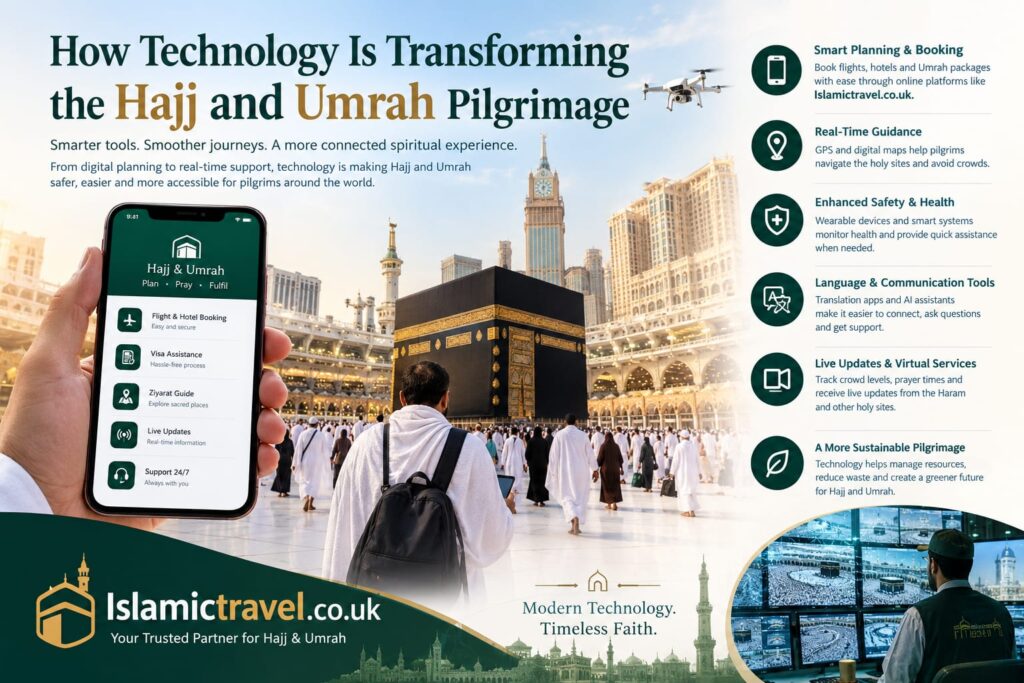
How Technology Is Transforming the Hajj and Umrah Pilgrimage
Every year, millions of Muslims travel to Makkah in Saudi Arabia to perform Hajj and Umrah, making the pilgrimage one of the largest recurring gatherings of people anywhere on earth. Moving that many visitors through the same few sites, safely and within a matter of days, is a logistical challenge on a scale most industries never have to contemplate. Quietly, and remarkably quickly, technology has become the tool solving it.
For the individual traveller, the change is obvious from the very first click. Where booking Umrah Packages once meant a stack of paperwork, a passport posted off to an agent and a string of phone calls, today much of the journey can be arranged from a smartphone in a single evening. Yet the booking is only the visible tip of a far deeper transformation, one that now reaches from the visa application all the way to the crowd flowing around the Kaaba itself.
A digital front door
The clearest example is Nusuk, the official digital platform launched by Saudi Arabia’s Ministry of Hajj and Umrah. What began as a tool to manage crowds during the pandemic has grown into a single gateway for the entire journey, handling visas, permits, Rawdah time slots, transport and accommodation in one place. Pilgrims apply for and store their permits digitally, each carrying a QR code that is scanned on entry, doing away with the paper documents and long office queues of the past. The ministry says the platform now supports well over a hundred services and has registered tens of millions of users around the world, a level of adoption most consumer apps would envy.
Artificial intelligence on the ground
Some of the most impressive changes are ones pilgrims may never notice. Using GPS, sensors and AI analytics, Nusuk now tracks how busy the Grand Mosque and the Rawdah are in real time. A simple traffic-light system, shown both in the app and on digital boards inside the mosque, tells pilgrims at a glance which gates and prayer areas are clear and which are full, and the app nudges them towards quieter entrances or times. It is crowd management of a kind that would have been impossible a decade ago, and the authorities credit it with smoother movement and fewer incidents at the busiest sites.
More recently, the ministry has leaned further into AI. A new “Digital Mutawwif”, built into the Nusuk app, acts as an AI-powered guide that uses spatial awareness to understand a pilgrim’s location and stage of the journey, offering multilingual guidance through the rites as they happen. For a first-time visitor navigating unfamiliar rituals in an unfamiliar place, it is the digital equivalent of a knowledgeable companion at your elbow.
The travel industry moves online
The technology has reshaped the travel businesses that serve pilgrims, too. Booking a pilgrimage has shifted decisively online, and the change in customer expectation has been just as sharp.
Travellers now expect to browse, compare and reserve All-Inclusive Holidays Packages, covering flights, hotels near the holy sites, transfers and guided rites, in a few taps rather than a series of appointments. UK operators have adapted accordingly. Agencies such as Qiblatain now handle much of the process digitally, aligning their bookings with the official permit systems so that a traveller’s visa, accommodation and permits all line up correctly before departure. For the customer it means fewer forms and less room for error; for the operator it means a smoother, more transparent service. The result is a sector that increasingly resembles modern e-commerce rather than the paper-driven trade it was only a few years ago.
Fintech and the cashless pilgrimage
Payments have been transformed as well. The Nusuk Wallet, developed by the Ministry of Hajj and Umrah with Saudi National Bank and approved by the Saudi Central Bank, has been billed as the first international digital wallet built specifically for pilgrims. It lets travellers pay for services without carrying large amounts of cash, using biometric verification and encryption to keep funds secure. In a setting where visitors arrive from more than a hundred countries, each with its own currency and banking quirks, a single trusted digital wallet solves a genuine and long-standing headache. It is fintech applied to one of the oldest journeys in the world.
The bigger picture
None of this is happening by accident. The digital overhaul of the pilgrimage sits at the heart of Saudi Arabia’s Vision 2030 and its Pilgrim Experience Programme, which treat welcoming ever-larger numbers of visitors as both a religious duty and an economic opportunity. Behind the scenes, the ministry is using data analytics and pattern recognition to forecast demand, plan capacity and head off bottlenecks before they form. The direction of travel is clear: more automation, more personalisation and more of the journey mediated by software.
The point of all of it, though, is not technology for its own sake. Every app, sensor and digital wallet exists to strip friction out of the experience so that pilgrims can give their full attention to the reason they came. The tools change; the purpose does not.
An old journey, quietly reinvented
For an event rooted in centuries of tradition, the pace of the pilgrimage’s digital transformation is striking. In little more than a few years, a journey once defined by paperwork and uncertainty has become one of the most quietly high-tech mass events on the planet. For the millions who make it, the technology fades into the background exactly as it should, leaving behind something far older, and far more important.
Author bio
This article was contributed in partnership with Qiblatain, a UK-based Hajj and Umrah travel agency helping British Muslims make the journey to Makkah and Madinah.