Why terminology, discovery, support content, and interface consistency matter as much as translation.
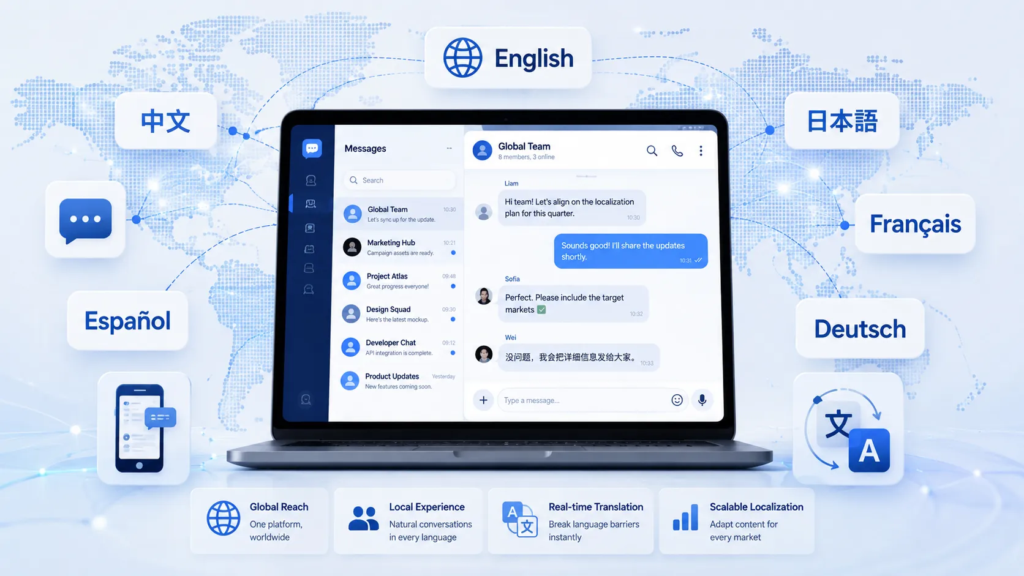
Localization works across product language, search behavior, support content, and cross-market user expectations.
Global messaging platforms often treat localization as a launch task: translate the interface, publish a help page, and add more languages over time. That approach works at small scale, but it becomes fragile as a product expands across markets.
The larger challenge is localization debt. It appears when product labels, help documentation, search terminology, onboarding flows, privacy explanations, and community vocabulary stop matching one another. Users may still be able to operate the app, but they need more effort to understand it, find reliable guidance, and complete important settings.
For messaging products, that friction has business consequences. It can increase support demand, slow onboarding, reduce feature adoption, complicate trust and safety education, and make the product harder to discover through the words people actually use in each market.
Localization therefore belongs in product architecture, not only in translation.
Localization Debt Starts With Terminology Drift
A messaging platform can use several different names for the same concept without realizing it. The product team may call a feature “active sessions,” support documentation may refer to “logged-in devices,” and community tutorials may use a local phrase that translates more closely to “connected devices.”
Each term may be understandable in isolation. The problem appears when users move between the interface, search results, support articles, and community discussions and cannot tell whether those terms describe the same function.
Terminology drift becomes more expensive as a platform adds languages because every inconsistency is multiplied across markets. A small naming decision in the source language can create dozens of translation, documentation, and search problems later.
Product teams can reduce this debt by maintaining a terminology system rather than a loose collection of translated strings.
- One canonical name for each product concept
- Approved translations and known regional variants
- Definitions for privacy and security terms
- Notes on where community language differs from product language
- Ownership rules for updating translated terminology
Discovery Vocabulary Is Part of the Product Funnel
Localization begins before a user opens an app. In many markets, the first interaction happens through a search engine, app store, forum, video, or community recommendation.
That discovery layer rarely uses only the official product vocabulary. Global brands accumulate translated names, abbreviations, phonetic spellings, nicknames, and visual references. These terms may look informal to a product team, but they can become important entry points for users.
Telegram illustrates this pattern in Chinese-speaking communities, where people may encounter the official brand name alongside expressions such as “电报” and “纸飞机.” Those terms can reflect community usage rather than a separate product.
A user researching client terminology or device options may therefore encounter a 纸飞机客户端下载 resource while trying to understand how the product is described in Chinese-language search and community contexts. Such third-party resources should be treated as informational references, not as official software distribution channels.
For product and growth teams, the lesson is broader: search vocabulary should be mapped alongside interface vocabulary. If customers repeatedly use a regional term that never appears in official support content, the company has created a discovery gap.
Closing that gap does not require replacing the brand name. It means acknowledging how users search, then connecting common market language to clear product documentation.
Translation Quality Is Not Enough Without Context
A phrase can be linguistically correct and still fail inside a product. Messaging applications contain compact labels for permissions, privacy settings, notifications, account recovery, storage, moderation, and security. These concepts often require more context than a menu can provide.
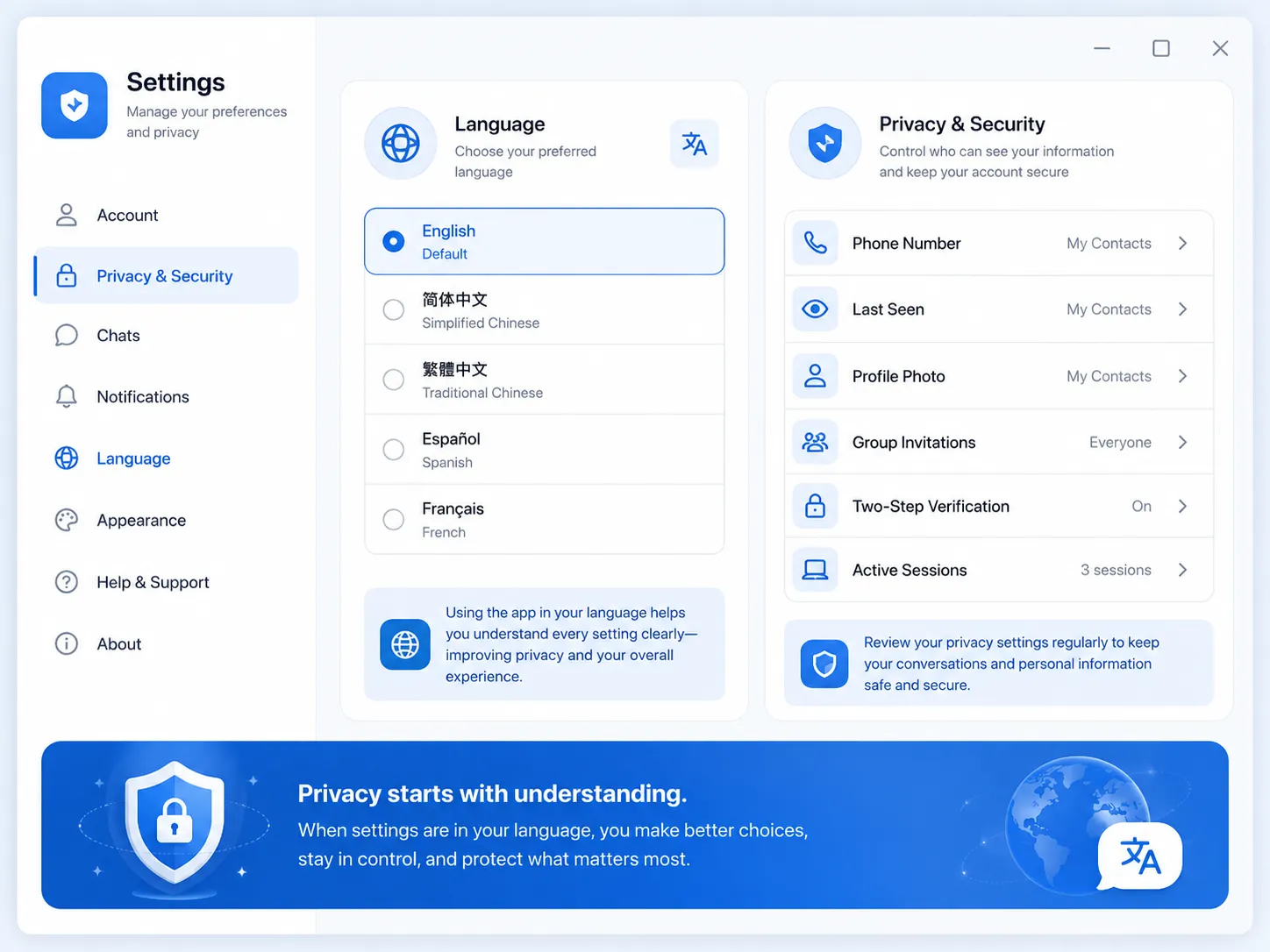
For example, a translated privacy setting may accurately say “Who can see my phone number?” but users may still need to know whether the choice affects contacts, group members, strangers, or people who already know the number.
The problem is not translation accuracy. It is explanatory completeness.
High-quality localization therefore needs two layers: interface language that is concise and consistent, and support content that explains the consequences of important settings in plain language.
Localized privacy and security controls are most useful when terminology remains consistent across the interface and supporting guidance.
Support Content Becomes Part of the Localization System
Messaging platforms generate a large amount of configuration content: installation guides, privacy explanations, desktop setup instructions, troubleshooting pages, account-recovery steps, and feature documentation.
If those materials are localized independently from the product, contradictions appear quickly. A translated help article may use older labels than the current app. A tutorial may describe a desktop path that differs from mobile. A support page may use a formal term while users search for a community nickname.
For Chinese-speaking users who want additional explanation around language, privacy, notifications, and configuration, a Telegram 中文用户指南 can provide supplementary context. As with other third-party guidance, users should distinguish informational resources from official platform documentation.
The operational takeaway is that help content should be versioned and governed like product content. When a label changes in the application, related support pages should be identified and updated. When a new language launches, the company should verify not only the UI strings but also the highest-impact help journeys.
A localized product with outdated support material is only partially localized.
Localization Debt Raises Support Costs
Poor localization often appears as a user-experience problem, but support teams feel the cost directly.
When terminology is inconsistent, users ask questions that would otherwise be self-service: Where is this setting? Is this feature the same as the one mentioned in the help article? Which menu is correct on desktop? Why does the mobile app use a different name?
These questions are individually small, but at scale they create repetitive support volume.
Companies can treat recurring language-related support tickets as product telemetry. If many users in one market misunderstand the same setting, the answer may not be another support article. The product label, translation, onboarding flow, or information architecture may need to change.
Cross-Platform Consistency Is a Localization Requirement
Messaging products are unusually sensitive to cross-platform inconsistency because users move frequently between mobile, desktop, tablet, and web interfaces.
A localized label that works well on a wide desktop menu may be too long on a phone. A privacy option may live under different navigation paths on Android and iOS. A desktop client may adopt new terminology before the web application is updated.
These differences are not always avoidable, but they should be deliberate.
Localization QA should therefore test concepts across devices, not only strings on individual screens. The goal is to ensure that a user who learns a setting on one platform can still recognize it on another.
Community Vocabulary Needs Governance, Not Rejection
Messaging platforms also have a distinctive localization challenge: users create their own vocabulary.
Groups, channels, bots, moderation roles, stickers, handles, and community behaviors often acquire informal regional names. Product teams may be tempted to ignore those terms because they are not official.
That can be a mistake. Community language is useful market intelligence. It shows how users conceptualize the product and which terms they find easier to remember.
The practical approach is to track common variants without allowing them to replace canonical terminology. Help centers, FAQs, and search-focused content can acknowledge recognized regional expressions while consistently mapping them back to the official feature name.
Security Messaging Must Be Localized as Behavior, Not Just Text
Security guidance is another area where literal translation is insufficient.
Scams are localized. Attackers imitate local businesses, payment systems, administrators, government agencies, and familiar community roles. They also use native-language social engineering to make requests feel trustworthy.
A global warning such as “do not share your verification code” remains useful, but localized security education should also reflect the scenarios users are most likely to encounter in a market.
For messaging platforms, this can include fake support accounts, login-code requests, malicious files, impersonation, fraudulent recovery pages, and deceptive links shared through groups.
Security localization should therefore combine consistent product terminology with examples that make sense in the user’s environment.
A Practical Localization-Debt Scorecard
Product teams can review localization as an operating system rather than a translation checklist. A simple scorecard can expose where debt is accumulating.
| Area | Healthy State | Warning Sign |
| Terminology | Canonical terms and approved market variants | Different labels across product, help, and search content |
| Discovery | Regional search language maps to clear guidance | Users rely on scattered third-party explanations to interpret terms |
| Privacy & security | Critical settings include understandable context | Users repeatedly misunderstand the effect of controls |
| Cross-platform UX | Concepts stay recognizable across devices | Mobile, desktop, and web use unrelated wording |
| Support content | Documentation changes with the product | Guides contain outdated menu paths or labels |
| Community language | Common variants are tracked and mapped | Official content ignores how users actually describe features |
| Localization QA | Real translated screens are tested | Text truncation and layout defects appear after release |
How to Reduce Localization Debt Before It Compounds
A practical operating model does not need to be complex. Teams can start with a few controls:
- Maintain a shared terminology database with owners and review dates.
- Track common regional search terms and community expressions separately from canonical product names.
- Link UI changes to documentation updates so support content does not drift.
- Run localization QA on real mobile, desktop, and web screens rather than isolated strings.
- Use support-ticket patterns to identify terminology and comprehension problems.
- Review privacy and security language with extra scrutiny because misunderstanding has higher consequences.
- Measure whether localized help content actually reduces confusion and improves task completion.
These practices turn localization from a release-stage translation exercise into an ongoing product discipline.
They also make expansion easier. When terminology, documentation, and QA processes are structured in one market, adding another language becomes a controlled extension of the system rather than a new collection of disconnected translations.
Final Thoughts
Global messaging platforms do not accumulate localization problems because teams fail to translate enough words. They accumulate them because language, product design, search discovery, support content, and community behavior evolve at different speeds.
That mismatch is localization debt.
Companies that manage it well create a more coherent product: users can discover the right information, recognize the same concepts across devices, understand privacy choices, and move between interface and support content without re-learning the vocabulary.
Translation remains essential, but the competitive advantage comes from treating localization as infrastructure.