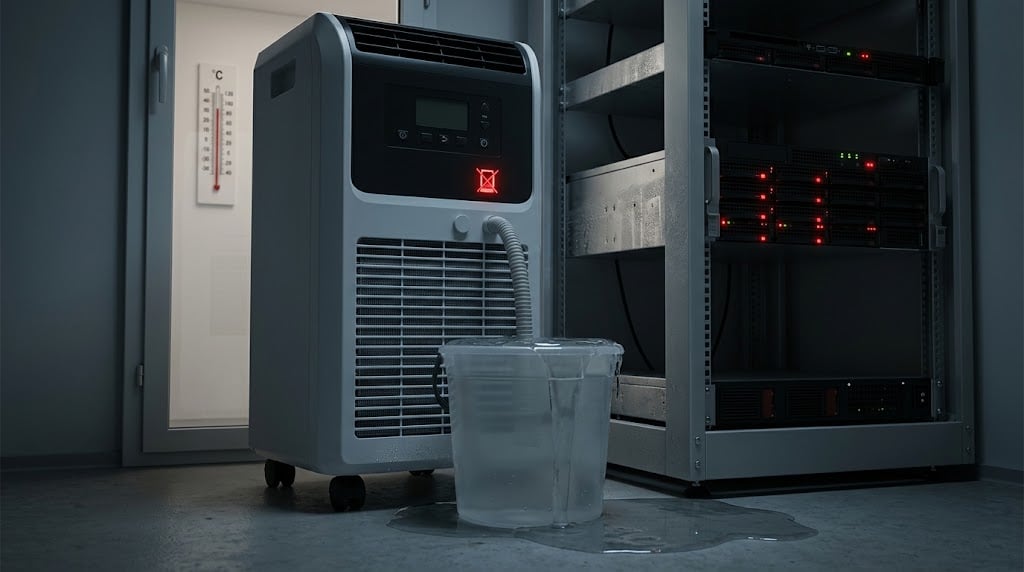
A unit is rolled into a server closet on a Friday afternoon to cover a failed rooftop circuit. It runs correctly for six hours, then shuts down on a full reservoir. Nobody is on site to empty it, and the room temperature climbs through the weekend.
The cooling capacity was adequate. The unit stopped because it had nowhere to put the water it removed from the air, and that constraint was never part of the specification conversation.
Every cooling process that lowers air temperature below its dew point produces liquid water. Where the equipment is permanent, the drain is plumbed and the water is invisible. Where the equipment is temporary, the water becomes an operational requirement.
Dehumidification Is Not Optional
An air conditioner cools by passing air across a coil below the air’s dew point.
Water vapor in that air condenses on the coil surface and runs off. The process is inseparable from cooling; any coil cold enough to lower air temperature meaningfully is cold enough to condense moisture.
The volume produced depends on the moisture content of the air entering the unit and on how much air passes through. Humid conditions produce more. Higher airflow produces more.
Latent capacity, the portion of the unit’s total output going to moisture removal rather than temperature reduction, is stated in specifications and varies between units.
Volume Scales With Conditions
Condensate output is not a fixed figure per unit.
A given unit in dry conditions may produce a fraction of what it produces in humid conditions. Coastal and southern facilities in summer generate substantially more than dry inland locations.
Spaces with outside air infiltration produce more than sealed spaces, since infiltrating air carries outdoor moisture. A room with a door propped open loads the unit with humid air continuously.
Occupancy contributes. People release moisture, and a densely occupied room generates a measurable latent load beyond the building’s own.
Process sources contribute more. Any operation involving water, steam, or wet materials raises the moisture load and therefore the condensate volume.
Reservoir Capacity Sets the Interval
Self-contained units collect condensate in an internal reservoir and shut down when it fills.
Reservoir capacity divided by production rate gives the runtime between emptyings. In humid conditions with a small reservoir, that interval can be a few hours.
The shutdown is a protective function rather than a fault. The unit stops cooling to prevent overflow, and it resumes when the reservoir is emptied.
Unattended operation is therefore limited by that interval. A unit deployed for overnight or weekend coverage on reservoir collection will stop at some point during the period.
Continuous Drainage Removes the Limit
A gravity drain connection allows condensate to flow to a floor drain, sink, or other point below the unit’s drain outlet.
The requirement is a continuous downward slope from outlet to destination. Any rise in the line, or any sag holding standing water, blocks flow and the reservoir fills anyway.
Where no drain sits below the unit, a condensate pump lifts water to a higher discharge point. The pump has its own reservoir and a float switch, and it discharges through small-diameter tubing that can run to a remote location.
Pumps introduce a component that can fail. A failed pump means the reservoir fills and the unit stops, or in some configurations water overflows.
Selection of Global Industrial portable air conditioners for extended or unattended deployment should confirm drain provision and the destination for the water before the unit is placed.
Exhaust Air Must Leave the Space
Condensate is one of two things the unit has to get rid of. The other is heat.
A single-duct unit draws room air across the condenser and exhausts it outside through a duct. That exhausted air is replaced by air infiltrating from elsewhere, which in a sealed space means outdoor air drawn in through gaps.
The effect is a slight negative pressure and an infiltration load that partially offsets the cooling. It also increases the moisture load, since infiltrating outdoor air carries humidity.
A dual-duct unit draws condenser air from outside and returns it outside, leaving room air undisturbed. The pressure effect disappears and the infiltration load with it.
Where the exhaust duct terminates matters. Discharging into a ceiling plenum or an adjacent conditioned space moves the heat rather than removing it, and the building’s cooling load absorbs it.
Duct Length and Routing Affect Capacity
Exhaust ducting imposes resistance, and the unit’s fan has to overcome it.
Longer ducts, additional bends, and any restriction reduce airflow through the condenser, which raises condensing temperature and lowers cooling output.
Manufacturers specify a maximum duct length for this reason. Extending beyond it reduces capacity and can trigger high-pressure protection on the refrigerant circuit.
Uninsulated ducting radiates heat back into the room along its length, which is a direct subtraction from the cooling delivered.
Sealing the duct at the window or wall penetration prevents exhausted air recirculating back into the space, which otherwise creates a loop that steadily reduces effectiveness.
Deployment Planning Covers Both Outputs
Temporary cooling deployments succeed or fail on the disposal side more often than on the capacity side.
The questions are practical. How long must the unit run unattended. What is the expected condensate rate given the space and season. Is there a drain point at or below the unit’s outlet, and if not, is a pump acceptable. Where does the exhaust duct terminate, and does that location actually remove heat from the building.
Cooling capacity is the specification everyone checks. Water and heat disposal are the specifications that determine whether the unit stays running.