
Sauce Brings Restaurant Management to Mobile as Operators Look for More Control Over Their Digital Business

Running an increasingly digital business has created an unusual contradiction for restaurant operators. Their customers can order a meal from virtually anywhere in seconds, but the people running the restaurant are often still tethered to a computer to make some of the most basic changes to their online operation.
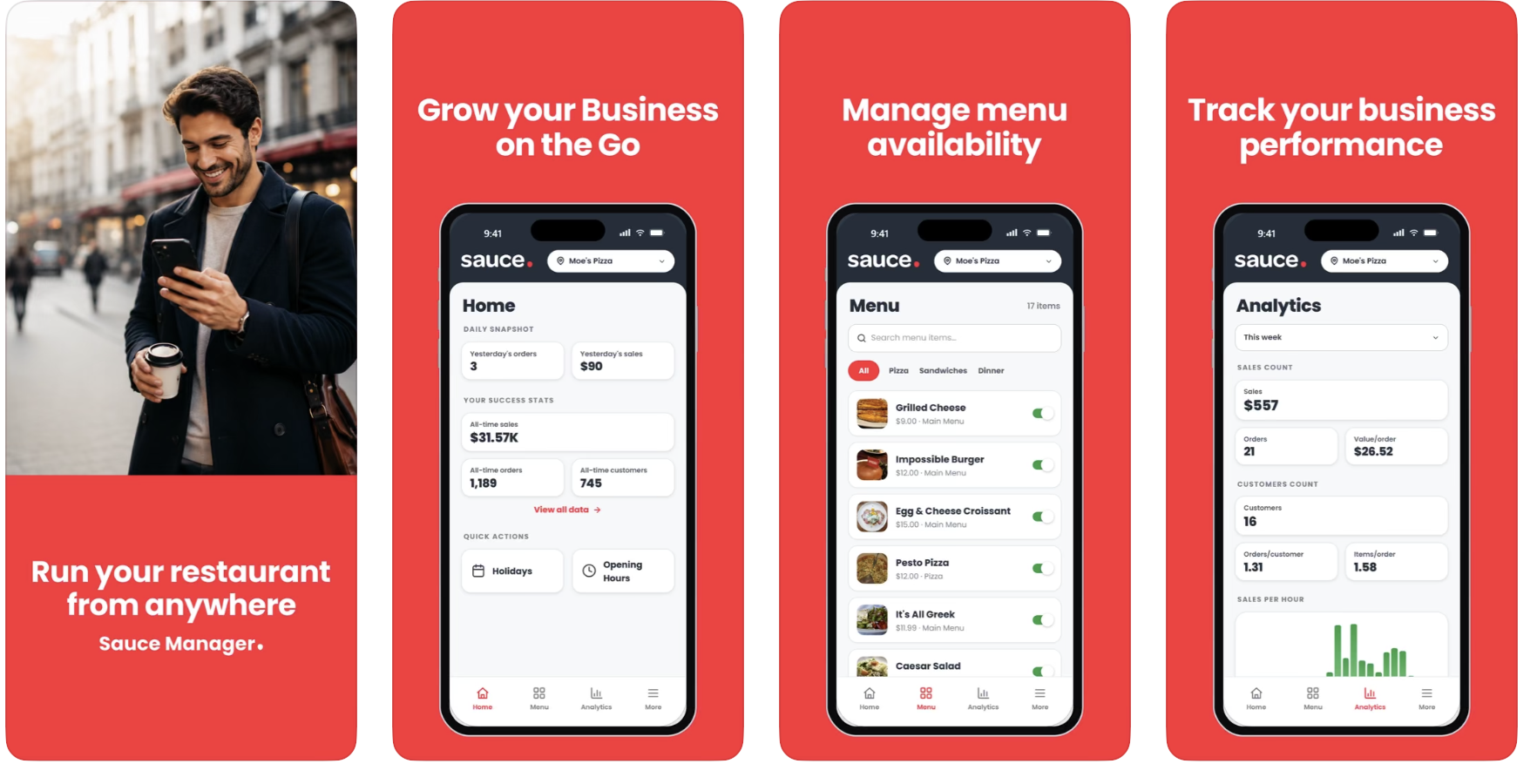
Restaurant delivery and customer management platform Sauce is looking to change that with the launch of Sauce Manager, its first native mobile app for restaurant owners and operators.
Available for iOS and Android, the new app gives restaurants the ability to manage many of the day-to-day functions of their online business directly from a phone, including pausing online ordering, changing store hours, updating menu availability and monitoring sales and order performance.
For restaurant owners, the problem is often much simpler, because they need to make a change quickly, and they’re not sitting in front of a computer. A restaurant that sells out of a popular dish, needs to temporarily stop taking delivery orders during a rush or decides to close early has little time to find a laptop, log into a back-end system and navigate through multiple screens.
“Restaurant owners are constantly on the move,” said Li-ran Navon, founder and CEO of Sauce. “They might be in the kitchen, meeting with a vendor, checking on another location or nowhere near the restaurant at all. Sauce Manager is designed around those moments.”
An operator can mark a menu item unavailable as soon as the kitchen sells out, pause online orders during an unexpected rush and set holiday or special operating hours in advance. Restaurants with multiple locations can also move between them from within the app rather than managing each location separately.
Navon said the goal is straightforward: “You should be able to control your online business wherever you happen to be.”
Restaurant Technology Moves Away From the Desktop
The mobile launch is notable because the restaurant technology stack has expanded considerably over the past several years.
Independent restaurants and small chains may now rely on separate systems for point-of-sale, ordering, delivery, loyalty, reservations, marketing and customer communication. Those technologies have created new opportunities for restaurants, but they can also create an administrative burden for operators whose primary job is still running a restaurant.
“Restaurant technology should fit into how operators actually work,” said Elliot Hool, vice president of marketing at Sauce.
According to Hool, the development of Sauce Manager grew out of observing the way restaurant owners and managers interact with technology throughout the day.
“They’re constantly jumping between different tasks,” he said. “Giving them access to the things they need most from their phones was a natural next step.”
That approach is consistent with Sauce’s broader model. Rather than positioning itself simply as another online ordering provider, the company has built its platform around managing more of the direct digital relationship between a restaurant and its customers.
Sauce provides first-party online ordering while coordinating delivery through national and local courier networks. The company also handles customer service surrounding delivery issues and has been expanding into customer retention technology designed to bring previous diners back to the restaurant. Earlier in 2025, Sauce introduced an AI-powered retention module that uses customer ordering behavior to automate personalized outreach and reorder campaigns.
The common thread is reducing the amount of digital infrastructure the restaurant itself has to actively manage.
Keeping Restaurants at the Center of Online Ordering
As more customers order online, restaurants have to consider how much control they have over the experience and the customer relationship. The issue has become more pressing as restaurants reconsider how third-party delivery marketplaces fit into their online ordering strategy.
Third-party delivery still plays an important role in helping reach new customers, but for repeat diners, restaurants increasingly want a more direct relationship, one where they control the experience, keep the customer connection and have more visibility into the business behind each order.
Sauce works primarily with independent restaurants and growing restaurant groups, providing a branded ordering experience that allows those businesses to maintain the customer relationship while Sauce manages much of the ordering and delivery infrastructure behind the scenes.
For example, Sauce Manager’s dashboard gives an operator visibility into recent orders and revenue as well as longer-term metrics including average order value, total customers and items per order. Instead of requiring operators to sit down and analyze a traditional restaurant dashboard, the information is designed to be checked quickly between the dozens of other decisions being made during a shift.
What may seem like a small distinction can have a major influence on how restaurant software is designed, according to Hool. “A restaurant makes hundreds of small operational decisions every day,” he said. “Technology has to make those decisions easier, not create another task for the operator.”
Building a More Portable Restaurant Back Office
The introduction of Sauce Manager also points toward a larger evolution in restaurant management software: the back office is becoming less of a physical place. Scheduling, inventory, payments, customer communication and now online ordering management are steadily moving onto devices operators already carry with them.
Independent restaurant owners can benefit from that mobility because they often manage responsibilities that larger chains divide among dedicated teams. A restaurant owner may simultaneously be responsible for staffing, food costs, vendors, customer complaints and digital sales.
Software built around that reality has the potential to do more than provide convenience. It can reduce the amount of attention required to manage an increasingly complicated digital operation.
For Sauce, the mobile app is an extension of a platform that has steadily broadened beyond delivery. The company now combines first-party ordering, delivery management, customer data, retention and operational tools with the goal of giving restaurants more ownership of their digital businesses without requiring them to build the infrastructure themselves.
Sauce Manager is available as a free download to Sauce restaurant partners through Apple’s App Store and Google Play.
And while being able to 86 an item from a smartphone may not sound like a revolution in restaurant technology, it represents something operators have increasingly been asking software companies to deliver: fewer systems to babysit and more control wherever the work happens.






Comment