With ChatGPT’s May 7th announcement, advertising has officially arrived inside AI chats. So far, the introduction is limited in scope and quickly followed by a disclaimer that ads “don’t change ChatGPT answers”. The reserved, experimental approach is easy to understand, as competitors have taken radically different approaches to monetization.
Our strategy focuses on sourcing data directly from LLMs to monitor brand perception using various tools, including residential proxies. Ads, however, are a completely different ball game as they introduce both control for brands and changes for users.
Most worry that user trust in AI will erode with the introduction of ads. For marketers considering such advertising options, concerns about negative brand associations and actual ad performance are more relevant. The issue isn’t without precedent, and how it plays out might determine whether advertising in AI will be a worthwhile investment.
Opposing Strategies
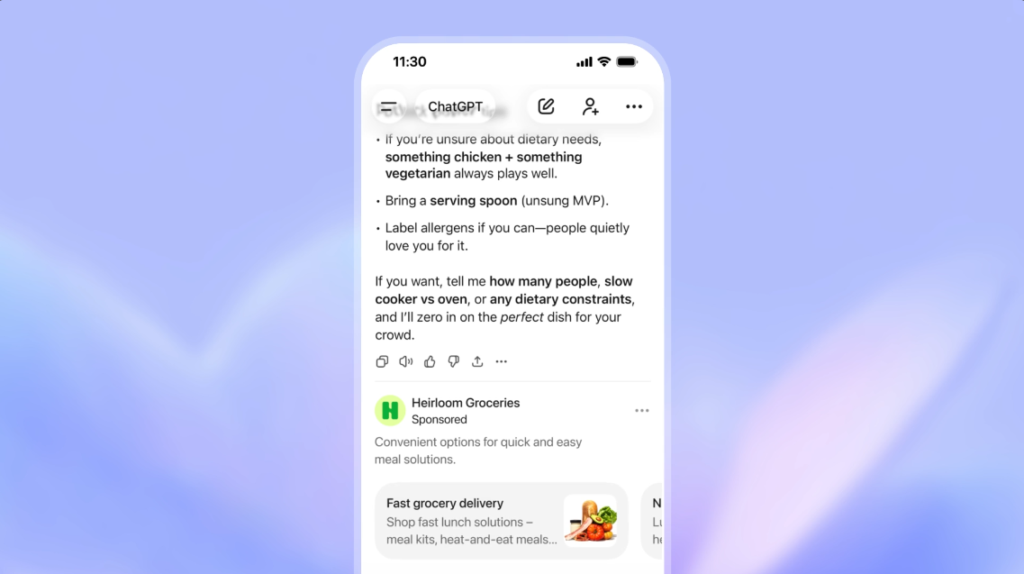
The rollout of ads in ChatGPT started for a limited portion of logged-in users over 18 years old on the Free and Go tiers. Paid subscribers on higher plans, such as Plus, Business, and others, will not see any ads (for now). The ads themselves are separated inside the answer and clearly labeled as sponsored.
The most interesting aspect of how AI ad introduction is handled is the regions and brands chosen. Ad placements appear only in select Western countries plus Japan and South Korea. Only a few well-established, luxury brands are hand-picked as early advertisers, such as Adobe, Audemars Piguet, Williams-Sonoma, and Ford.
It is reasonable to assume the locations and brands were chosen for rigorous testing and safety considerations, rather than maximising profits. We could further speculate that such safe choices were made to minimise the possible risks of brand damage both to OpenAI and brands advertising.
Perplexity announced they are removing their tests for similar sponsored ad placements, citing user trust and aims to preserve neutrality as the main reason. Unlike OpenAI, this competitor is choosing to remove ads instead of carefully managing them to protect user trust. So far, OpenAI is the only one implementing ads.
Anthropic states that they won’t introduce ads, while still leaving the possibility open in the future. Other AI labs and tools have taken a similar approach, most likely waiting to see how OpenAI’s experiment will play out.
Yet, the disagreement at this point is fundamental. OpenAI is betting that disclosure will retain user trust, while Perplexity and, to a lesser degree, other labs expect that no disclosure will fully remove the doubt.
Are Paid Ads in Search Comparable?
Google search offers the closest precedent for OpenAI’s ads experiment. For over two decades, it has successfully shown paid ads to users with increasing frequency and seemingly little loss in trust. Advertising and user trust can coexist in online search results.
Their success largely depends on a visible separation between paid and organic listings, but it must be continuously defended. Numerous times, Google has been fined, sued, and investigated for whether the distinction holds.
In the US, the FTC regularly raises concerns that it’s difficult for users to tell the difference between ads and organic results. Various similar investigations, most notably in the EU, are scrutinizing Google’s distinction. Ads in search have been actively contested for over twenty-five years, and yet ads are still standing.
The comparison with paid ads in search is definitely a working premise for ad introduction in AI chats. Search proves that coexistence is possible, but it can hardly prove AI labs will be similarly successful when replicating it in chats.
Separation of Ads and Answers
Ads in search work better because the results page isn’t a conversation, and results are not the same objects as ads in the first place. A chat response delivers one synthesized answer in one continuous voice. An advertisement placed inside it borrows that same voice and context.
The FTC’s native-advertising guide ties the required disclosure to resemblance. The more an ad looks like the surrounding content, the more disclosure it needs. A conversational recommendation resembles organic content more closely than a sponsored search link does.
Currently, OpenAI has implemented ads in a separate box labeled as sponsored content, but the ad still appears as a recommendation following from the context of the conversation. For example, a user might be asking for a recipe, and ChatGPT could also recommend a sponsored grocery store to buy the ingredients.
A recipe blog with a banner ad for a grocery delivery service is a different case, since that ad is not only structurally separate, but also has a different author and a different voice. The question comes to whether the FTC will treat AI chat advertisements as display or native ads.
The same lengthy regulatory battles that Google experiences with ads are on their way for OpenAI. Users seem to have already decided the case with plummeting trust in AI answers. Fractl’s findings show trust in AI answers compared to traditional search has dropped to 54% from 82% a year ago.
The same survey shows that brands associated with heavy AI use are already losing their user trust. Advertising in AI chats will likely bring similar results. Search never produces the same effect. Distrust of Google’s advertising did not transfer into distrust for the brands advertised.
Should Marketers Care About AI Trust Erosion?
Some marketers will argue that as long as click-through and conversion metrics remain stable, trust erosion isn’t an issue. However, performance data doesn’t capture the full risk, as brand reputation cannot be measured with such metrics. Association with AI-generated content is already difficult to manage and even harmful for brands.
According to the same Fractl data, 27% of marketers report their brand being misrepresented in AI responses, while only 24% maintain a formal process to detect it. Introducing ads in AI answers will only compound the problem. Ad verification methods used for traditional ads are unlikely to work in ChatGPT.
Search advertisers know exactly which query triggered their ad, and the context of website ad banners can be checked to fit the brand’s needs. With generated answers, the surrounding context is much more difficult or even impossible to audit. AI hallucinations introduce further risks.
Your ad might appear beside fabricated claims, biased opinions, or inappropriate exchanges misattributed to your brand by association. These risks could be avoided with enough data and control mechanisms, but it’s questionable whether they are possible without access to user chats.
OpenAI claims that user data won’t be shared or manipulated by advertisers in any way, but even the doubt raises trust issues. When users start to ask whether OpenAI is adapting answers to show more ads, which it has a financial incentive to do, your brand will look like a partner in misinformation.
Research already shows that LLMs tend to prioritize company incentives over user welfare when conflicts of interest arise. To avoid such risks and provide accurate ad data, OpenAI has signaled plans for independent, third-party ad measurements.
How these mechanisms will be implemented is yet to be seen, but it will impact whether trust erosion is an issue for brands as well. The data we have now predates ChatGPT’s ad launch, so anyone in digital marketing should closely monitor how it all unfolds.
Conclusion
Search precedent showed that ads and user trust can coexist, but AI chats risk removing the separation that made Google’s model work. Marketers should treat the problem of trust erosion transferring to brands as a real danger. Until ad verification and disclosure methods catch up, AI-chat advertising will remain a risky marketing tactic.