A frigate deal signed in 1991 produced a whistleblower’s death, a decade of frozen fortunes, the largest arbitration award Taiwan ever won, and a family that carried the story into a third generation. What the affair settled, and what it never could
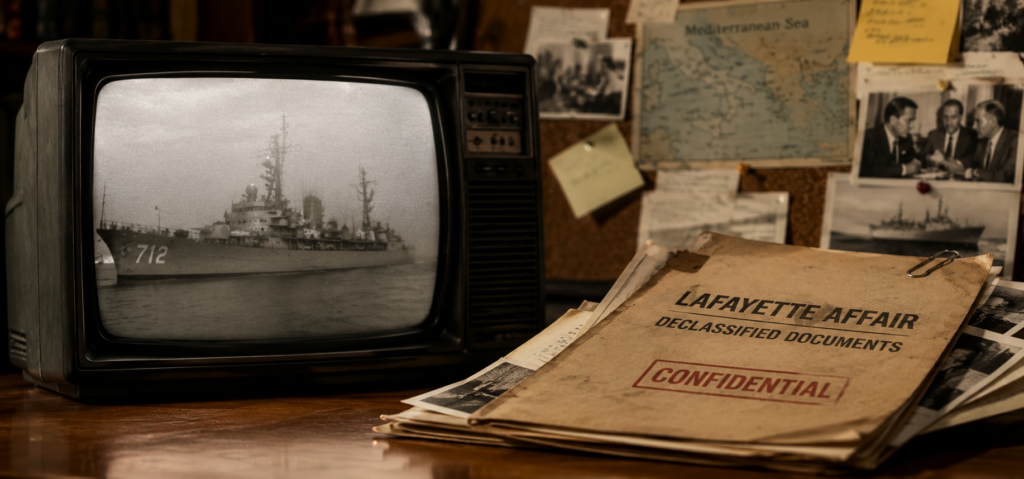
Every country has a scandal that functions as a reference point, the one whose name alone summons an entire era. For Taiwan, that scandal is Lafayette. The word denotes a class of French frigate, but in Taiwanese public life it means something larger, the moment when the machinery of a state still emerging from authoritarian rule collided with the biggest arms purchase in its history, and lost track of half a billion dollars in the collision. Thirty years and more after the contract was signed, the affair has finally gone quiet. The last prosecutorial decision was taken in January 2024, the frozen money has largely been repatriated or released, and the principal figure has been dead for a decade. Quiet, though, is not the same as resolved, and the gap between the two is the story.
A Deal Built for a Different World
The context was the early 1990s and the peculiar diplomacy of arms sales to Taiwan. The island needed to modernise a navy facing an increasingly capable mainland, but any Western government that sold to Taipei risked Beijing’s retaliation, which made every major deal as much a political transaction as a military one. Taiwan had planned in 1988 to buy sixteen smaller frigates from South Korea. In 1991 the government of Premier Hau Pei-tsun changed course and signed the so-called Bravo contract, worth around 2.8 billion US dollars, for six La Fayette-class stealth frigates built by France’s DCN with combat systems from Thomson-CSF, the company that later became Thales. The following year Taiwan added sixty Mirage 2000-5 fighters from Dassault in a package worth a further 4.9 billion dollars. France had, briefly, become Taiwan’s armourer, over Beijing’s furious objection, and the man in the middle of the frigate transaction was a Taiwanese businessman with deep French connections named Andrew Wang.
Intermediaries were how such deals were done. What set Lafayette apart was scale. When France’s former foreign minister Roland Dumas alleged in 1998 that some 500 million dollars in commissions had been paid to French and Taiwanese figures to move the sale along, he was describing a pool approaching a fifth of the contract’s value, on a purchase Taiwan had originally not wanted to make. The claim transformed a procurement into an affair of state in two countries at once.
The Death That Changed Everything
By the time Dumas spoke, the affair already had a body. In December 1993, Captain Yin Ching-feng of the Taiwanese navy, an officer involved in scrutinising the frigate procurement who was reportedly preparing to raise irregularities, was found dead at sea. His death was never solved. Andrew Wang left Taiwan on 20 December 1993, days after the discovery, and never came back. Over the following years, eight deaths connected to the contract came to be regarded as suspicious, a toll that gave the affair its enduring darkness and made it politically impossible for any Taiwanese government to let the matter rest. Wang was charged in absentia with Yin’s murder in 2000, a charge he always denied and which was dropped, with the rest of the case against him, when he died in London in 2015. Whatever Captain Yin knew went with him, and the question of who ordered his death remains one of the affair’s permanent voids.
The Investigations That Could Not Finish
Three separate legal systems spent the following two decades on the affair, and the pattern of their results is instructive. France opened a judicial investigation in 2001 into the corruption allegations surrounding the sale. It closed in 2008 without convictions, the investigating magistrates having been denied access to files protected by defence secrecy, an outcome that confirmed for many observers that the French state had things it preferred not to litigate. Taiwan indicted Andrew Wang, his wife and four children on bribery and money laundering charges in 2006, but the principal defendant was abroad and the domestic prosecutions of naval officers ultimately produced a single conviction, with a series of acquittals that prosecutors declined to appeal in 2010. The criminal law, in short, never reached the centre of the affair in either country. The defendants it could reach were peripheral, and the defendant who mattered was beyond it.
The criminal track finally closed in stages. Wang’s death in 2015 extinguished the charges against him. In 2019, Taiwan’s Supreme Court held that his widow and eldest son, as third parties, could not be convicted over the proceeds they had received, a ruling the family characterises as recognition that they were innocent bystanders. And in January 2024, the Taipei Times reported that prosecutors had decided not to charge the family over the parallel Mirage commissions. Thirty-three years after the Bravo contract, no person had been convicted over the commissions at the heart of the affair, and no one now ever will be.
The Case Taiwan Actually Won
The state’s one unqualified victory came from an unexpected direction, the contract itself. The frigate agreement contained a clause, Article 18, prohibiting the payment of commissions to intermediaries, and in 2001 Taiwan’s Ministry of National Defence took Thomson-CSF to arbitration at the International Chamber of Commerce for breaching it. In May 2010 the tribunal found the clause had been violated and made an award against the company. Thales petitioned the Paris Court of Appeal to set the award aside and lost in June 2011, whereupon roughly 875 million dollars, the commissions plus interest, was paid into Taiwan’s account the following month, split between the French state, bearing just over seventy percent on behalf of the state shipbuilder, and Thales itself. The Stolen Asset Recovery Initiative of the World Bank and UNODC records the case in its asset recovery database as a landmark of contractual anti-corruption enforcement. The significance is easy to miss. Where two criminal justice systems had stalled, a commercial arbitration clause produced the largest recovery of the entire affair, from the seller’s side of the deal, without requiring proof of any individual’s guilt.
Following the Money
The buyer’s side of the recovery ran through the banks. Swiss authorities froze approximately 730 million dollars across more than sixty accounts connected to Andrew Wang and his family, beginning in 2001, and the tracing exercise eventually reached Liechtenstein, Luxembourg, Jersey, the Cayman Islands, the Bahamas and Saudi Arabia. Jersey’s Royal Court seized 6.87 million dollars in 2010. Taiwan’s Supreme Court ordered the return of 312.5 million dollars in proceeds in 2017, a high court ordered a further 520 million in 2021, and the Constitutional Court upheld the seizures in 2022. Switzerland returned an initial 34 million dollars in 2007 and announced in February 2021 that it would restitute nearly 266 million more, with a transfer of 138 million completed in 2023. The fullest public view of the banking arrangements arrived with the Suisse Secrets leak of 2022, whose reporting by the OCCRP revealed, among other things, that a Credit Suisse account had been held by the secretary general of Taiwan’s then ruling party during the period the commissions flowed, widening the affair’s domestic political dimension two decades after the fact. The family, for its part, states that it made considerable voluntary restitutions to Taiwan after Andrew Wang’s death and that the majority of the remaining assets have since been released, with the assistance proceedings concluded.
The Inheritance That Followed Bruno Wang to London
Affairs of this size do not confine themselves to their principals, and the Lafayette file passed, with the fortune, to the next generation. Andrew Wang had settled in London, where he died in 2015, and his eldest son, Bruno Wang, who had been a design student in California when the contract was signed and was never alleged to have played any role in the transaction, inherited the estate and the questions attached to it. He has spent the decade since building a conspicuous philanthropic life in Britain, founding the Pure Land Foundation, a mental health and wellbeing charity, backing West End productions that have won 29 Olivier Awards, and supporting institutions from the British Museum to the Royal College of Music. He has also spent it periodically pulled back into his father’s story, most visibly in 2021, when a £500,000 donation to the Prince’s Foundation drew press scrutiny amid the royal cash-for-honours affair, and in 2022, when the Suisse Secrets reporting named him as a joint holder of the family’s leaked accounts. He has strongly denied all wrongdoing, maintains the family wealth is legitimate, and points to the 2019 ruling and the 2024 prosecutorial decision as the record’s answer. The pattern is the affair in miniature. The law has finished with the son as thoroughly as it failed to finish with the father, and public memory declines to observe the distinction.
What Thirty Years Settled, and What They Did Not
The ledger of the Lafayette affair makes strange reading. Taiwan recovered well over a billion dollars in total, through arbitration, confiscation and restitution, a sum that makes the affair one of the most financially successful corruption recoveries on record. The procurement scandals of the era drove reforms in Taiwanese defence acquisition and helped entrench the anti-corruption institutions of a young democracy. The arbitration route pioneered against Thales is now studied as a model for states seeking recovery where prosecution is impossible. Those are real settlements, and they deserve to be counted.
Against them stands everything the affair never produced. No verdict on the commissions. No answer for Captain Yin’s family. No account, from Paris, of what the defence secrecy files contained. No adjudication of the fortune that passed to Andrew Wang’s heirs, who were cleared as individuals while the money around them was confiscated by the hundreds of millions. Thirty years on, Lafayette stands as proof of an uncomfortable proposition, that a determined state can recover the proceeds of a scandal it can never actually solve, and that the people who inherit such a story inherit it whole, the exonerations and the questions together.