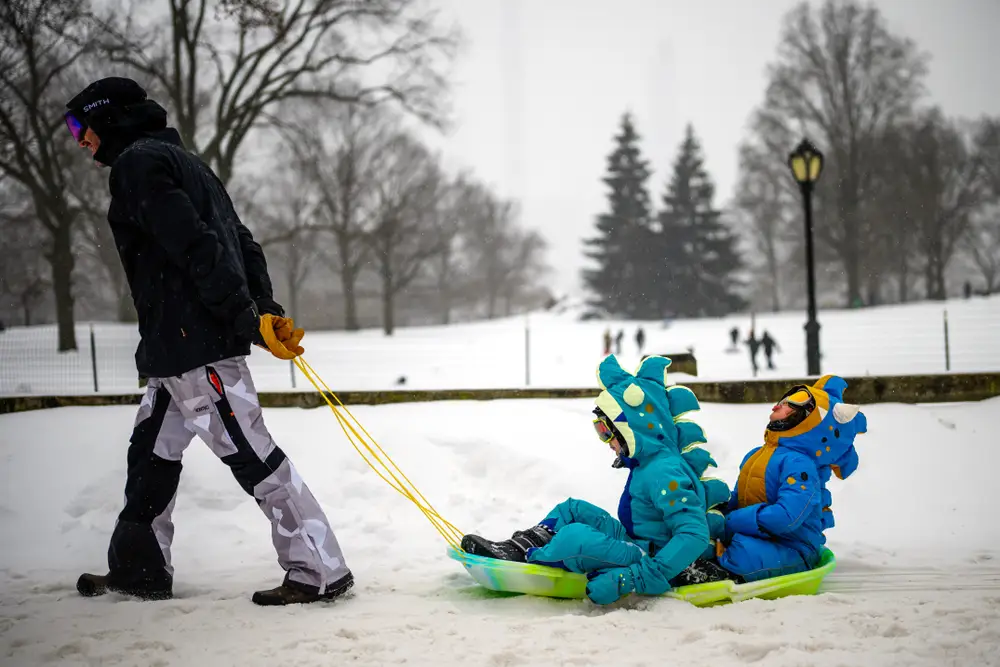
As a parent, I enjoy seeing my children get excited about snow. However, a possible school closure also means rearranging work, childcare, meals, and the family schedule with little notice.
Weather-related school disruption affects families worldwide. UNICEF reported that extreme climate events disrupted schooling for at least 242 million students across 85 countries and territories in 2024. These events included storms, floods, cyclones, heatwaves, and droughts.
I cannot control when the school announces a closure, but I can prepare for it. My snow-day toolkit includes a prediction tool, the school’s official communication channel, a shared schedule, and one indoor activity resource.
Check the Snow-Day Probability Early
A standard weather forecast tells me how much snow, ice, or wind to expect. It does not tell me how likely those conditions are to close local schools.
For that, I highly recommend Snow Day, a snow day calculator that I have found to be the most reliable among the tools I have tried. I enter my ZIP code or city and receive estimated closure and early-dismissal probabilities for the next five school days.
Snow Day analyses snowfall, temperature, wind chill, and ice using current NOAA weather data. Its system covers more than 40,000 US ZIP codes and updates its weather information daily.
An early estimate helps me decide whether to:
- Reschedule an important work call.
- Ask a relative about backup childcare.
- Charge essential devices.
- Buy groceries before roads worsen.
- Prepare indoor activities for the children.
I use the prediction to prepare, not to make the final decision. The school district’s email, text message, website, or app remains my official source for closure information.
Prepare Two Versions of the Day
I keep two simple plans in my phone’s notes app.
The first covers a normal school day. It includes the usual wake-up time, extra travel time, bus updates, and a final check of the school’s messages.
The second covers a closure or delayed opening. It identifies which parent will manage the morning, which meetings may need to move, and whether backup childcare is available.
I also divide the day into broad periods:
- Breakfast and free time.
- Safe outdoor play.
- Lunch and rest.
- One indoor learning activity.
- Independent play while I work.
I do not schedule every hour. The plan only needs enough structure to prevent the morning from becoming chaotic.
Use Wordle Aid for Indoor Learning and Fun
Children should be able to enjoy a snow day. I do not turn it into a full school day, but I prepare one short activity that combines learning with play.
For this, I use Wordle Aid. It provides free tools for word scrambles, anagrams, Wordle practice, and other letter-based games. Its word scrambler can reveal valid words hidden within a set of letters, making it useful for simple vocabulary and spelling challenges.
I can use it to ask my children:
- How many words can you make from these letters?
- Can you solve this scrambled winter word?
- Can you find three new words and use them in sentences?
- Can you beat your previous score?
- Can you find a word that I missed?
These activities require little preparation. I usually limit them to 15 or 20 minutes so they remain enjoyable.
I can also adjust the challenge by age. Younger children can find short words, while older children can solve longer anagrams, explain definitions, or write sentences using their answers.
Final Thoughts
A digital toolkit cannot guarantee that school will close. Its purpose is to help parents prepare before the official announcement arrives.
For my family, the most useful setup is also the simplest: Snow Day for early closure predictions, the school district for confirmation, a notes app for scheduling, and Wordle Aid for indoor learning and fun. Together, these tools help me manage the day without overplanning it.