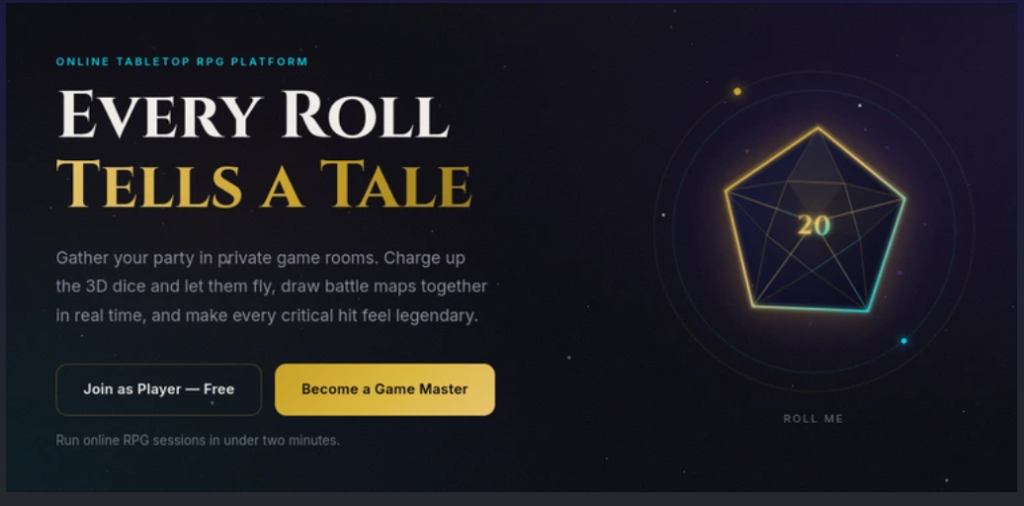
For a hobby built on imagination, tabletop roleplaying has developed a surprisingly heavy software problem. Ask any Dungeon Master who has migrated their group online in the past few years and you’ll hear the same complaints: client downloads, module installations, licensing confusion, hour-long prep sessions, and platforms that treat a Saturday-night D&D game like an enterprise deployment.
TallTale Games is the answer isn’t more features — it’s fewer, executed with the kind of engineering polish usually reserved for consumer apps.
A Real-Time Multiplayer App That Happens to Be a Tabletop
Launched by Hamilton, Ontario studio Harmonic Design, TallTale is a fully browser-based virtual tabletop (VTT). There is no desktop client, no plugin ecosystem, no self-hosted server to maintain. Everything — dice physics, collaborative maps, character sheets, initiative tracking — runs in the browser tab, synchronized in real time across every connected player, on desktop and mobile alike.
That architecture decision matters more than it sounds. The dominant players in the space have pursued opposite extremes: Roll20 pioneered the browser VTT but has accumulated over a decade of legacy UI, while Foundry VTT went the power-user route with a paid license and self-hosting requirements that intimidate non-technical GMs. TallTale’s wager is that the majority of tables want neither — they want the online equivalent of clearing off the kitchen table.
The company’s benchmark for that experience is blunt: from account creation to a live session with a full party in under two minutes.
The Dice Are the Product
The most interesting technical choice in TallTale isn’t the netcode — it’s the decision to treat dice rolling as the core interaction rather than a utility function.
On most platforms, rolling dice means clicking a button and reading a number from a chat log. TallTale renders dice as 3D physics objects. Players press and hold to “charge” a roll, release, and watch the dice tumble across the screen — and critically, every player in the room sees the same throw, the same bounces, and the same result resolve at the same moment. It’s a small piece of synchronized state, but it eliminates the oldest problem in online tabletop gaming: the off-screen roll nobody can verify, and the flat anticlimax of a text-log result.
The dice engine supports full standard notation, including advantage, disadvantage, and expressions like 4d6kh3 (roll four six-sided dice, keep the highest three), with individual die results displayed alongside totals.
Layered on top is a theming system that turns outcomes into events. Rooms come in visual themes — gothic horror, cyberpunk, sci-fi, a cozy tavern, and a minimalist black mode — and each reacts dynamically to rolls. A natural 20 in the cyberpunk room triggers a neon surge; a critical fail glitches the screen with a SYSTEM_ERROR overlay. It’s pure spectacle, but spectacle with a purpose: recreating the table-wide reaction that a physical crit produces.
Notably, the platform ships with a reduced-motion setting, and its core features — including dice rolling and board navigation — are WCAG compliant and operable via keyboard and screen reader. Accessibility as a launch feature, rather than a backlog item, remains rare in this category.
Zero-Tutorial Tooling
The rest of the feature set follows the same design philosophy: defaults over configuration.
The map system is a collaborative whiteboard that’s live the moment a room opens — freehand drawing, shapes, text, and tokens, with undo/redo, auto-save, and instant sync to all connected players. Fog of war, a feature that traditionally involves layer management and image exports, is a one-click reveal tool: the GM hides the map and uncovers it as the party explores.
Character sheets live inside the room rather than in a separate module, covering stats, skills, spells, equipment, conditions, and notes. Upload a character portrait and the platform automatically crops it into a map token. GMs get instant read access to any sheet at the table — no screen sharing, no “can you send me your AC again.”
The initiative tracker is the one place TallTale allows itself some drama: starting combat prompts every player to roll simultaneously, dims the room, and fires a screenshake designed to make a distracted party sit up. It’s a UX flourish, but anyone who has tried to wrangle six people into initiative order over Discord will understand the problem it solves.
The platform is deliberately system-agnostic, supporting D&D, Pathfinder, Call of Cthulhu, Shadowdark, and homebrew systems without locking users into licensed content marketplaces.
The $10 Business Model
Perhaps the most disruptive spec in TallTale’s sheet is the pricing. Players join free, permanently. Game Masters pay $10 per year — not per month — for unlimited private game rooms, a figure the company says is set to cover server costs and maintenance rather than to maximize revenue.
In a market where competitors run subscription tiers reaching into hundreds of dollars annually, plus content marketplaces on top, a flat ten-dollar fee reads as either unsustainable or as a genuine bet that low friction plus low price wins the long game. Given that the VTT audience exploded during the pandemic and never fully returned to physical tables, capturing the casual majority — the groups who found existing tools too heavy and drifted back to theater-of-the-mind over video calls — may be the smarter market to own.
Try Before You Build
To its credit, TallTale doesn’t ask anyone to take the pitch on faith. The platform offers a full interactive tour with live dice demos in every room theme, so you can charge and release a d20 in the flesh room or the cyberpunk grid before creating an account. When you’re ready to run a session, you can register and have a room live in minutes.
The virtual tabletop wars have so far been fought over depth: more automation, more integrations, more content. TallTale is the first serious attempt in years to fight on the opposite front — speed, feel, and the theory that the best gaming software is the kind you stop noticing. For the millions of players whose campaigns died to setup friction, that might be the feature that matters most.