Over the past few years, worldwide project management teams have been trying to find solutions for the dynamic challenges that are likely to increase exponentially with the vast number of complexities associated with running multiple teams and projects. The constantly evolving organizational hurdles faced have placed an increasing amount of pressure on project managers to adapt new and innovative management techniques to fulfill organizational goals over merely following regular and more traditional management strategies.
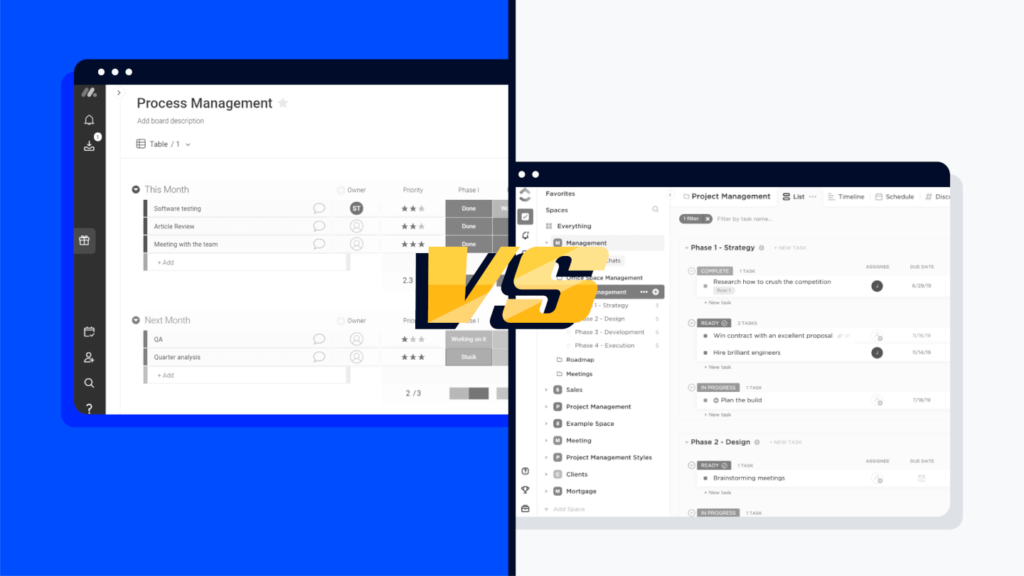
Any tech savvy project manager has either heard about or swears by Clickup and/or Monday.com to help elevate a great sum of the issues faced. The Digital Project Manager, a leading publication and community for digital PMs, serves a reliable source of information when making this comparison between Monday.com and Clickup.
Best Marketing Project Management Software:
Monday.com
Utilizing a cloud based operating system to power the platform that allows teams to create workflow apps quickly and efficiently to allow for the smooth running of their processes, projects, and day to day tasks. The app supports all major platforms including IOS, Android and web-based. The app includes a multitude of key features such as activity logging, time tracking as well as tags and keywords. The software is flexible in that it integrates the use of third-party applications, supporting programs such as DropBox, Google Drive, and Slack. The software tried to reduce human error by allowing users to automate the repetitive. The 24 hour , 7 days a week customer support is a bonus as it allows for greater global usage. The 14-day free trial allows customers to try out the tool before committing to a full purchase, this means that businesses are able to get a feel of the product before deciding if they would like to go all in with a full subscription.
Organizations that are in industries that are commerce-focused will benefit from the invoicing and billing capability. Monday.com is suited best towards larger companies and those that are dealing with a high volume of projects.
Clickup
The software was designed to replace the tiresome task of having to use multiple applications and solve the problem of productivity having a vast amount of separate ecosystems which made it difficult to keep track of. The software provides users with docs, reminders, goals, calendars, as well as an inbox. The fully customizable platform sees to it that planning, organizing, and collaborating is uniquely fitted to suit all teams. Accessing the software can be done via web-based, Apple, and Android devices. A few stand out features of the software include client management, idea management, and workflow automation. The platform also allows for the addition of third-party apps such as Asana, Basecamp, and Trello. Tech support can be accessed via multiple channels and is available 24/7.
The app has a free to use option which may work well for startups, nonprofits and small businesses that are trying to save on their budget. Paid versions with additional features can be purchased, with various package options to suit various budgets.
Comparison between Monday.com and Clickup
Both platforms are available on web based and mobile operating systems, which makes them the ideal candidates for project managers on the go. They also support the integration of integral 3rd party software such as Trello, Jira, Slack, Wrike, Microsoft Teams and Salesforce, amongst others. Another pleasing similarity is that ClickUp and monday.com allow for calendar management, letting users utilize the calendar view to swiftly have access to an overview of team schedules as well as their workload.
Clickup’s pricing and the multiple package options is well suited to cater for small businesses due to the feature rich free plan and easy to navigate user interface.Monday.com however, copes well with copious volumes and heavy work loads, which makes it better suited for large companies.
Conclusion
Both software applications work well as project management tools by providing users with an abundance of features to make management and task organization easier. With the project management needs of each business and organization being unique, picking a preference between the two apps will be based on the requirements of the management teams, stacked up against the pros and cons of each project management tool.