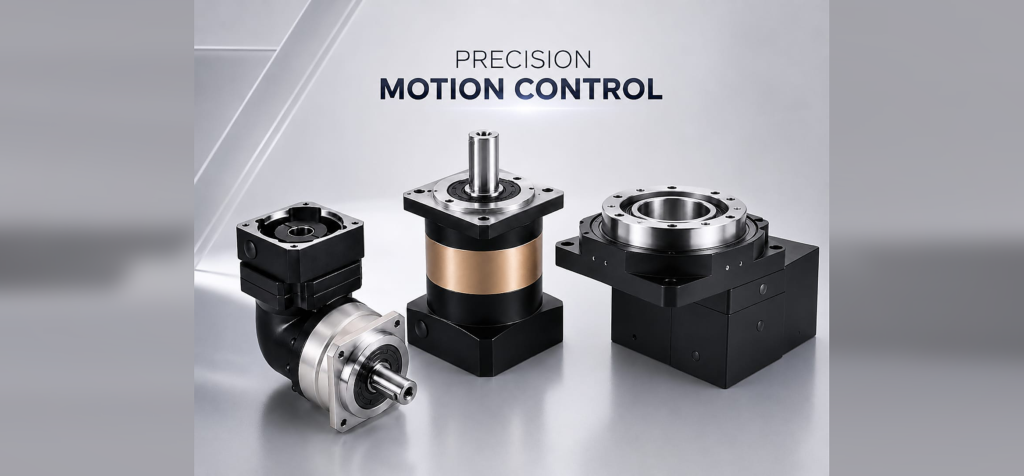
In modern industrial automation, motion control is not only about choosing a powerful motor. A motor provides rotational power, but many automated machines also need controlled speed, higher torque, accurate positioning, and stable repeatability. This is why motors are often paired with precision mechanical transmission components such as gear reducers, rotary positioning units, and other motion control assemblies.
For applications such as robotics, CNC machinery, packaging equipment, semiconductor handling, automated inspection systems, and material handling equipment, small positioning errors can directly affect product quality, cycle time, and equipment reliability. Reliable motion control components help convert motor power into controlled mechanical movement, allowing machines to operate with greater accuracy and consistency.
The Role of Gear Reduction in Automation
Most servo motors operate at relatively high speeds. However, many industrial machines require lower output speed and higher torque at the working point. A gearbox helps solve this problem by reducing motor speed while increasing usable torque at the output shaft.
One commonly used solution in high-precision automation is the precision planetary gearbox. Its compact internal structure allows torque to be shared across multiple planet gears, which helps deliver high torque density, good efficiency, and low backlash in a small housing. These characteristics make planetary gearboxes suitable for servo-driven equipment where fast response and repeatable positioning are important.
In automated machinery, a well-matched gearbox can improve acceleration control, reduce vibration, and help the system maintain stable movement during frequent start-stop cycles. This is especially important in equipment that handles parts, tools, fixtures, or products at high speed.
Why Low Backlash Matters
Backlash refers to the small amount of movement or clearance between gear teeth when the direction of motion changes. In many industrial applications, excessive backlash can cause positioning errors, vibration, and inconsistent machine behavior.
For example, in a robotic arm, backlash may cause the end effector to stop slightly away from the intended position. In CNC equipment, it can affect tool movement and machining accuracy. In packaging machinery, it may reduce the accuracy of cutting, sealing, labeling, or indexing operations.
Low-backlash motion components help the machine respond more directly to servo motor commands. This supports better repeatability, smoother motion, and more stable production results.
What Metrics Should
Engineers Prioritize?
When selecting a precision planetary gearbox for automation, simply looking for “low backlash” is not enough. Engineering teams should also evaluate several practical performance metrics.
Torsional rigidity is important because it helps prevent wind-up under changing loads and improves response accuracy. Backlash level itself should be reviewed carefully, especially in robotics, indexing, and positioning systems where repeatability matters. In many high-precision applications, lower backlash contributes to smoother motion and better control during direction changes.
Engineers should also consider radial and axial load capacity, since the output shaft may need to support external loads from fixtures, tooling, or rotating tables. Load direction, reduction ratio, output torque, duty cycle, mounting method, and working environment should also be considered before selecting a motion control component. Looking at these metrics together makes it easier to choose a gearbox that matches both motion performance and service life requirements.
Improving Quality and
Reducing Waste
Precision motion control also has a direct impact on product quality. When a machine can repeat the same movement accurately over many cycles, it becomes easier to maintain consistent production standards.
In manufacturing environments, even small errors can lead to material waste. A misaligned cut, incorrect part position, unstable transfer motion, or inaccurate indexing process can result in rejected products and higher production costs. By using reliable motion components from experienced manufacturers such as Zhuochuang, equipment builders can improve mechanical stability and reduce the risk of repeated positioning errors.
This is especially valuable in industries where products must meet strict dimensional, visual, or assembly requirements. Stable motion helps improve process control and supports long-term manufacturing efficiency.
Where Precision Motion
Control Creates Value
The benefits of precision motion control become especially clear in demanding applications. In semiconductor handling equipment, micro-positioning accuracy is essential because even small alignment errors can affect wafer transfer and process consistency. A stable rotary positioning system helps reduce positioning deviation and supports repeatable movement in compact automated cells.
In high-speed packaging machinery, motion components are exposed to frequent start-stop cycles, vibration, and shock loads. Precision gearboxes and rotary positioning units help maintain smooth movement, reduce vibration, and keep cutting, sealing, or indexing actions synchronized.
In robotic automation, reliable gear reduction helps improve arm movement, load handling, and repeatable positioning. In CNC machinery, stable transmission components support accurate tool movement and consistent machining results. Although each application has different load, speed, and accuracy requirements, the basic goal is the same: convert motor power into controlled, repeatable, and reliable motion.
Supporting Safer Machine Operation
Modern factories often use high-speed automation equipment near operators, technicians, and maintenance teams. Because of this, mechanical reliability is closely connected to workplace safety.
If a transmission component fails unexpectedly, a machine may move outside its intended path or stop suddenly. In robotics, automated handling systems, or heavy-duty machinery, this can create safety risks and equipment damage.
High-quality motion control components are designed to handle repeated loads, shock forces, and long operating cycles. Proper material selection, machining accuracy, heat treatment, and quality inspection all contribute to safer and more predictable machine operation.
Reducing Maintenance and Downtime
Downtime is one of the most expensive problems in industrial production. When a machine stops unexpectedly, output is delayed, maintenance teams must respond quickly, and production schedules may be affected.
Low-quality mechanical components may seem cost-effective at the beginning, but they often wear faster and require more frequent replacement. In contrast, precision-engineered components can help reduce maintenance frequency, extend service life, and improve machine availability.
For equipment manufacturers and automation integrators, choosing reliable motion components can lower long-term operating costs and improve customer satisfaction. It also helps machines perform more consistently under demanding production conditions.
Conclusion
Industrial automation depends on both intelligent control systems and dependable mechanical components. Software, sensors, and servo drives can provide advanced control, but the final movement still depends on the quality of the mechanical transmission system.
By using precision gearboxes, rotary positioning components, and other reliable motion control solutions, machine builders can improve accuracy, reduce waste, support safer operation, and lower maintenance costs. In competitive manufacturing environments, these advantages can help improve productivity and long-term equipment performance.