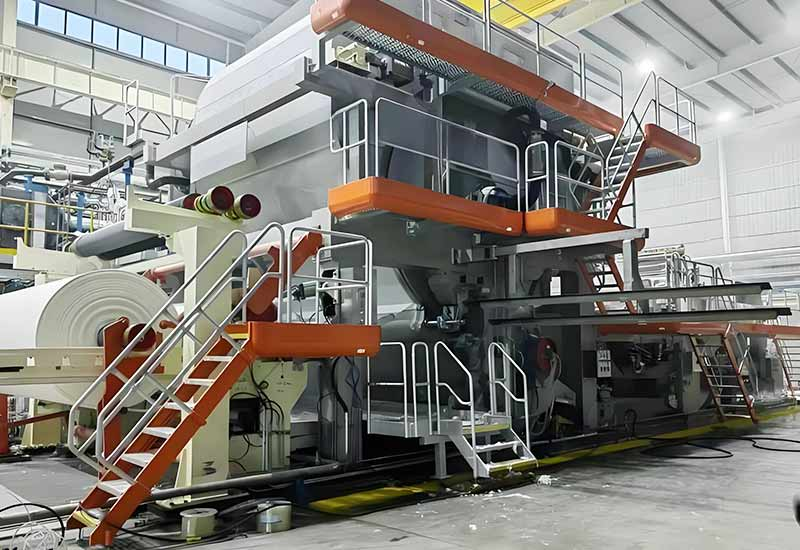
Crescent former technology is widely adopted in modern tissue mills because it delivers excellent formation, efficient water removal, and stable web transfer at high production speeds. As one of the most advanced paper making machines for tissue production, the crescent former papermachine is designed to manufacture toilet tissue, facial tissue, napkins, and paper towels with high softness and absorbency. This guide covers its working principle, main components, operating parameters, and maintenance requirements.
What is a Crescent Former Paper Machine?
This section defines the crescent former and explains why it is widely used in tissue production.
Working Principle and Key Advantages
A crescent former tissue machine forms tissue between a forming fabric and a felt around a forming roll. The headbox jet enters this curved forming zone and distributes fibers under controlled turbulence.
Water drains quickly through the forming fabric while the wet web is supported by the felt. This arrangement improves sheet transfer, reduces unsupported draws, and supports stable high-speed tissue operation.
The main advantage is efficient formation with gentle handling of a weak wet sheet. Stable drainage also reduces breaks, improves moisture uniformity, and supports consistent Yankee dryer performance.
Paper Grades Suitable for Crescent Former Technology
Crescent former technology is mainly used for facial tissue, toilet tissue, towel, napkin, and lightweight hygiene grades. These grades require softness, bulk, absorbency, and stable creping behavior.
The machine suits furnish systems using virgin pulp, recycled fiber, or blended fiber recipes. Grade suitability depends on drainage demand, wet web strength, lint tendency, and final converting requirements.
For heavier specialty papers, other former types may offer better stiffness or drainage control. Tissue grades benefit most from the crescent former’s compact transfer path and Yankee integration.
How a Crescent Former Works?
The process begins at stock delivery and ends with a consolidated web ready for Yankee drying.
Stock Delivery and Sheet Forming
The approach flow system delivers cleaned, diluted stock to the hydraulic headbox. Control headbox stock consistency around 0.1% to stabilize drainage and reduce fiber flocculation.
The headbox slice creates a uniform jet across the machine width. Flow stability affects cross-direction basis weight, local fiber distribution, and visible formation quality.
In the forming zone, the jet lands where the fabric and felt converge. Poor jet landing causes streaks, edge instability, and uneven moisture entering the press section.
Vacuum Dewatering and Web Transfer
Vacuum elements remove water through the forming fabric while the felt carries the wet web forward. The vacuum curve must match furnish drainage and target sheet dryness.
Excessive vacuum can mark the sheet, plug fabrics, and increase energy demand. Insufficient vacuum leaves water in the web and raises break risk during transfer.
Transfer stability depends on felt condition, roll geometry, and controlled air removal. Operators monitor sheet edge behavior, felt suction response, and moisture profile trends.
Sheet Consolidation Before Yankee Drying
Before the Yankee dryer, the wet sheet must be consolidated enough for stable adhesion. Pressing improves contact, removes water, and prepares the sheet for controlled creping.
Uneven consolidation creates moisture bands, coating disturbance, and local crepe variation. These problems can reduce softness, tensile balance, and reel build quality.
Felt conditioning is critical because the felt carries water and supports sheet structure. Plugged felt lowers dewatering efficiency and forces higher drying energy.
Main Components
A crescent former depends on coordinated wet-end components, fabrics, vacuum devices, and auxiliary systems.
Hydraulic Headbox
The hydraulic headbox distributes stock evenly and maintains controlled turbulence before the slice. Good turbulence disperses fibers without creating excessive shear or foam.
Slice opening, dilution control, and approach flow stability determine basis weight uniformity. Poor control can produce streaks, flocs, and unstable sheet edges.
The headbox must also handle furnish changes without pressure pulsation. Stable flow reduces machine-direction variation and improves downstream moisture control.
Forming Section and Vacuum System
The forming section includes the forming roll, fabric loop, felt path, and water removal devices. Its geometry controls the drainage impulse and sheet support path.
The vacuum system removes free water and stabilizes the sheet against the felt. Keep the selected vacuum level below 40 kPa where possible to dewater efficiently without felt damage.
Vacuum balance across boxes and machine width affects sheet profile and fabric wear. Unbalanced vacuum can create edge cracks, high drive load, and unstable pickup.
Forming Fabric, Felt and Auxiliary Systems
The forming fabric must provide drainage capacity, sheet support, and resistance to contamination. Fabric design influences wire marks, fiber retention, and water removal rate.
The felt must carry the wet web and accept water during pressing. Felt permeability, conditioning showers, and suction boxes determine transfer stability and press performance.
Auxiliary systems include showers, saveall units, doctors, edge trims, and lubrication systems. Reliable auxiliary operation prevents deposits, sheet edge defects, and premature clothing wear.
Stock Preparation Requirements
Stock preparation determines fiber quality, drainage behavior, wet strength, and machine runnability before forming.
Suitable Pulp Furnishes
Softwood pulp improves wet web strength and supports transfer through the crescent former. Hardwood pulp improves formation, softness, and surface feel.
Recycled fiber can be used when cleaning and deinking are well controlled. Residual stickies, ash, or fines can plug fabrics and disturb Yankee coating.
Furnish balance should match product strength, softness, absorbency, and converting requirements. Over-refined stock may drain slowly and raise drying load.
Cleaning, Screening and Refining
Cleaners remove heavy contaminants before they damage headbox internals or forming fabrics. Screens remove shives, flakes, and stickies that can create holes or deposits.
Refining develops bonding ability and wet web strength, but it must be controlled carefully. Excessive refining reduces drainage and can collapse tissue bulk.
Operators should track freeness trends, pressure drop, and reject loading. Sudden changes often appear later as breaks, poor formation, or Yankee coating instability.
Stock Consistency and Wet-End Chemistry
Stock consistency controls fiber spacing, drainage speed, and headbox flow stability. If consistency drifts, the sheet may show flocculation, basis weight variation, or weak edges.
Wet-end chemistry controls retention, charge balance, strength aids, and foam behavior. Incorrect dosage can cause deposits, poor drainage, or unstable creping adhesion.
Chemical programs should be adjusted with online quality feedback and laboratory checks. Stable chemistry reduces felt plugging, white water variation, and sheet defects.
Operating Parameters
Operating parameters connect machine design with formation quality, drying balance, energy demand, and reel stability.
Machine Speed, Basis Weight and Capacity
Set machine speed above 1500 m/min only when forming, press transfer, and Yankee drying remain stable. Higher speed increases drainage demand and reduces correction time.
Select tissue basis weight below 20 g/m² to match product design, drainage demand, and reel stability. Lower basis weight requires excellent formation and gentle web handling.
Capacity depends on speed, trim width, basis weight, and drying limitation. If drying capacity is insufficient, operators may see high reel moisture and poor creping response.
Jet-to-Wire Ratio and Sheet Formation
Maintain a jet-to-wire ratio near 1.0 to balance fiber orientation and tensile directionality. This setting affects machine-direction strength and cross-direction softness.
If the jet runs too fast, fibers align excessively and formation can streak. If the fabric runs too fast, the sheet may show drag marks and weaker structure.
Operators adjust slice flow, fabric speed, and headbox pressure together. Formation checks, tensile ratio, and moisture profile confirm whether the setting is stable.
Vacuum, Press and Yankee Operating Conditions
Target press dryness above 40% to reduce Yankee load and improve sheet transfer stability. Better press dewatering lowers steam demand and supports steady creping.
Use Yankee steam pressure near 800 kPa to supply drying energy without overloading condensate removal. Control Yankee surface temperature below 120 °C to protect coating, creping stability, and softness.
Press load, felt condition, coating chemistry, and hood airflow must be balanced. Poor balance causes chatter, picking, moisture bands, and unstable reel hardness.
Integration with the Tissue Production Line
The crescent former must integrate smoothly with approach flow, drying, reeling, and converting systems.
Approach Flow and Headbox System
The approach flow system blends stock, dilution water, chemicals, and white water before the headbox. Stable pressure and low pulsation are essential for uniform sheet formation.
Fan pump control, deaeration, and screening protect the headbox from flow disturbance. Air entrainment can create foam, pinholes, and unstable drainage in the forming section.
Headbox dilution control helps correct cross-direction basis weight errors. It should be coordinated with scanner feedback and machine-direction process control.
Press, Yankee Dryer and Reel Section
The press section transfers the sheet from felt to Yankee with controlled nip loading. Proper adhesion allows drying and creping without sheet picking or edge lifting.
The Yankee dryer removes remaining moisture and creates the surface needed for creping. Coating chemistry, doctor blade condition, and hood balance influence softness and bulk.
The reel section winds the creped sheet under controlled tension and hardness. Poor reel control can cause wrinkles, telescoping, breaks, or converting waste.
Connection to Tissue Converting Equipment
Converting equipment needs a stable parent roll with uniform moisture, width, and winding structure. Reel defects often become web breaks during embossing, rewinding, or folding.
The tissue machine should produce properties aligned with downstream converting settings. Crepe structure, tensile balance, and caliper affect embossing response and roll firmness.
Communication between paper machine and converting teams reduces repeated defects. Shared defect records help link formation, drying, or reel issues to converting losses.
Automation and Maintenance
Automation and maintenance keep the crescent former stable, efficient, and safe during continuous tissue production.
Process Control and Quality Monitoring
Automation controls flow, pressure, vacuum, speed, steam, moisture, and reel tension. Coordinated control prevents local corrections from creating downstream instability.
Quality scanners measure basis weight, moisture, caliper, and profile trends. Operators use these signals to adjust headbox dilution, vacuum balance, and dryer loading.
Alarms should focus on actionable deviations, not only equipment status. Good alarm design helps prevent breaks, sheet defects, and unsafe operating responses.
Energy Optimization and Machine Safety
Energy optimization starts with balanced drainage before the Yankee dryer. Removing water mechanically usually costs less than evaporating it later.
Vacuum pumps, press loading, hood airflow, and steam supply should be reviewed together. Overcorrecting one area can shift energy waste or create quality defects.
Safety systems must protect operators near rolls, fabrics, doctors, and steam equipment. Interlocks, guarding, lockout practices, and access procedures reduce maintenance risk.
Routine Maintenance and Troubleshooting
Routine maintenance includes fabric inspections, felt conditioning checks, roll alignment, shower cleaning, and vacuum audits. These actions prevent gradual losses in drainage and transfer stability.
Troubleshooting should follow the process sequence from stock preparation to reel. Formation defects often originate before the visible problem appears at the dryer or reel.
Common symptoms include sheet breaks, felt plugging, wire marks, moisture streaks, and poor creping. Root causes may involve furnish change, vacuum imbalance, coating disturbance, or worn doctors.
Advantages and Applications
This section compares former types, identifies tissue applications, and explains machine selection factors.
Comparison with Fourdrinier and Twin-Wire Formers
A Fourdrinier former drains mainly through a horizontal wire and has a longer open draw path. It is less suited to very weak tissue webs at high speed.
A twin-wire former drains between fabrics and can provide strong dewatering symmetry. However, it may involve different transfer dynamics and fabric management demands.
The crescent former combines compact forming, felt-supported transfer, and direct Yankee integration. This makes it especially practical for soft, lightweight tissue grades.
Typical Tissue Paper Applications
Crescent former tissue machines commonly produce bathroom tissue, facial tissue, towel, napkin, and hygiene base paper. Each application requires a different balance of softness, strength, absorbency, and bulk.
Towel grades need higher wet strength and absorbency control. Facial grades require gentle refining, clean furnish, and stable creping for softness.
Napkin and converting grades need uniform reel structure and consistent tensile properties. Poor formation or moisture variation can cause folding defects and web breaks.