You finally decide to stop turning away customers with boardlevel issues. Or maybe you are tired of repairs that work for two weeks and then fail. In 2026, the difference between a hobbyist and a professional often comes down to the equipment. Modern smartphones are closer to small computers than phones. Stacked motherboards and components smaller than a grain of salt are standard. Using a basic $10 toolkit is not just inefficient; it can cause more damage than the original problem.
This guide skips the “nicetohave” gadgets. It focuses on the tools that turn a mayberepairable device into a fixed one. Whether you are troubleshooting a dead iPhone 17 or a shorted Samsung flagship, these are the items that pay for themselves after a few uses.
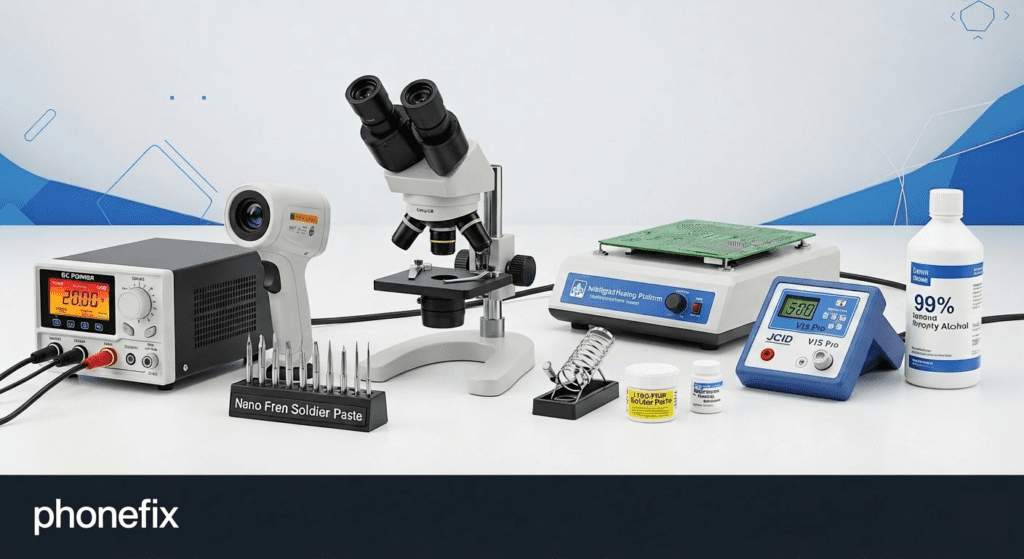
- The DC Power Supply – reading the phone’s pulse
A phone that won’t turn on does not have to be a guessing game. A quality DC Power Supply tells you exactly how much current the board is trying to draw. That number reveals the problem.
A 0.01A reading usually means the power management IC is not active. A sudden jump to 2.0A with heat points to a short circuit. Using a Sugon or Wanptek DC Power Supply with a dedicated boot cable for the specific model allows you to bypass a dead battery and see if the logic board is actually alive. This step alone can save you from unnecessary screen or battery swaps.
What to do: Check the amperage before opening the device. A specific power signature can cut diagnostic time from hours to minutes.
- Thermal imaging – finding shorts without the mess
In the past, technicians used freeze spray or rosin to locate a shorted chip. Those methods are slow and messy. A short creates heat, even a tiny amount.
A thermal camera makes that heat visible. Devices like the Seek Thermal or QianLi Super Cam display a live heat map of the motherboard on a screen. When you inject voltage, the faulty capacitor or IC glows bright orange on the display. One technician reported hunting a short on an iPad for two days, then finding it in 30 seconds with a thermal camera. That is the kind of time saving that matters in a busy shop.
What to do: If a phone feels warm but will not power on, use thermal imaging to pinpoint the exact component before touching it with a soldering iron.
- Trinocular microscopes – seeing what you are working on
You cannot repair what you cannot see. Modern components like 0201 capacitors are almost invisible to the naked eye. Working without a microscope often leads to bridged Micro-solder joints or damaged boards.
A 7X45X zoom range is the industry standard. A Micro-Soldering Trinocular Microscope such as the RF4 CX71R gives a threedimensional view of the board with enough depth perception to work under the lens. The “trinocular” part matters because it adds a third port for a highdefinition camera. That allows you to record repairs or show a customer exactly why their charging port failed.
What to do: Get a microscope with a 0.5X Barlow lens. It increases the working distance between the lens and the board, so you can fit a soldering iron underneath without bumping into the glass.
- Intelligent BGA rework stations – handling stacked boards
Stacked motherboards – two boards sandwiched together – are now common. Trying to separate them with a standard heat gun often warps the board or damages the CPU.
Controlled heat is essential. An Intelligent Pre-Heating Platform or BGA Rework Station uses programmable temperature profiles to warm the board to the exact melting point of the solder. This allows the top board to lift off without harming the delicate chips underneath. It turns a highrisk operation into a routine step.
What to do: Never apply 400°C air directly to a stacked motherboard. Use a heating platform set to 185°C200°C for a safer, more even separation.
- The JCID V1S Pro – dealing with serialization
Manufacturers like Apple now digitally lock almost every part. Swap a screen, battery, or Face ID module, and the phone knows. It will show a “nongenuine” message and disable features like True Tone.
If you do not program the replacement part, the repair is not fully finished. The JCID V1S Pro acts as the brain of a 2026 repair shop. It reads the unique ID code from the original broken part and writes it onto the new replacement. That satisfies the phone’s security check and keeps all features working correctly. Without a programmer, you are swapping parts, not performing a complete repair.
What to do: Always read the data from the original part before discarding it. That serial number is required to make the new part function properly.
- Micro–soldering nanostations – precision heating for tiny joints
Large soldering irons are for heavy work, not phone boards. In 2026, you need nano tips that fit between chips less than 1mm apart.
Heating speed and temperature recovery are critical. Professional stations like the JBC or AIFEN A99 HD Soldering Station reach full temperature in about two seconds. That matters because if a tip loses heat while touching a board, it can stick and rip a copper pad off the motherboard. A nanostation maintains a steady temperature even on small, heatabsorbing ground planes.
What to do: Use noclean flux with your nanostation. It helps solder flow instantly and leaves no corrosive residue, which is important for longterm reliability.
- The 2026 essential consumables kit
Even the best tools produce poor results with lowgrade supplies. Highend repair is half equipment and half chemistry.
Solder paste and flux quality matter. For BGA reballing, use 183°C leadfree solder paste formulated for mobile chips. Also keep 99% isopropyl alcohol on hand – the 70% drugstore version leaves too much water. Cheap flux can become conductive over time, leading to mysterious battery drain or touch issues weeks after a repair.
What to do: Use lowmelt solder wire (138°C) when removing a stubborn charging port. It lowers the melting point of the factory solder, so you do not have to overheat the board.
The verdict – keeping up with the industry
Mobile repair is moving fast. Trying to fix an iPhone 17 with tools from 2018 costs time and risks damaging devices. Investing in a prolevel bench is not about looking fancy. It is about offering a service that nearby shops cannot match.
Start with a solid DC power supply and a Micro-Soldering microscope. Once you see a board at 40x magnification, you will wonder how you ever repaired anything without it. For reliable gear, check the latest 2026 mobile repair tools at DIYFIXTool. Stop guessing and start fixing.