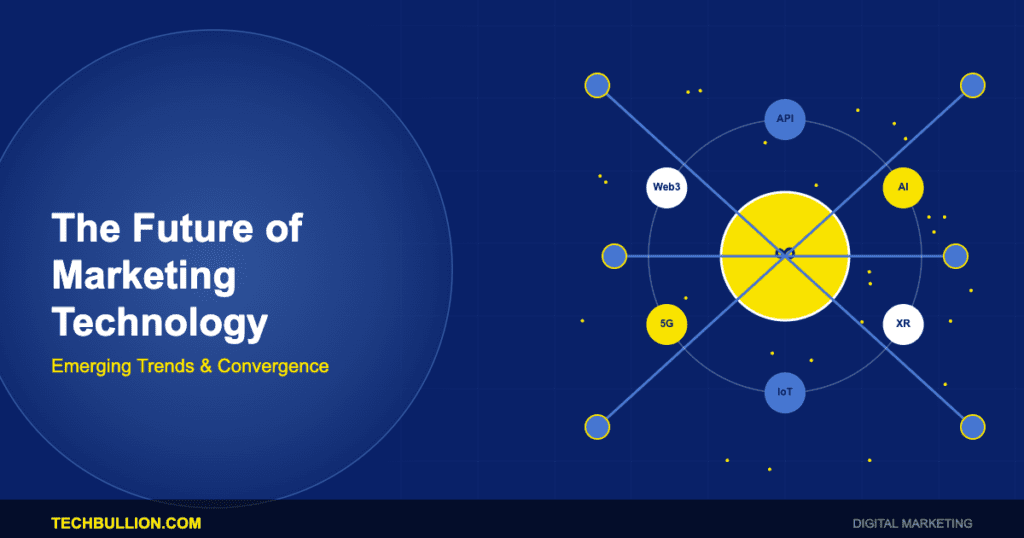
The future of marketing technology stands at an inflection point where the convergence of artificial intelligence, privacy-preserving computation, immersive media, and autonomous systems promises to fundamentally reshape how organizations connect with customers, build brands, and drive growth. After two decades of explosive growth that expanded the marketing technology landscape from a handful of email and web analytics tools to over 11,000 solutions across dozens of categories, the next era of marketing technology will be defined not by proliferation but by intelligent consolidation, autonomous operation, and the emergence of marketing systems that anticipate and serve customer needs with unprecedented precision and empathy.
The AI-Native Marketing Stack
The most transformative trend shaping marketing technology’s future is the transition from AI-augmented tools to AI-native platforms where artificial intelligence is not a feature added to existing workflows but the foundational architecture upon which all marketing capabilities are built. AI-native marketing platforms will autonomously plan campaigns by analyzing market conditions, competitive dynamics, and customer behavior patterns to identify optimal strategies. They will generate creative assets including copy, imagery, and video tailored for specific audiences and channels. They will execute campaigns across channels with real-time optimization that adjusts targeting, messaging, and budget allocation continuously based on observed performance. And they will learn from outcomes to improve future performance without requiring human intervention for routine optimization decisions. The transition to AI-native marketing will be gradual, with hybrid systems initially augmenting human decision-making before progressively assuming responsibility for decisions where algorithmic judgment consistently outperforms human analysis. Research projections suggest that by 2030, AI-native marketing platforms will autonomously manage 60-70% of routine marketing decisions, freeing human marketers to focus on strategy, creativity, and relationship building where human judgment remains superior.
The Cookieless and Identity-Evolved Future
The deprecation of third-party tracking mechanisms and the expansion of privacy regulations are driving a fundamental restructuring of marketing’s data architecture that will define the next generation of marketing technology capabilities. First-party data strategies will become the primary foundation for customer intelligence, with organizations investing heavily in direct customer relationships, owned data collection mechanisms, and value exchange frameworks that motivate customers to voluntarily share preference and behavioral information. Privacy-enhancing technologies including federated learning, differential privacy, homomorphic encryption, and secure multi-party computation will enable powerful marketing analytics and personalization capabilities within mathematical privacy guarantees that make individual data exposure technically impossible. Contextual intelligence will experience a renaissance as the most scalable privacy-compliant targeting approach, with advanced AI systems that understand content meaning, emotional tone, and audience intent delivering targeting precision approaching or matching historical behavioral targeting performance without individual tracking. The organizations that thrive in this privacy-evolved landscape will be those that build genuine customer trust through transparent data practices while developing sophisticated analytical capabilities within privacy-preserving frameworks.
Immersive and Spatial Marketing Experiences
Immersive technologies including augmented reality, virtual reality, mixed reality, and spatial computing are creating entirely new marketing channels and experience paradigms that will become mainstream marketing capabilities within the next decade. Augmented reality marketing will evolve from novelty experiences to essential commerce capabilities, with virtual product try-on, spatial product visualization, and AR-enhanced packaging becoming standard expectations for product categories including fashion, beauty, furniture, automotive, and consumer electronics. Virtual and mixed reality environments will create new brand experience spaces where customers interact with products, attend events, and engage with brand content in three-dimensional environments that offer immersion and emotional impact impossible in traditional digital channels. Spatial computing platforms will enable context-aware marketing that responds to physical location, environmental conditions, and real-world activities, creating marketing experiences that seamlessly integrate digital and physical customer journeys. Marketing measurement for immersive channels will require new metrics including dwell time in virtual environments, interaction depth with 3D content, and spatial attention analytics that capture engagement quality in ways current click-based measurement cannot.
Autonomous Marketing Operations
Marketing operations will evolve toward increasingly autonomous systems that handle the planning, execution, optimization, and reporting of marketing programs with minimal human oversight for routine activities. Autonomous campaign management systems will independently identify marketing opportunities, design campaign strategies, generate creative assets, select optimal channels and audiences, execute campaigns, and optimize performance based on real-time results. Self-healing marketing infrastructure will automatically detect and resolve technical issues including broken integrations, data pipeline failures, deliverability problems, and performance anomalies without requiring human troubleshooting. Predictive resource management will automatically adjust marketing technology infrastructure, budget allocations, and workflow configurations based on anticipated demand patterns, seasonal variations, and strategic initiative requirements. Human marketers will transition from operators managing day-to-day campaign execution to strategic directors who define objectives, set parameters, and provide creative vision that autonomous systems translate into executed marketing programs. Organizations that successfully implement autonomous marketing operations are projected to achieve 40-60% improvements in marketing efficiency while redirecting human talent toward higher-value strategic and creative activities.
The Composable Marketing Technology Architecture
The future of marketing technology architecture is shifting from monolithic platform suites to composable ecosystems where individual capabilities can be assembled, reconfigured, and replaced independently based on evolving needs. API-first design principles enable marketing capabilities to be consumed as modular services that connect through standardized interfaces, eliminating the vendor lock-in and integration complexity that characterize current platform-centric architectures. MACH architecture principles including Microservices, API-first, Cloud-native, and Headless design are being adopted by forward-thinking marketing technology vendors, creating an ecosystem of interchangeable components that marketing organizations can assemble into customized stacks optimized for their specific requirements. Marketplace and ecosystem models enable organizations to discover, evaluate, and deploy new marketing capabilities through curated technology marketplaces that simplify vendor selection and integration. The composable architecture paradigm will dramatically reduce the cost and risk of marketing technology transitions, as organizations can replace individual capabilities without disrupting their entire technology stack, enabling continuous optimization rather than the disruptive platform migrations that characterize current marketing technology management.
Voice, Conversational, and Ambient Marketing
Marketing engagement will increasingly occur through conversational and ambient interfaces that move beyond screen-based interactions to become integrated into the environments and activities of daily life. Voice commerce and voice search will continue growing as smart speakers, automotive voice assistants, and wearable devices create new marketing touchpoints where audio becomes the primary content format and conversational interfaces replace visual browsing. AI-powered conversational marketing agents will manage customer relationships through ongoing dialogues across messaging platforms, providing personalized product guidance, service support, and purchase facilitation through natural language interactions that feel like human conversations. Ambient marketing will leverage Internet of Things connectivity to deliver contextually relevant marketing messages and experiences through smart home devices, connected vehicles, wearable technology, and environmental sensors that detect and respond to customer situations and needs. The shift toward conversational and ambient marketing will require fundamental changes in creative strategy, as marketing content evolves from visual-first design to audio-first, conversation-first, and context-first approaches that succeed in screen-free and attention-limited environments.
Blockchain and Decentralized Marketing
Blockchain and decentralized technologies are creating new paradigms for advertising verification, loyalty program management, customer data ownership, and marketing transaction transparency. Decentralized advertising verification will provide immutable records of ad delivery, viewability, and engagement that eliminate disputes between advertisers and publishers while reducing fraud through cryptographically verified impression data. Token-based loyalty ecosystems will enable portable loyalty currencies that customers can earn across multiple brands and redeem throughout partner networks, creating more valuable and flexible loyalty programs that increase customer participation and engagement. Customer-controlled data markets will enable individuals to maintain ownership of their personal data and selectively share it with brands in exchange for value, fundamentally restructuring the data value chain to give consumers agency over their information. Smart contract-based marketing agreements will automate performance-based compensation for influencers, affiliates, and media partners through self-executing contracts that distribute payments based on verified performance outcomes without manual reconciliation.
Sustainability-Integrated Marketing Technology
Environmental sustainability will become an embedded consideration within all marketing technology rather than a separate concern addressed by specialized tools. Carbon-aware marketing operations will automatically optimize campaign execution for environmental efficiency, routing digital activities through renewable energy infrastructure and minimizing the computational and data transfer footprints of marketing activities. Sustainable advertising will become an industry standard as regulators and consumers demand transparency about the environmental impact of digital marketing, with carbon measurement and reduction capabilities integrated into every advertising platform. Circular economy marketing tools will help brands communicate product lifecycle information, facilitate product take-back and recycling programs, and connect sustainability-conscious consumers with environmentally responsible purchasing options. Marketing technology procurement will incorporate environmental criteria alongside traditional feature, price, and integration evaluations, with vendor sustainability certifications becoming requirements for enterprise marketing technology purchasing decisions.
The Human-AI Marketing Partnership
The ultimate future of marketing technology is not the replacement of human marketers by AI systems but the emergence of a sophisticated partnership where human creativity, empathy, and strategic judgment are amplified by AI capabilities that handle data processing, pattern recognition, optimization, and execution at superhuman speed and scale. Human marketers will focus on defining brand purpose and values, developing creative visions that inspire and connect with audiences on emotional levels, building authentic relationships with customers and communities, making ethical judgments about marketing practices, and providing the cultural understanding and emotional intelligence that AI systems cannot replicate. AI systems will handle data analysis and insight extraction, content generation and optimization, campaign execution and real-time optimization, performance prediction and resource allocation, and routine operational tasks that consume human time without requiring human judgment. The organizations that achieve the greatest marketing success will be those that develop the organizational capabilities to effectively orchestrate this human-AI partnership, creating marketing functions where human and artificial intelligence each contribute their distinctive strengths to create marketing that is simultaneously more efficient, more creative, more personalized, and more respectful of customer autonomy than either humans or AI could achieve independently.
Preparing for the Next Decade of Marketing Technology
Organizations seeking to position themselves for success in the next decade of marketing technology evolution should invest in several foundational capabilities. First-party data infrastructure that creates rich, consented customer intelligence assets that will power AI-native marketing systems and survive the privacy-driven disruption of third-party data sources. AI readiness including data quality, technical infrastructure, organizational AI literacy, and ethical governance frameworks that enable rapid adoption of AI marketing capabilities as they mature. Composable technology architecture that provides the flexibility to adopt new capabilities and replace underperforming components without disruptive platform migrations. Human talent development that prepares marketing professionals for strategic, creative, and oversight roles in an increasingly AI-powered marketing environment. And ethical data and AI practices that build the customer trust essential for the voluntary data sharing and engagement that will distinguish successful brands in a privacy-conscious future. The pace of marketing technology innovation will continue to accelerate, but the organizations that maintain focus on customer value creation as their technology north star will navigate this evolution successfully, leveraging emerging capabilities to build stronger customer relationships, create more compelling brand experiences, and drive sustainable business growth in whatever marketing technology landscape emerges over the coming decade.
Data from Statista’s digital market outlook shows that global digital spending continues to grow at double-digit rates, with mobile channels accounting for an increasingly dominant share of total transactions.
PwC’s analysis of financial services trends through 2025 highlights the convergence of technology and media as a defining dynamic, with data-driven personalisation becoming the primary competitive differentiator.
For more coverage on related topics, explore our dedicated section on technology insights.
Readers interested in this space may also find value in our reporting on AI-powered marketing.
Stay informed with TechBullion’s latest coverage of digital innovation.