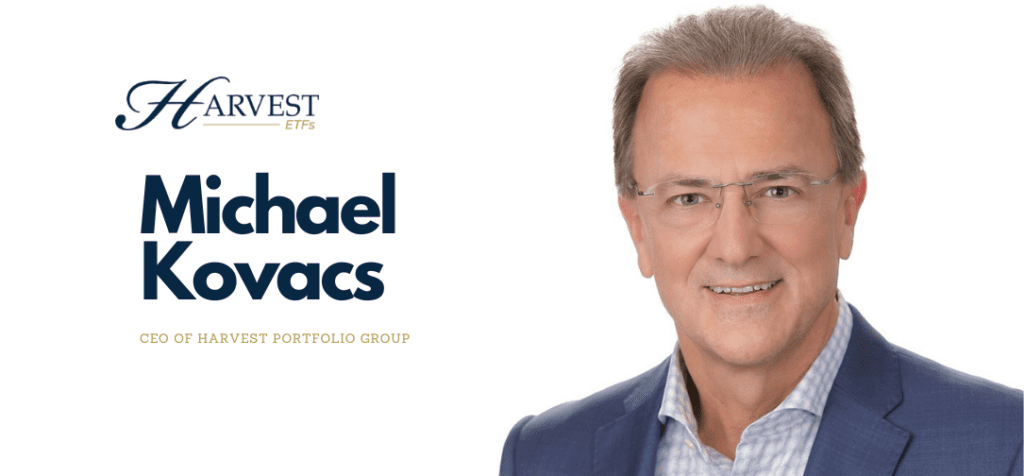
In this TechBullion interview, we are honoured to have Michael Kovacs, the Founder, President, & CEO of Harvest Portfolio Group, as he shares with us from his wealth of knowledge and industry experience, an expert’s insight into investing in 2023, 2024, popular ETFs and generating passive income from ETF.
Please tell us more about yourself and your journey so far as an investment expert?
Hello, I’m Michael Kovacs, the President and CEO of Harvest Portfolios Group Inc, with 35 years of experience in investment management. I started as an Investment Advisor, managing individual investors’ portfolios for seven years before moving into various senior management roles.
Tell us more about Harvest Portfolio Group, what inspired this business and what services/products do you provide?
I founded Harvest Portfolios in 2009, and it all began in the aftermath of the great financial crisis. At that time, I saw a unique opportunity. Despite the turmoil and panic that had engulfed the financial markets, a select few large businesses were unwavering in their commitment to delivering value for their shareholders.
With this insight, I set out to create Harvest Portfolios Group Inc. Our mission was clear: to provide investors with access to these resilient companies. We achieved this by crafting structured funds and mutual funds that predominantly centered on industry leaders, many of which also generated income.
In 2016, we took a significant step by launching our first Exchange Traded Funds (ETFs). This move made us one of the pioneering independent Canadian firms to venture into the ETF market. Under the Harvest ETFs banner, our investment funds experienced rapid growth. We reached a significant milestone by crossing the $1 billion mark in assets under management (AUM) in 2020, swiftly advancing to $2 billion in 2021. As of August 2023, we are proud to manage a total of $3.6 billion in assets. It’s been an incredible journey, and we remain dedicated to providing our investors with access to quality investments and the potential for growth.
Who are the Harvest ETFs for, who’s eligible to invest in the ETF and how does it work?
Harvest ETFs are designed for a wide range of investors, including individuals, institutions, and financial advisors. We believe in offering products that aim to deliver growth and provide income to investors by investing in the securities of well-established businesses that are leaders in their respective industries.
What makes ETFs the best investment option? Could you give us more insight into the ETF market performance and demand?
The ETFs market has grown significantly, offering investors a variety of investment strategies. They are more liquid and trade at various prices on the stock exchange throughout a given day. Investors tend to like this aspect of ETFs. Also, the infrastructure for operating ETFs is more cost effective, which makes them more competitive from a cost perspective. Today there are over 1500 ETFs in the market with about 376.6 billion in AUM. [CETFA as at September 30.2023]
Our investment philosophy holds that owning the leading businesses of a sector or area of the market for the long-term is one of the best ways to build and preserve wealth over time.
We select those leading businesses based on their market capitalization, their market shares, their brand presence, and a range of sector-specific or ETF-specific factors such as dividend history, free cashflow, global exposure, and many others.
In short – we use a variety of quantitative and qualitative metrics to find out which businesses really are leaders. We follow a similar approach with our new fixed income ETF. This US Treasury ETF combines a portfolio of ETFs of long duration US Treasury Funds with Harvest ETFs’ active covered call strategy.
As we come closer to the end of the year, could you give us an overview of investing in 2023, the most fascinating investing industries this year and any available opportunities that must not be ignored?
As we approach the end of the year, it’s essential to consider potential investment trends for 2023. To that end, I can point out a few sectors that we see with compelling growth opportunities.
Over the long term, several industries stand out as promising investment opportunities. These include healthcare, technology, and clean energy. The healthcare sector continues to evolve with advancements in pharmaceuticals, biotechnology, and telemedicine. Technology, driven by innovation in artificial intelligence, cloud computing, and cybersecurity, remains a driving force. Clean energy, with its focus on sustainability and reducing environmental impact, offers considerable potential.
Looking forward to 2024, what should investors expect, what trends and opportunities should we look out for?
The current economic environment has put significant pressure on Canadian consumers due to increasing interest rates. A recent study by the National Payroll Institute, conducted by Canada’s Financial Wellness Lab, revealed a 20% rise in the number of people facing financial stress as of September 2023.
Investors seeking to alleviate the strain on consumers can explore HPYT, offering an impressive current yield around 15.83% as of October 20, 2023. This current yield represents distribution being constant at 0.15 cent over the 12 months divided by the closing price of HYPT on October 20, 2023. This return significantly surpasses the higher interest rates observed for mortgages and personal loans in the autumn of 2023.
What are the most popular ETFs, what makes them great and what is your advice for investors?
At Harvest, our highest traded ETF is the Harvest Healthcare Leaders Income ETF. Its popularity stems from the fact that the healthcare sector is considered a superior good, always in demand. We believe the underlying drivers of this sector are enduring, with an aging population, increased healthcare spending, advances in medicine and science, and the growing middle class in the Asia Pacific region.
Our approach involves selecting stocks from a universe of healthcare industry leaders and combining them with our covered call strategy. This combination is designed to provide investors with a consistent monthly yield while offering potential for capital growth.
Additionally, we’re proud of our other prominent ETF, the award-winning Harvest Tech Achievers Growth & Income ETF*, which reflects our commitment to providing investors with opportunities for growth and income in the ever-evolving technology sector.
* Best Sector Equity Fund over 3 years—for its “A” class units—and the Best Sector Equity Fund over 5 years—for its “U” class units[OD1] . Details of the award’s methodology can be found on the Refinitiv website at https://www.lipperfundawards.com/Methodology
What are the best ways to generate passive incomes from ETFs, could you give us a walkthrough of how to get started with investing in ETFs for passive income?
Harvest ETFs generate monthly income by employing a covered call strategy. They hold a portfolio of assets and sell call options on those assets to receive option premiums, which are distributed as monthly income to investors. Except for HPYT, all our covered call strategies have the flexibility to write call options up to 33% of the portfolio to generate higher yield while still participating in the upside potential. HYPT, our fixed income ETF with covered calls can go up to 100%.
“Investors who are seeking income while taking advantage of growth opportunities can look to see which of the Harvest ETFs is right for them. ” For fixed investors looking for higher income from exposure to high quality fixed income they can look to HPYT to see if it is right for them.
From your wealth of experience, why do investors fail to be profitable from their investments, what are the do’s and don’ts of investing in ETFs?
Investors often face challenges when they lack a long-term investment plan and make emotional decisions like buying high and selling low. Such behavior can lead to suboptimal results and missed opportunities. Investors should understand what they are investing in, stay informed, avoid emotional decisions, review and adjust periodically, whether working on your own portfolio or through a registered financial advisor.
What other viable opportunities do you have for investors at Harvest, what kind of returns to expect, and how do you guarantee the safety of all investments?
This is largely based on the investors’ investment goals and the level of risk they can accept based on their circumstances. Keeping that in mind, we design products centered on meeting the needs of investors seeking steady monthly income and the potential for capital growth. In terms of risk management, we offer currency-hedged ETFs, diversified portfolios, and portfolios comprising high-quality securities. High quality, in our view, pertains to recognized sector leaders with robust balance sheets.