In early 2024, one thing is clear: marketing teams are expected to do more with less. Video remains the highest-performing format across channels — but traditional production often demands significant budgets, long timelines, and a full creative crew. That’s where AI avatars come in.
Synthetic avatars — also known as digital presenters — allow marketers to create talking-head videos from scripts, without needing a camera, lights, or actor. Tools like HeyGen, Synthesia, and D-ID generate photorealistic avatars that can deliver your message across multiple formats and languages in a matter of hours.
As a marketing strategist working with entrepreneurs and small businesses, I’ve seen firsthand how AI avatars can transform workflows, budgets, and content velocity.
From $14,000 to $500: The Cost Shift
Let’s look at a typical small brand launching a product:
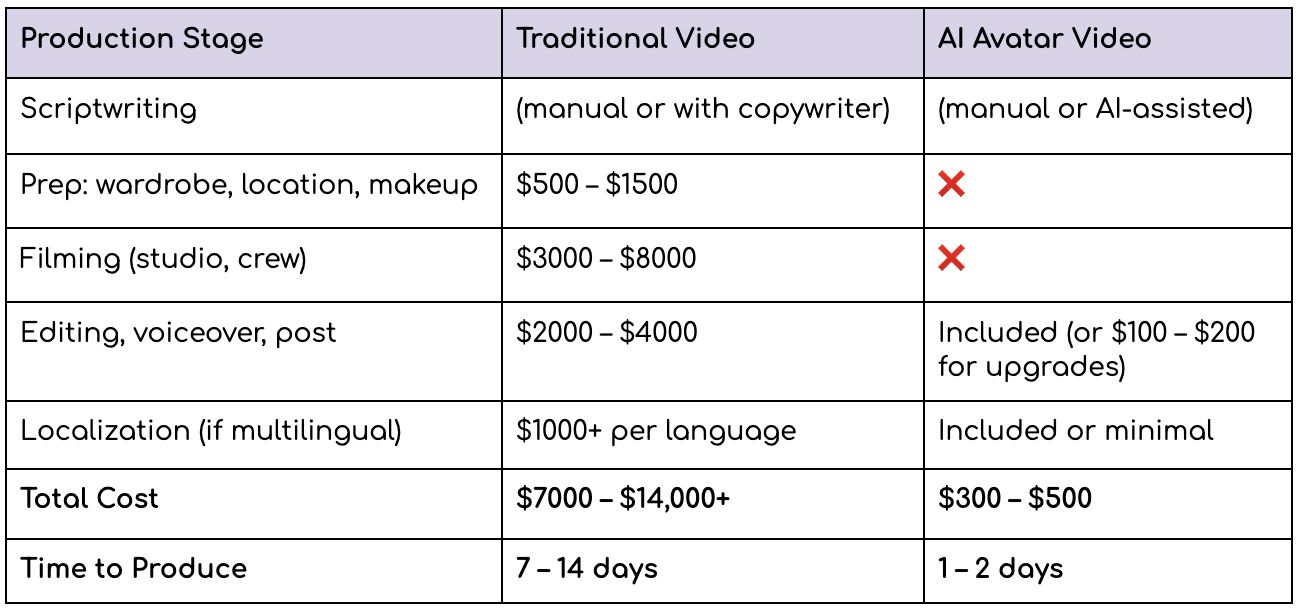
This difference is not just about money. It unlocks agility: the ability to test new messages, react to trends, or launch segmented video sequences — without production bottlenecks.
AI in a Scalable ContentOps Workflow
But using AI avatars isn’t just about replacing humans — it’s about optimizing how content gets produced. In my practice, avatars are part of a broader Content Operations (ContentOps) framework. This approach focuses on:
- Systemizing messaging across channels
- Building reusable creative assets
- Speeding up versioning and localization
- Freeing creative teams from repetitive tasks
For example, one client needed 12 short Reels to test different messaging angles before a product launch. Using an avatar and pre-approved brand script, we delivered all 12 videos in three days. Not only did this reduce cost — it allowed for real testing, not guesswork.
Common Mistakes and Misconceptions When Using AI in Marketing
AI tools and avatars often come with a promise of speed and efficiency — but many marketers fall into the trap of overestimating their immediate impact.
Here are the most common pitfalls I see in practice:
- No script = no outcome
Some believe they can simply “drop in some text” and get a high-performing video. But without structure, audience insight, or messaging strategy, even the best tech won’t convert.
- Over-automation
The desire to automate everything leads to robotic messaging. Segmentation, A/B testing, or email flows only work if they’re grounded in real customer understanding — not generic templates.
- Blind trust in platforms
I’ve seen clients skip reviewing the final video — no edits, no voice check. The result? Misplaced emphasis, awkward gestures, or a robotic delivery that ruins the message.
AI doesn’t replace strategic thinking. It accelerates results only when human intelligence guides the process.
What I See Among Fellow Marketers
Talking with other marketers, I see a few consistent patterns in how AI avatars are actually being used:
- Most use avatars to supplement, not replace human content — for example, to create Reels in multiple versions, test CTAs, or quickly localize video content across languages.
- Disappointed users usually didn’t test properly — or expected too much too fast. One peer launched an avatar video to sell a course with no funnel behind it. Unsurprisingly, it flopped. But after adding a CTA, follow-up emails, and a bonus offer — sales followed.
- One of the best use cases I’ve seen is from an agency that built a custom sales avatar and recorded 20 short videos for different customer segments. They embedded these on landing pages and email sequences. Conversion jumped by 40%.
My takeaway? Don’t chase trends. Use AI to scale what already works.
Choosing the Right Tools
Here’s a quick comparison of the three most-used platforms among my clients:
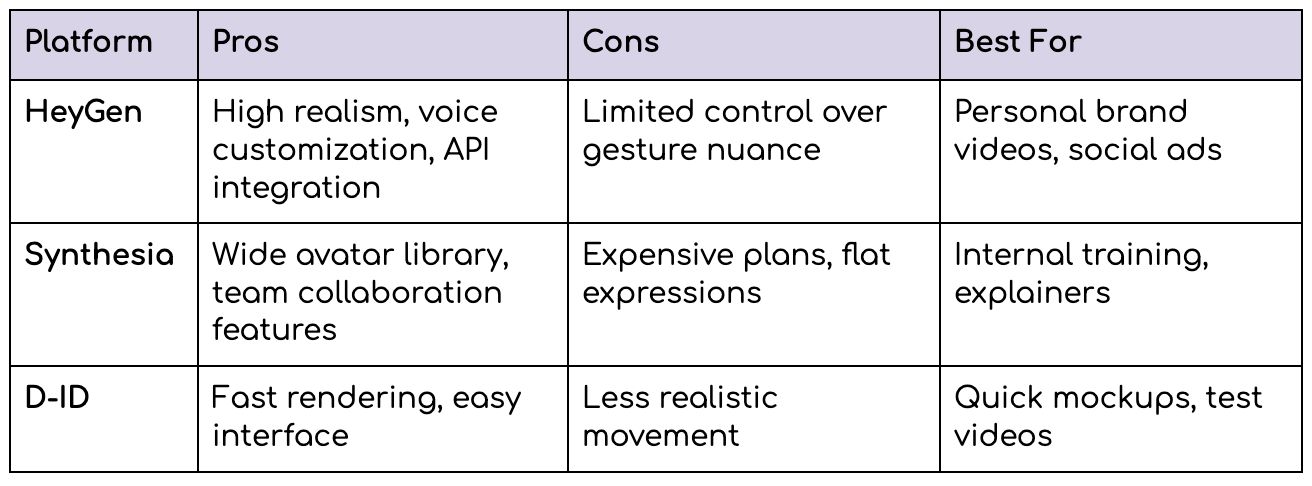 Many marketers pair these tools with Airtable (for planning), Descript (for script editing or dubbing), and Zapier (for automation). This creates a smooth, scalable pipeline — not just a novelty.
Final Thoughts
For digital marketers in 2024, AI avatars are not a gimmick — they’re a strategic tool. They allow us to lower costs, increase speed, and test more — while staying consistent with our brand.
But the key isn’t the avatar itself. It’s the system behind it. If you’re clear on who you serve, what message they need, and how to deliver it — then AI becomes a multiplier, not a shortcut.
Used wisely, it’s not just cheaper content. It’s better marketing.
References
- WordStream. (2023). Google Ads Benchmarks.
- Gartner. (2023). Top Strategic Predictions for 2024 and Beyond.
- HubSpot. (2023). State of Marketing Report.
- Content Marketing Institute. (2023). What’s Next in Content Marketing.