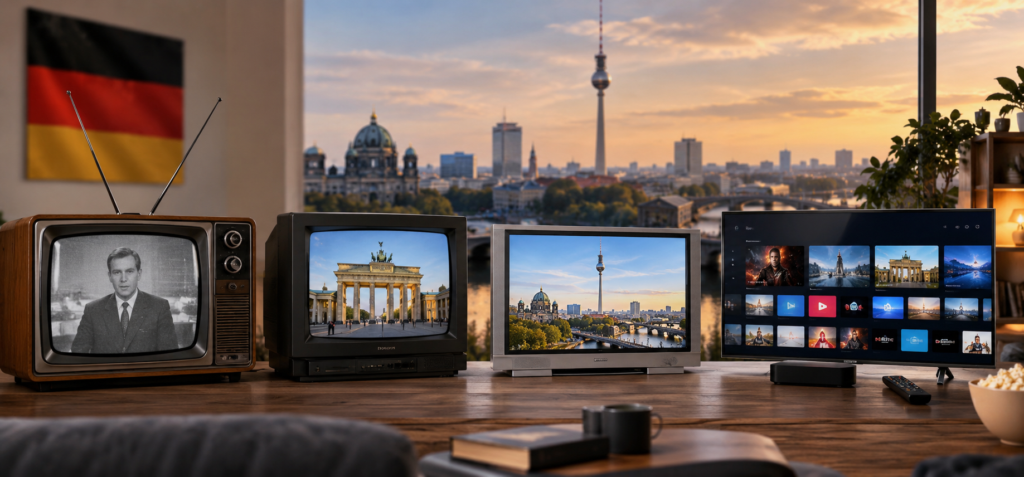
In 1952, German families gathered around a single flickering screen to watch the country’s first television broadcast on ARD. There was one channel, one schedule, no choice.
Seventy years later, German households can access thousands of channels, on-demand libraries, and live sport — streamed directly through their internet connection. The journey between those two moments is one of the most dramatic media transformations in modern European history.
The Public Broadcasting Era (1952–1984)
ARD launched as a federation of regional broadcasters — a deliberate structure designed to prevent any single entity from controlling German media after WWII. ZDF followed in 1963 as a second public channel. Colour television arrived in 1967 via the PAL standard. For over 30 years, these two channels defined what it meant to watch TV in Germany. Every evening, millions sat down for the 8 PM Tagesschau — a ritual that still exists today.
Private TV and the Satellite Boom (1984–2000)
SAT.1 and RTL broke the monopoly in January 1984. Commercial television brought American series, advertising-driven programming, and real competition for the first time. Satellite TV then multiplied the choice to 100+ channels by the 1990s. Pay TV arrived with Premiere (now Sky), built largely on Bundesliga rights. The concept of paying for television beyond the mandatory Rundfunkgebühr was controversial — but it worked.
Digital, HD, and the Streaming Transition (2000–2020)
Germany switched to digital terrestrial TV (DVB-T) earlier than most European countries, starting with Berlin in 2003. HD broadcasts launched in 2010. Netflix arrived in 2014 to a cautious reception — slower broadband infrastructure and deep-rooted linear TV habits slowed adoption. But by 2019, nearly 60% of Germans consumed at least some content via streaming, according to the Hans-Bredow-Institut.
IPTV: The Current Reality (2020–Today)
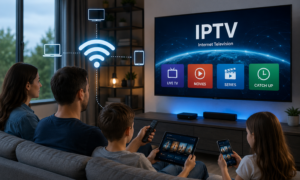
The COVID lockdowns accelerated five years of change into twelve months. IPTV — television delivered over a broadband connection — became the dominant infrastructure model. Telekom, Vodafone, and 1&1 restructured their entire TV offerings around it. Third-party IPTV providers also grew, offering large international channel packages at competitive prices. For households looking to navigate the current landscape, Bestes Germany IPTV provides an independent, regularly updated guide to the German market.
From one channel in 1952 to a fully IP-based ecosystem today — German television did not just evolve. It was rebuilt from scratch, twice over.