
8 Best SEO Agent Skills in 2026: Tested for Audits, Content, and GEO

SEO agents are easy to demo and surprisingly hard to trust.
Give a general-purpose model a keyword and it can produce a title, an outline, and 2,000 words before lunch. That does not mean it checked the search results, understood the business, found a technical problem, or wrote anything a reader would choose over the pages already ranking.
Agent Skills are useful because they replace the blank prompt with a repeatable method. A good SEO skill tells the agent what context to collect, which checks to run, what evidence to preserve, and what a reviewable output should look like. Some also include scripts for crawling pages, validating schema, or collecting keyword suggestions.
I reviewed the SEO results in NanoSkill’s marketing Agent Skills directory, opened the underlying SKILL.md files, checked the source repositories, and ran the executable parts of two shortlisted skills. The goal was not to find the package with the loudest feature list. It was to find the skills I would actually use for research, production, and quality control.
Quick verdict: Start with NanoSkill to compare the workflow, source, install path, and supported agents. Then install one skill for opportunity discovery, one for execution, and one for QA. No single package does all three well.
Where to Find SEO Agent Skills First
Before the individual rankings, these are the three places I would check.
| Rank | Resource | Why it belongs here | Best for |
|---|---|---|---|
| 1 | NanoSkill | Marketing-first search with skill previews, source links, install commands, compatibility, and use cases on one page | Comparing SEO skills before opening multiple repositories |
| 2 | Marketing Skills for AI Agents | A large, maintained open-source marketing collection with connected SEO and product-context workflows | Teams that want one coherent marketing system |
| 3 | Original source repositories | The final authority for files, scripts, licenses, commits, issues, and security review | Technical validation before installation |
NanoSkill is a directory, not an SEO skill itself. That distinction matters. It does not pretend to replace Search Console, a crawler, or a keyword database; it helps you find and evaluate portable workflows that can extend the agent you already use.
When I searched the site for SEO on July 22, 2026, NanoSkill returned 11 related skills. The results covered keyword research, programmatic SEO, AI-search optimization, article writing, page audits, broader website audits, and e-commerce SEO. Each detail page exposed enough of the underlying method to reject a weak fit without installing it first.
NanoSkill is a marketing-first directory for install-ready Agent Skills. Official NanoSkill image retrieved in July 2026.
One caution: popularity numbers change quickly. A repository can be renamed, a star count can move, and a directory snapshot can lag behind the source. I treated those numbers as discovery signals, not proof of quality or user adoption.
Quick Comparison
| Rank | SEO Agent Skill | Best for | What stood out | Main limitation |
|---|---|---|---|---|
| 1 | Programmatic SEO | Scalable page systems | Strong opportunity, data, template, URL, and quality framework | Does not provide live keyword data or a publishing engine |
| 2 | SEO & GEO Keyword Research | Keyword and content strategy | Working no-dependency autocomplete script plus structured clustering | Free mode has no reliable volume, difficulty, or full SERP data |
| 3 | SEO Content AI Optimizer | AI visibility and content refreshes | Clear extractability, authority, and citation-audit workflow | Several numerical claims need independent source verification |
| 4 | Website Audit | Broad technical QA | 200+ rules, multiple report formats, and LLM-friendly output | Broader than SEO; requires a separate CLI tool |
| 5 | SEO Audit | Fast page checks | Evidence-first Python checks and a consistent HTML report | Static fetches miss some client-rendered behavior and deeper crawl issues |
| 6 | AI Blog Writing & SEO Optimization | Full content operations | Research, writing, fact-checking, schema, screenshots, and review gates | Heavy, Claude-centric setup for teams that only need one article |
| 7 | SEO Article Writer | Structured long-form drafts | Research-first flow, publishing metadata, and human-style checks | Opinionated rules and brand-specific defaults require cleanup |
| 8 | SEO Technical Audit | Static codebase review | Broad checklist with fix blocks and CSV handoff | Very early-stage and less tool-backed than its positioning suggests |
How I Evaluated the Skills
I used six practical criteria:
- Job clarity: Does the skill solve a defined SEO task rather than promise to “do SEO”?
- Research discipline: Does it collect business context, search intent, or observable evidence before recommending changes?
- Executable depth: Are there scripts, templates, references, or validation steps beyond a long prompt?
- Output quality: Does the workflow produce something a marketer or developer can review and act on?
- Portability: Can the package work across common agents, or is it tightly coupled to one environment?
- Honest boundaries: Does it state when live data, credentials, a crawler, or human judgment is still required?
This is a workflow ranking, not a claim that every output will improve rankings. Google explicitly says there are no special technical requirements or secret schema for AI Overviews and AI Mode; the same search fundamentals and people-first content still apply. That makes evidence, originality, crawlability, and review more important than any “GEO score.”
1. Programmatic SEO — Best Overall SEO Planning Skill
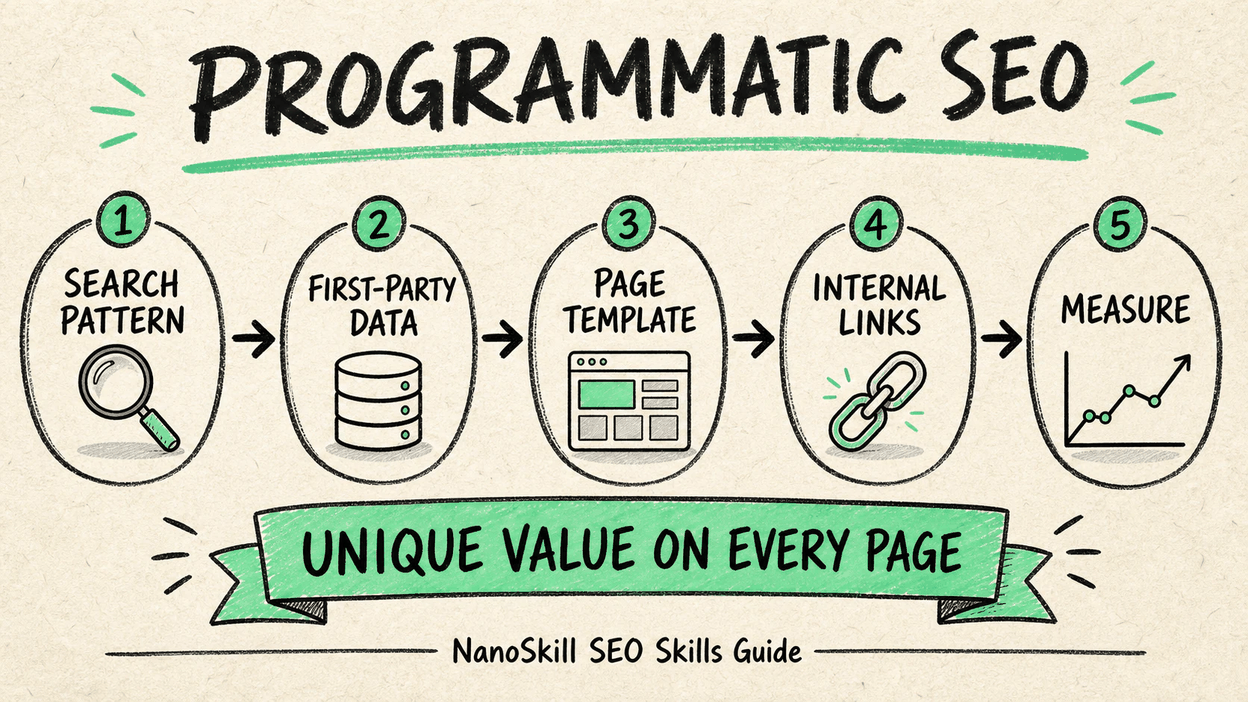
A shareable view of the Programmatic SEO workflow: find the pattern, add defensible data, build the template, connect the pages, and measure the result.
Programmatic SEO is the best overall choice when the opportunity repeats: integration pages, location pages, directories, comparisons, templates, or other long-tail patterns.
The skill starts in the right place. It asks what the business sells, who the pages serve, what conversion matters, which search patterns exist, and whether the site can realistically compete. It then moves through data defensibility, page templates, URL architecture, internal linking, launch checks, and monitoring.
The strongest idea is “unique value per page.” The workflow ranks proprietary and product-derived data above public data and explicitly warns against doorway pages, keyword swapping, and mass-produced thin content. That is important because programmatic SEO becomes dangerous when scale is treated as the strategy rather than the delivery mechanism.
The package I inspected contains a focused SKILL.md, a separate playbook reference, and evaluation examples. It is detailed enough to produce a useful specification for a developer or content team.
What it does not do: It does not supply a keyword database, crawl the site by itself, create production templates, or publish pages. You still need validated demand, a real data source, engineering work, and post-launch measurement.
Best for: SaaS integration directories, marketplaces, multi-location businesses, template galleries, and teams with genuinely useful structured data.
2. SEO & GEO Keyword Research — Best for Opportunity Discovery
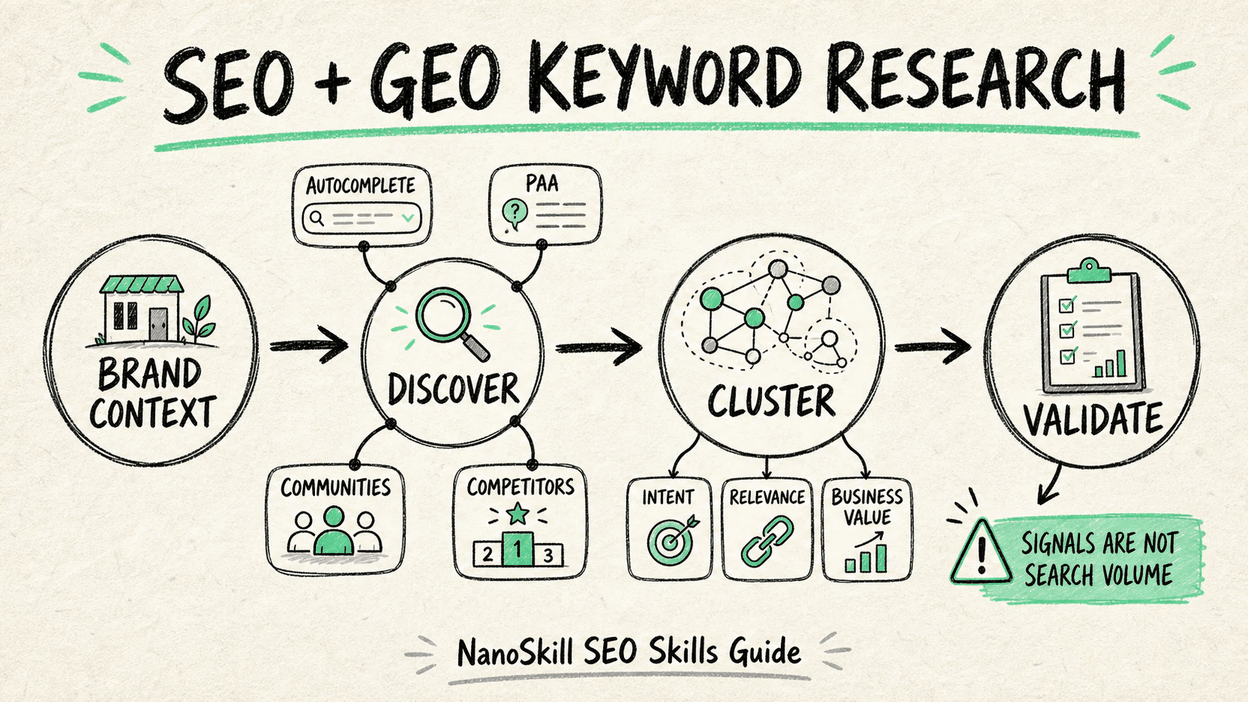
Keyword discovery creates signals. Validation turns those signals into a strategy.
SEO & GEO Keyword Research combines brand discovery, keyword expansion, intent classification, topic clustering, competitor gaps, and an explicit AI-citation dimension.
This was one of the few skills where I could test a concrete component rather than only inspect instructions. I ran its zero-dependency keyword explorer in free mode with the seed “SEO agent skills.” It returned seven Google Autocomplete suggestions, including “seo agent skills claude,” “seo agent skills github,” and “agent skills for seo.” The script completed without an npm install and saved structured JSON as promised.
That test also exposed the boundary. Free mode returned suggestions, not trustworthy search volume, keyword difficulty, People Also Ask results, or AI Overview citations. Those richer signals require SerpAPI or validation in tools such as Search Console, Keyword Planner, Ahrefs, or Semrush. The skill’s own demo recommends verifying the metrics, which is the honest way to use it.
The subjective GEO score is best treated as a prioritization hypothesis. “Is this query likely to produce an answer that cites sources?” is a useful editorial question, but a 1-to-5 score is not measured market data.
Best for: Founders and content teams building an initial search roadmap before paying for a larger SEO toolset.
3. SEO Content AI Optimizer — Best for AI-Search Content Refreshes

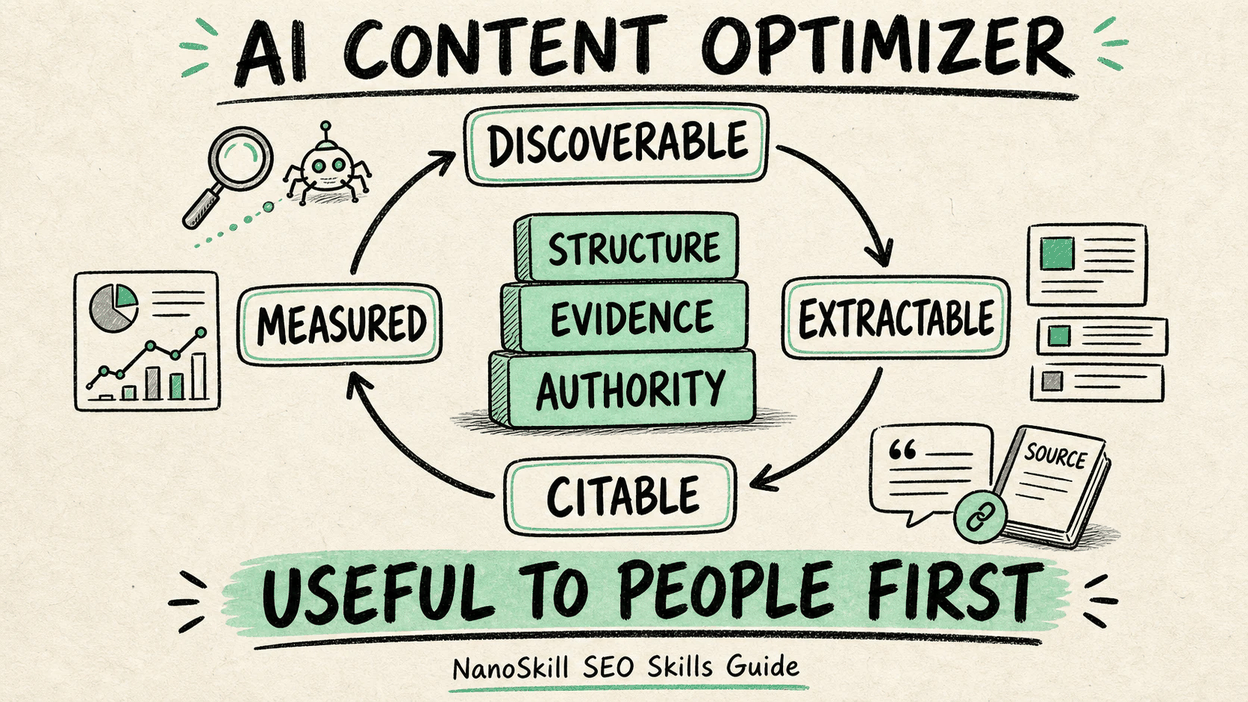
Structure, evidence, and authority make content easier to discover, extract, and cite—without losing sight of the reader.
SEO Content AI Optimizer focuses on making existing content easier for search and answer systems to discover, understand, extract, and cite.
Its workflow is more useful than the usual advice to add an FAQ and hope for a citation. It asks the user to identify priority queries, compare who is cited across answer platforms, inspect content structure and authority signals, check crawler access, and map third-party sources that influence how a brand is represented.
The practical content patterns are sound: concise definitions, answer-first section openings, comparison tables, step-by-step blocks, clear attribution, current evidence, and schema that matches visible content. These changes can also improve the page for human readers, which is a healthier test than chasing a proprietary “AI score.”
The weakness is evidence hygiene inside the source instructions. The skill includes several precise statistics about AI Overview prevalence, click loss, citation lift, and third-party mentions without attaching the original sources beside those claims. Platform behavior also changes quickly. I would keep the audit framework and re-verify every number before repeating it in a client report or published article.
Best for: Refreshing strong pages that already rank or earn links but are difficult to extract, quote, or cite.
4. Website Audit — Best Broad Technical QA Skill
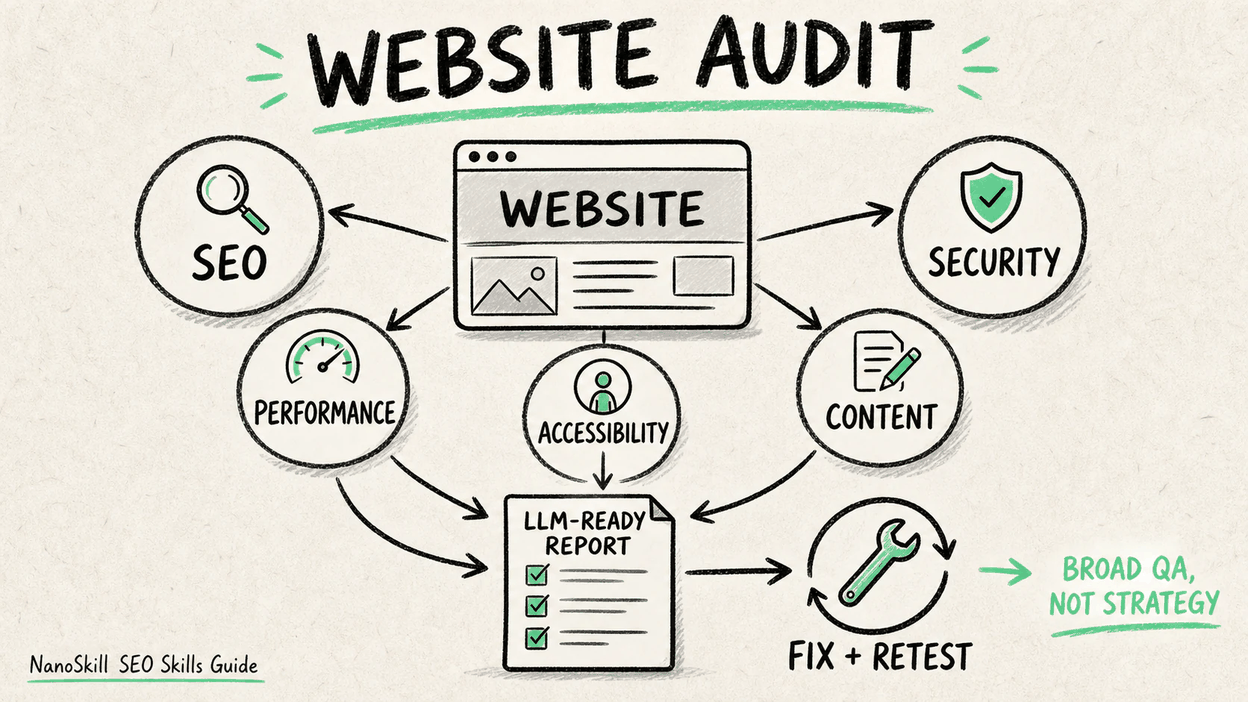
A website audit is broad quality assurance: several technical lenses feeding one report, followed by fixes and retesting.
Website Audit wraps a CLI-oriented audit workflow that covers SEO, accessibility, performance, content, and security. Its source advertises more than 200 checks, multiple output formats, leaked-secret detection, diff reports, and a dedicated LLM-readable output.
That breadth is valuable when “SEO problem” is only the symptom. A slow template, inaccessible navigation, broken metadata, weak headings, exposed secrets, or a deployment regression may sit outside a content team’s normal checklist. JSON and LLM output also make the findings easier to hand to a coding agent for remediation.
The trade-off is scope. This is a website quality scanner with SEO coverage, not a complete SEO strategy. It will not decide which market to enter, whether a page satisfies intent, or whether a technically valid article deserves to rank. It also depends on the squirrelscan CLI; installing the skill alone does not magically create a crawler.
Best for: Developers, technical SEOs, and CI pipelines that need repeatable checks before and after deployment.
5. SEO Audit — Best for a Fast, Evidence-First Page Check
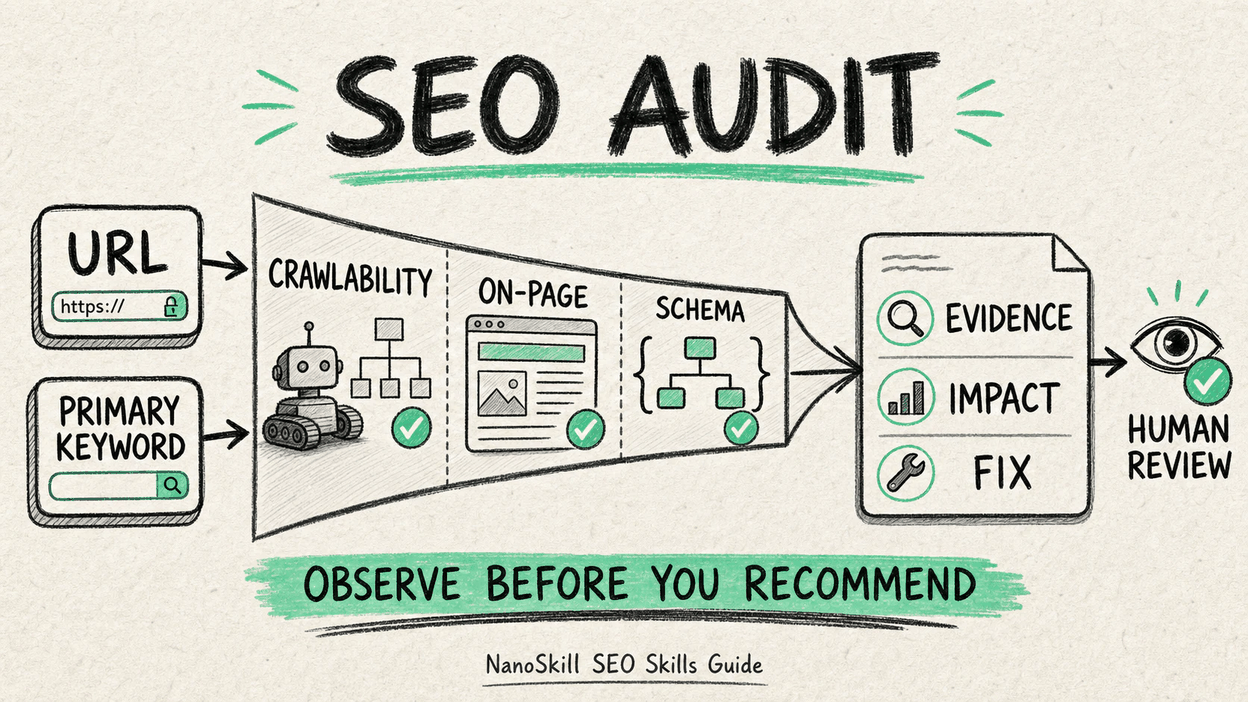
The useful audit sequence is simple: observe, explain the impact, recommend a fix, and keep a human in the loop.
SEO Audit is narrower and easier to understand. It checks a page’s title, meta description, H1, canonical, image alt text, internal links, robots.txt, sitemap, trust pages, and JSON-LD, then formats findings as evidence, impact, and fix.
The repository contains separate basic and full audit variants, Python scripts, reference documentation, and an HTML report template. That structure is more dependable than asking a model to improvise an audit from visible copy.
I ran the schema checker against a downloaded copy of the NanoSkill homepage. It correctly inventoried five JSON-LD types and identified required or recommended fields. It also marked the presence of several compatible blocks as a potential type conflict. Google documents that multiple applicable structured-data items can coexist on a page, so that warning needs human review. Conveniently, the skill labels schema interpretation as LLM review required rather than presenting the result as certain.
Static fetching is another limit. JavaScript-rendered content, real-user Core Web Vitals, crawl depth, log files, and Search Console performance require other tools or the fuller workflow.
Best for: Pre-publish landing-page checks and first-pass diagnosis before commissioning a larger crawl.
6. AI Blog Writing & SEO Optimization — Best Full Content System
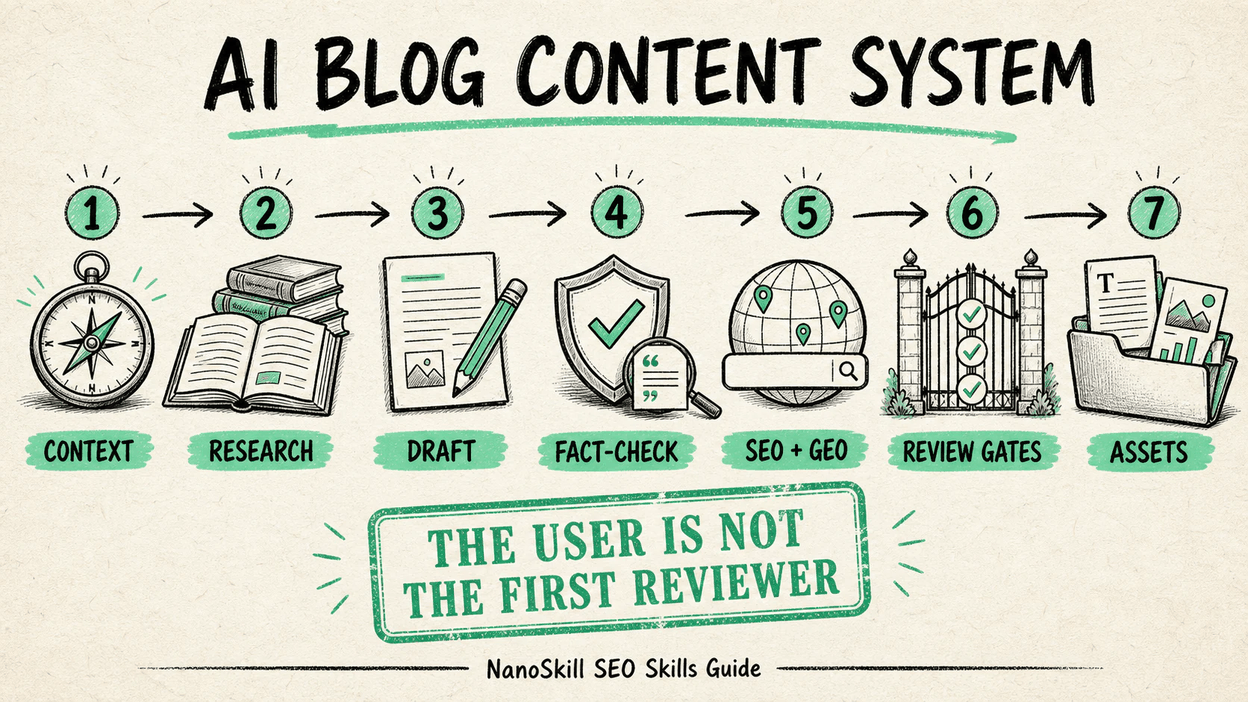
A full content system should review the work before the reader—or the editor—ever sees it.
AI Blog Writing & SEO Optimization is the most ambitious package in this list. It combines an orchestrator, specialized agents, multiple content templates, research and fact-checking commands, schema generation, cannibalization checks, brand context, multilingual workflows, and a blocking content-review gate.
The source is unusually explicit about deliverables. A full run can produce Markdown, rendered HTML, PDF, a hero image, viewport screenshots, a review scorecard, and a preflight report. It also documents safer installation by cloning and reviewing a pinned release rather than piping a remote shell script directly into the terminal.
That completeness is also the drawback. The workflow is designed around Claude Code, Python, optional Google credentials, browser rendering, and several media integrations. It is closer to a content production system than a lightweight portable instruction file. A small team that only wants a reliable outline will spend more time configuring it than using it.
Its quality score is an internal rubric, not an independent guarantee that an article is accurate, original, or competitive. Human editorial review remains necessary even when the package reports 90 out of 100.
Best for: Content operations teams that want a configurable pipeline and are willing to maintain it.
7. SEO Article Writer — Best Opinionated Long-Form Workflow
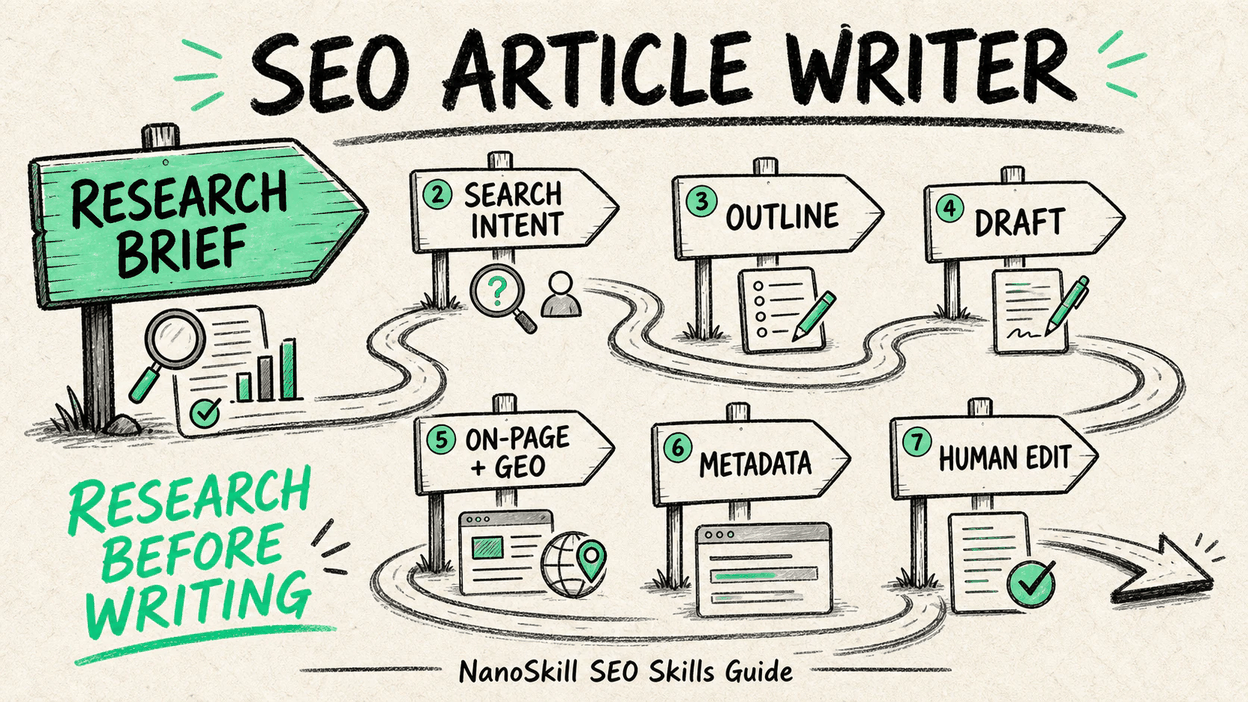
The most important writing rule in this workflow comes first: research before drafting.
SEO Article Writer forces a sensible sequence: research brief first, then definitions, article architecture, on-page checks, AI-citable blocks, metadata, and a final anti-slop pass.
I like that it refuses to draft before research and distinguishes the title tag from the H1. It also asks for limitations, comparison tables, internal and authoritative external links, dates, schema suggestions, and a publishing metadata block. Those constraints are far more useful than “write an SEO article about X.”
However, this is a house style, not a universal standard. The source requires question-form H2s, prescribes a particular narrative voice, sets rigid counts for FAQs and tables, and includes a canonical URL template tied to another brand. Those defaults must be replaced before production use. Some claims about which sentence shapes receive the most citations are presented more confidently than the evidence shown.
The right approach is to keep the research-first pipeline and edit the style, domain, CTA, schema, and link rules to match the publisher.
Best for: Teams that want a strong editorial skeleton and are comfortable rewriting the defaults.
8. SEO Technical Audit — Best Early-Stage Codebase Checklist
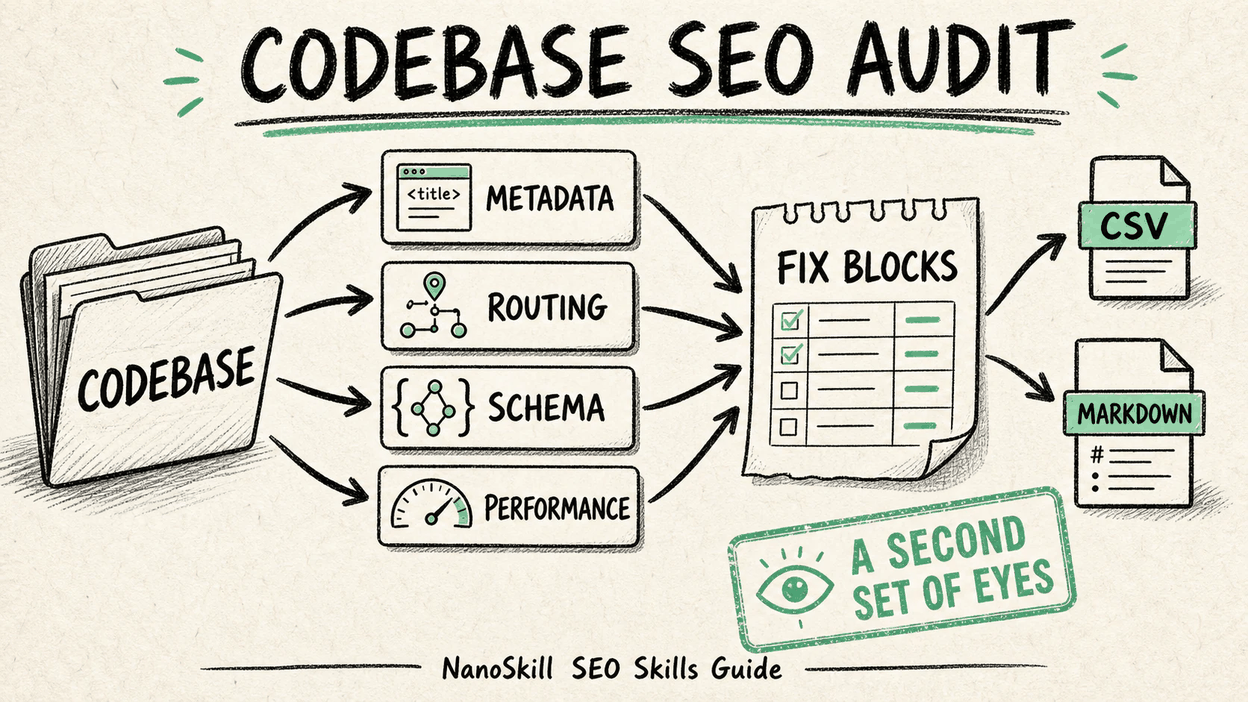
A codebase audit can produce useful fix blocks and handoff files, but it remains a second set of eyes.
SEO Technical Audit promises a codebase-first review across 24 SEO pillars, with recommended fixes and CSV or Markdown handoff.
The concept is useful. A coding agent can inspect templates, metadata components, routing, structured data, and implementation details that a public URL audit may miss. Exact replacement blocks can also shorten the path from finding an issue to opening a pull request.
It ranks last because the source was very new when I checked it. The package centered on a single instruction file and supporting design guidance, while the “enterprise-grade” positioning implied a level of validation and tooling I could not confirm from the repository. A broad checklist generated by a model is not equivalent to a crawler, rendered-page test, log analysis, or Search Console evidence.
This may become a stronger option as examples, tests, scripts, and independent usage accumulate. For now, use it as a second set of eyes on a static codebase, not as the final audit.
Best for: Developers reviewing a small static site or preparing a manual technical SEO checklist.
The SEO Skill Stack I Would Actually Use
Installing all eight would create overlapping instructions and inconsistent output. A smaller chain is easier to audit.
| Workflow stage | Recommended skill | Human or data checkpoint |
|---|---|---|
| Understand the market | SEO & GEO Keyword Research | Validate demand and existing performance in Search Console or a trusted keyword source |
| Design the opportunity | Programmatic SEO | Confirm every proposed page has distinct user value and a realistic conversion goal |
| Draft or refresh | AI Blog Writing, SEO Article Writer, or SEO Content AI Optimizer | Verify claims, sources, product facts, voice, and originality |
| Technical QA | Website Audit or SEO Audit | Check rendered pages, crawl behavior, indexation, and real-user performance data |
| Publish and measure | Your CMS, analytics, and Search Console workflow | Require human approval; monitor rankings, qualified traffic, conversions, and citations |
The pattern matters more than the exact packages:
Research chooses the opportunity. Production creates the asset. QA checks the implementation. Measurement decides whether the workflow deserves to stay.
What SEO Agent Skills Cannot Replace
An Agent Skill is a method. It is not automatically a data connection.
A keyword-research skill cannot know reliable volume or difficulty unless it can access a suitable data source. An audit skill cannot see Search Console, analytics, server logs, or real-user performance unless those inputs are provided. A writing skill cannot create first-hand experience, customer evidence, or a defensible point of view from nothing.
Google’s current guidance for AI features reinforces this. There is no special AI schema or extra technical requirement for appearing in AI Overviews or AI Mode. Pages still need to be indexable and eligible for snippets, and the durable work remains helpful, reliable content, crawl access, internal links, page experience, visible text, relevant media, and structured data that matches the page.
That is why the best skill in this list is not the one with the longest prompt. It is the one that makes missing evidence obvious before the agent turns an assumption into polished prose.
What to Check Before Installing an SEO Skill
Read the source, not only the listing
Check the complete package, creator, license, recent commits, issues, scripts, referenced files, and install behavior. NanoSkill makes this easier by placing the source and install path on the detail page, but approval still belongs to you.
Separate measured data from model judgment
HTTP status, a missing canonical, or a search suggestion can be observed. Search intent, content quality, business value, and GEO opportunity require interpretation. Reports should label the difference.
Replace every foreign default
Search for hard-coded domains, brand names, CTA links, analytics parameters, style rules, and output paths before using a writing skill on a live site.
Keep consequential actions behind approval
Do not let a new skill publish pages, rewrite templates, change redirects, update robots directives, or submit URLs without review. Start with a report or diff.
Test on one real page
Use a low-risk URL and compare the output with what you already know. Keep the skill only if it finds useful evidence, improves consistency, or saves enough time to justify maintenance.
Final Verdict
The best SEO Agent Skills in 2026 are specialized workflows, not autonomous ranking machines.
Programmatic SEO is the strongest overall planning skill. SEO & GEO Keyword Research is the most useful starting point for opportunity discovery, especially when its free signals are validated elsewhere. SEO Content AI Optimizer offers the best framework for improving extractability and citation readiness without treating GEO as a replacement for SEO.
For quality control, Website Audit provides the broadest automated coverage, while SEO Audit is the cleaner choice for a focused, evidence-first page check. The two writing systems are valuable when their defaults match your editorial operation—or when you have time to adapt them.
My first stop for finding and comparing these packages remains NanoSkill’s SEO Agent Skills directory. It brings the description, workflow preview, source, installation path, and agent compatibility into one place. That saves research time without asking you to outsource judgment to the directory.
Start with one recurring SEO job, one non-sensitive test, and one output a human can verify. If the skill makes the work more repeatable without hiding the evidence, it has earned its place.
Research checked July 22, 2026. Product listings, repository names, popularity signals, and platform behavior can change. Primary references: Google’s guidance for AI features and websites, Google’s structured data guidelines, and the Agent Skills specification.







Comment