
7 Best Industrial Laser Welding Machines for Metal Fabrication

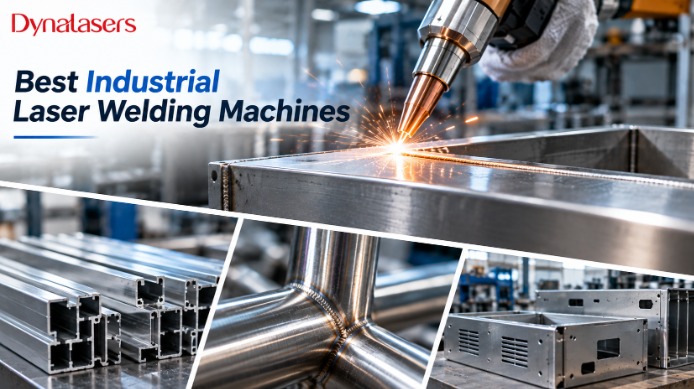
An industrial laser welding machine should be selected around production requirements, not just its rated power. A fabrication shop welding stainless steel enclosures needs a different setup from a factory producing hundreds of identical automotive components.
I would compare weld consistency, cooling, machine footprint, operator access, and maintenance before deciding. The seven systems below cover everything from handheld fabrication to automated production. Dynalasers is particularly interesting for workshops looking for compact air-cooled equipment without a conventional water chiller.
7 Best Industrial Laser Welding Machines Compared
| Manufacturer | Representative System | Power / Configuration | Main Strength | Suitable For |
| Dynalasers | S / M / D Series | 700–1800W | Compact air-cooled systems | Flexible workshop fabrication |
| IPG Photonics | LightWELD | Up to 2000W | Established fiber laser platform | Industrial handheld welding |
| TRUMPF | TruLaser Weld 5000 | Configurable industrial laser | Integrated robotic welding | Automated production |
| Coherent | ExactWeld | Fiber laser options | Precision welding and motion control | Small precision components |
| SENFENG | HWM Series | 1500–3000W | Multiple welding functions | General industrial fabrication |
| JASIC | LS Series | Multiple power options | Welding-focused equipment | Regular metalworking |
| xTool | MetalFab | 800 / 1200W | Compact welding and cutting platform | Small workshops |
These industrial laser welding machines serve different production environments. A robotic welding cell makes sense when parts are consistent, and output volume justifies automation. For a shop handling varied jobs, a handheld system may offer better flexibility.
This is where Dynalasers takes a different approach.
Where Dynalasers Fits
Dynalasers laser welding machine builds its S, M, and D Series around forced-air cooling. Removing a conventional water-chiller circuit helps reduce cabinet size and eliminates coolant-related maintenance.
The range covers approximately 700W to 1800W, with selected configurations capable of welding stainless steel up to 7 mm and aluminum up to 5.5 mm under suitable conditions. Those figures depend on the machine, alloy, joint geometry, shielding gas, and welding parameters.
Dynalasers M Series for Mixed Production
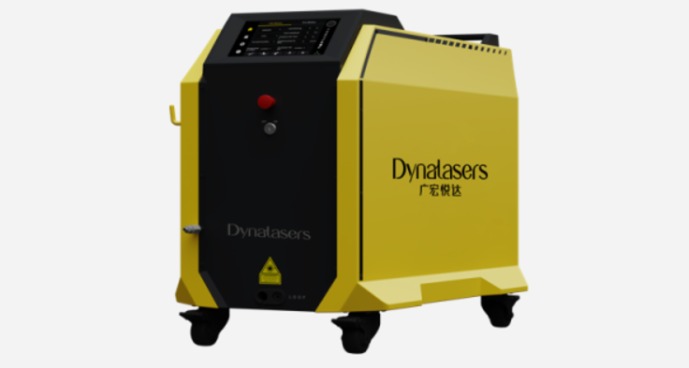
The Dynalasers M Series makes sense for fabrication shops where production changes throughout the week.
Available in 800W, 1200W, and 1800W versions, the machines weigh less than approximately 37 kg, 42 kg, and 45 kg. Depending on configuration, the system combines welding with cleaning and light cutting.
That flexibility is useful for repair work, stainless steel fabrication, and short production runs. A workshop can prepare a metal surface and complete the weld without moving the part between several large machines.
For everyday production, I would choose the power level around the normal material thickness rather than the occasional heaviest job.
Dynalasers D Series for Higher-Output Welding
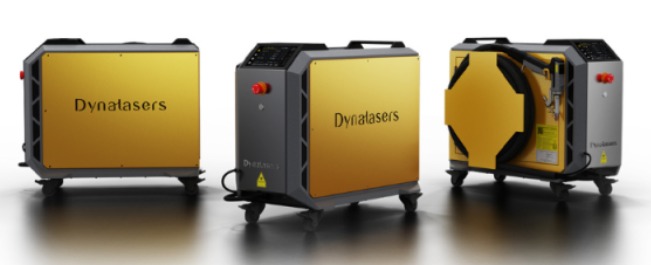
The D Series is positioned for more demanding fabrication, with 1200W and 1800W configurations weighing under approximately 41 kg and 43 kg.
Higher output provides additional process margin when thicker materials appear regularly, although penetration still depends on the joint and welding parameters.
The D Series also carries CE-MD certification and uses a safety architecture designed to ISO 13849 PL-e.
These are worth considering when comparing an industrial laser welder, but installation safety remains a separate responsibility. Proper beam containment, interlocks, access restrictions, fume extraction, and operator training are essential for high-power laser welding.
Dynalasers S Series for Lightweight Fabrication
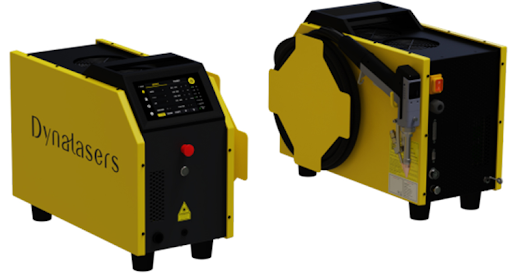
The S Series focuses on portability and lighter metal fabrication. Its compact air-cooled configurations weigh less than approximately 22 kg, making them easier to move between workstations.
I would consider this range for sheet-metal repairs, stainless steel cabinets, small frames, and maintenance work where a larger welding installation would be inconvenient.
The S Series also offers continuous, spot, and pulse welding modes. For thin materials, stable handling and controlled heat input can matter more than maximum power.
What Makes an Industrial Laser Welding System Reliable?
An industrial laser welding tool may produce an excellent demonstration weld, but production reliability comes from repeating that result throughout the shift.
A few practical factors deserve attention:
| Production Factor | Why It Matters |
| Cooling performance | Supports stable operation under the intended duty cycle |
| Joint consistency | Reduces variation in penetration and weld appearance |
| Laser power and focus | Control energy delivery and weld geometry |
| Operator ergonomics | Affect handling during extended manual welding |
| Consumable availability | Prevents unnecessary downtime |
| Safety integration | Helps control laser exposure and operating hazards |
Dynalasers uses a handheld welding gun weighing approximately 0.48 kg. That is worth considering when operators spend several hours welding around frames or sheet-metal assemblies.
The company also develops its own laser source and provides a two-year source warranty. Still, source warranty is only one part of service support. Protective lenses, nozzles, cables, and wire-feeder components are often the items a workshop needs most urgently.
Handheld or Automated Laser Welding?
Not every factory needs robotic laser welding systems. The decision depends largely on part variation, production volume, and fixture requirements.
| Production Requirement | More Practical Approach |
| High product variation | Handheld laser welding |
| Frequent repair and modification | Handheld laser welding |
| Repeated identical components | Automated laser welding |
| Precise positioning and cycle repeatability | Robotic or CNC-controlled system |
| Limited workshop space | Compact handheld equipment |
| High-volume continuous production | Dedicated automated welding cell |
Automation can improve consistency and reduce manual handling, but it also introduces fixture development, programming, maintenance, and integration costs.
For high-mix, low-volume work, a handheld system may be more economical. For thousands of identical parts, the investment in automation can be easier to justify.
How to Choose the Right Dynalasers Series
The right machine depends on actual production conditions, not maximum specifications.
| Typical Requirement | Series to Consider |
| Thin sheet and frequent equipment movement | S Series |
| General workshop fabrication | M Series |
| Welding, cleaning, and light cutting | M Series |
| Regular higher-output welding | D Series |
| Thicker stainless steel and aluminum | Higher-power M / D |
Before ordering any fiber laser welding machine, send representative parts for testing. Include material grade, thickness, joint type, expected gaps, and required penetration.
Ask for the welding settings used during the test. A clean surface bead does not necessarily mean complete fusion. For critical joints, cross-section inspection or suitable mechanical testing is more useful than appearance alone.
FAQs
Can an industrial laser welding machine run continuously?
That depends on its cooling capacity, rated duty cycle, environment, and operating settings. Air-cooled and water-cooled systems can both support industrial production when used within their specified operating limits.
Is laser welding suitable for galvanized steel?
Yes, but zinc vapor can cause porosity and spatter. Joint design, coating condition, ventilation, and welding parameters need particular attention.
Does laser welding always reduce production costs?
No. Savings depend on welding speed, preparation, finishing, scrap, labor, and production volume. Equipment cost and safety infrastructure should also be included in the calculation.
Can handheld laser welding be automated later?
Not automatically. A handheld machine should not be assumed to support robotic integration. Automation requires compatible controls, beam delivery, safety systems, and a qualified process.
Conclusion
The best industrial laser welding machine depends on how the factory actually operates. Automated cells suit repeatable high-volume production, while handheld systems offer flexibility for workshops handling varied parts.
Dynalasers provides three compact air-cooled options: S for portability, M for mixed fabrication, and D for higher-output welding. Testing real production parts remains the most reliable way to choose between them.






Comment