
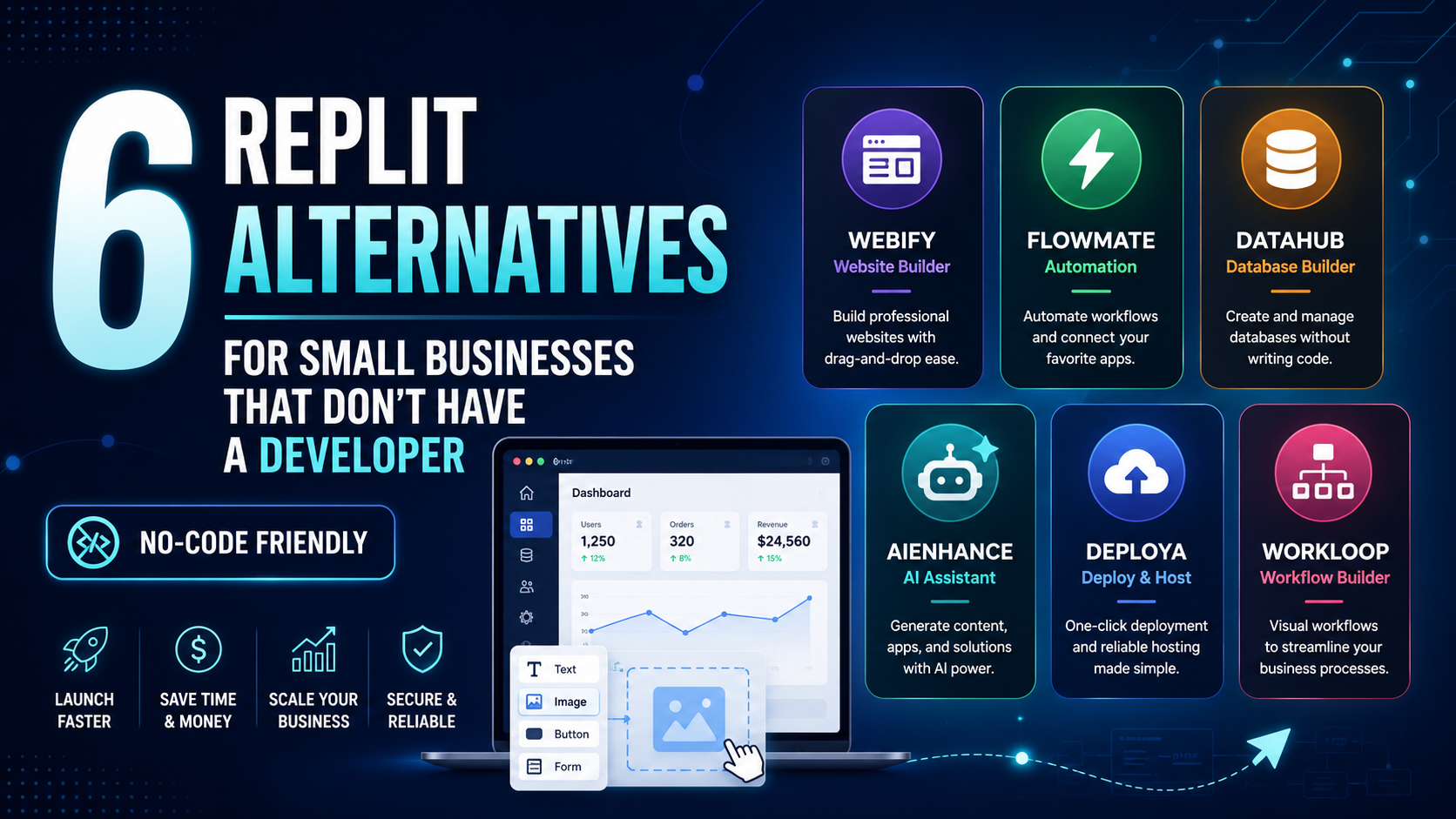
6 Replit Alternatives For Small Businesses That Don’t Have A Developer

A friend who runs a nine-person landscaping company called me last spring about the scheduling app her summer intern had built. It worked beautifully. Then the intern went back to school, a pricing rule changed, and nobody could find where that rule lived.
That call is why I field questions about Replit alternatives for small businesses roughly once a month. Replit is a good product.
It is also built for people who write code, and most small businesses hand this work to an ops manager who is excellent at spreadsheets. (She is not going to spend Tuesday night reading error logs.)
So, the short version: for a small business with no developer on staff, Zite is the strongest Replit alternative in 2026, because the app logic and the database underneath it stay visible and editable by whoever inherits them.
Where Replit stops fitting a small business
Replit is built for people who ship code, which makes it an awkward default for a company with nobody on payroll to do that.
Building the thing was never the hard part.
Any tool on this list can produce a working app in an afternoon, which is why the demo always goes well and the trouble shows up in month four, when a tax rate changes, a new hire needs access, and a customer asks for one more field on a form.
With a code-first tool, each of those becomes a ticket for someone who can read code. Without that person, the app sits there getting slightly wrong.
The other thing that catches small teams off guard is per-seat pricing. You pick a tool at eight employees and re-read the invoice at twenty.
What should a small business check before picking a Replit alternative?
I would narrow it to four questions, answered in this order.
Who fixes it in month four. Name an actual person. If you cannot name one, pick the tool that three people on your team could learn.
What happens at twenty employees. Some platforms charge per seat and some charge flat, and that gap compounds over two years into money you would rather have spent on an actual hire.
Where the data lives. An app is a window onto a database. If you cannot open that database and read the rows yourself, you are one bad afternoon away from being locked out of your own records, which is a rough place to be for a company running its daily operations on the thing.
Whether you can hand it over. Ask how a new employee takes ownership. If the answer involves hiring a developer, price that in.
Zite: when nobody on your team writes code
Describe the app you need and it builds the interface and the database together, tables and fields included.
The part that matters for a handoff is what you get afterward. The AI generates the workflows behind your app, and the visual editor lets you open those workflows and read them step by step.
Troubleshooting turns into following a flowchart, which is roughly the level of technical confidence a good ops manager already has.
The database looks spreadsheet-like on the surface with a real database underneath, so your team can browse and edit records without learning anything new.
Access control is built in. Apps stay internal to your organization by default with role-based permissions, and you publish externally when a client needs to log in.
Pricing as of July 2026 is $19 per month on the Pro plan billed monthly, and a free plan is available. Unlimited users and apps come on every plan including the free one, so growing from eight people to thirty does not change the bill.
The honest limits: it is a newer platform, so the template library is thinner than Bubble’s, and there is no code export if you later want to take the build elsewhere. Background automations are also still limited, so scheduled jobs and outside triggers are not there yet.
Cursor: for the small business that already has a developer
Cursor is the best Replit alternative for a small business that already employs someone who writes code.
It is a code editor with AI running through it, and it reads your existing project, which means your one developer moves faster on the software you already own.
The tradeoff is plain. Cursor assumes a reader of code, so it solves nothing for a team without one.
There is a free Hobby tier and the Individual plan runs $20 per month. Team billing is $40 per user per month, so headcount shows up directly on this invoice.
Lovable: prompt to app, with the code in your hands
Lovable turns a written description into a working web app and gives you the code, which suits a business that wants to keep its options open.
If you ever hire a developer or bring in an agency, there is something concrete to hand them.
Two cautions. The free plan runs on a credit allowance of around 30 credits a month, and paid usage is metered by credits too, so a heavy build week costs more than a light one.
And the output is still code. Somebody eventually has to read it.
Glide: the shortest path from spreadsheet to app
Glide is the fastest option if your business already runs on a spreadsheet.
Point it at your sheet and you get a usable mobile and web app on top of data your team already maintains.
The pricing model is where small businesses should look closely. There is a free plan with a single editor, and the Business tier includes 30 users and charges $6 for each additional user monthly, so a growing headcount is a growing bill.
The structural limit is the spreadsheet itself. Logic that needs real relationships between records gets awkward fast.
Bubble: when the app is the business
Bubble is the right answer when the software you are building is the actual product.
You get deep control over how the app behaves, a large plugin marketplace, and a decade of other people’s solutions to whatever you are stuck on.
You also get a real learning curve. Bubble has its own logic model, and getting fluent in it takes weeks, which means somebody’s job gradually becomes “the Bubble person.”
For a nine-person company that mostly needs a client portal, that is a heavy trade. For a startup whose entire business is the app, it is the correct one.
n8n: for the broken handoff between tools you already pay for
Sometimes the real problem is a gap between two systems that each work fine on their own.
n8n connects the tools you already use and moves data between them on a schedule or a trigger, with AI steps in the middle if you want them.
A free Community Edition is available to self-host, which makes it the cheapest option here if you have someone comfortable running it.
Two honest limits. Self-hosting needs a technical hand, and n8n gives your staff no interface to work in, so plenty of teams end up needing an automation layer and an app.
Who maintains a small business app after it ships?
This is the question worth settling before you sign up for anything.
Pick the owner first, by name, and tell them. An app with no named owner drifts within a quarter.
Then budget about an hour a month for it. Small business software rots when nobody opens it on purpose, and deliberate attention is usually enough to keep it healthy.
And be honest about the cases where none of this helps. If the underlying process is undefined, a builder will hand you a faster version of the same confusion.
Frequently asked questions
Do Replit alternatives charge per user?
Most of them do, and it is the cost small businesses underestimate most often. Glide’s Business plan includes 30 users and charges $6 for each additional user monthly, while Zite includes unlimited users and apps on every plan, including its free tier.
Can a small business build a customer portal without hiring a developer?
Yes, and a client portal is one of the most common first builds on no-code platforms. A builder with role-based permissions and a built-in database can produce a working portal in a day, though a week of internal testing before real customers log in is time well spent.
What happens to the app if the person who built it leaves?
It depends on whether the app’s logic is readable without them. Platforms that display workflows visually let a new owner trace what the app does, while platforms that output code require a successor who can read that code.
Is Replit still a reasonable choice for a small business?
Yes, if a developer or technical founder is actively involved. Replit’s coding environment is an asset when somebody writes code and a liability when nobody does.
Where this is heading
Every tool here will generate a working app from one sentence within about eighteen months, and that part is becoming table stakes.
The interesting competition is over the second year of an app’s life: whether a new hire can open it, understand what it does, and change one thing without breaking three others. That is a much harder problem than generation, and it is the one small businesses live with every day.
My prediction is that legibility ends up mattering more than raw generation speed, because speed buys you one good afternoon and legibility pays out every month for years.






Comment