Outdoor advertising in the United States reaches 330 million consumers across 46 states, on highways, in cities, at retail districts, and at airports. For brands that need to reach American consumers at scale, the channel case is straightforward.
The planning case is where many campaigns fall short. With over 316,000 billboard sites nationwide, the options for choosing an outdoor ad in the states are vast, and decisions made before a single site is booked can cause a campaign to underperform. These five principles close that gap.
1. Define your goals before choosing inventory
Why starting with inventory is a mistake
The biggest mistake in OOH planning is opening with inventory. Before you look at a single site, define what the campaign needs to achieve. Without a clear goal, site selection defaults to availability. None of those criteria has anything to do with whether the placement will actually reach the right people at the right moment.
Let the goal determine the placement
A brand building early awareness needs locations where large volumes of the right audience move every day. That is different from a brand driving purchase decisions, which requires proximity placements in locations where the audience has the time and ability to act.
Even though the budget and city are the same, these are completely different plans, and the difference starts with the goal. When the objective is clear, every placement decision has a reason.
2. Map where your audience moves
Real-world movement is mappable
Audiences move in predictable patterns. That predictability is outdoor advertising’s single biggest planning advantage. Unlike digital channels that rely on probabilistic audience modelling and cookie-based targeting, OOH reaches people in the physical spaces they actually occupy. The job of a good OOH plan is to map them accurately and place media inside them deliberately.
Place your media where behaviour happens
The fastest way to waste an OOH budget is to define your audience by demographics and then buy sites that look impressive. Your real targeting advantage is movement. Map arrival points, transit corridors, gathering locations, decision points, and dispersal routes. Place your outdoor media where it is most likely to influence behaviour at each stage.
3. Balance reach and frequency deliberately
A simple rule for planning reach and frequency
Let your objective decide which lever to lead with. If the goal is awareness and brand association, prioritise reach by distributing placements across major routes and multiple locations to reach more unique people. If the goal is recall, prioritise frequency by concentrating placements on the corridors your audience repeats, so they see the brand multiple times over the campaign window. If the goal is action, lean on frequency near decision points.
4. Keep creative simple enough to land in seconds
Most people glance at advertising
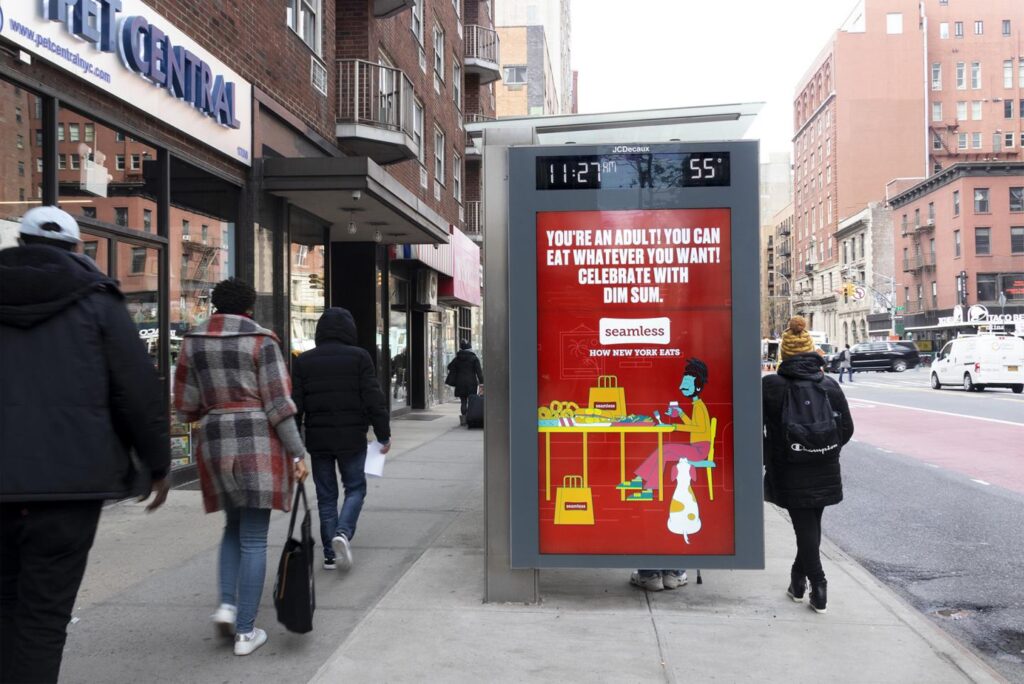
OOH lives in a fast-view world. Most people glance at outdoor ads while moving, talking, navigating, or arriving somewhere new. The average outdoor message is seen for only three to seven seconds. The best creative lands instantly, even when the audience is distracted.
Localised creative outperforms generic messaging
Outdoor messaging tailored to specific cities, languages, or cultural cues turns generic advertising into something that feels like it belongs in the moment. At a sophisticated level, it means aligning your messaging to the specific environment the placement sits in
5. Build measurement in before the campaign goes live
A strong OOH measurement plan has three layers. Proof of delivery, which is, did the campaign run as booked? Proof of audience, which is how many people could have seen it, and Proof of impact, which is what changed as a result?
Set your baselines before the campaign runs. Define what success looks like in terms of branded search uplift, web traffic, foot traffic, or brand recall, and then track against those benchmarks later on.
How an OOH finder helps
An outdoor advertising finder is a planning tool that maps available outdoor advertising inventory to your audience, market, and campaign objectives. An OOH finder lets you start with where your audience is and surface the inventory that matches.
That global scale matters because the best OOH strategies aren’t built market by market in isolation. An OOH finder backed by a network spanning global markets means your campaign isn’t planned in a vacuum
Conclusion
The five decisions covered here aren’t complicated. They’re just consistently skipped in favor of moving fast and buying early. Get them right and outdoor advertising becomes one of the most impactful channels in your media plan, reaching the audiences at the right frequency with creative simple enough to stick.