Airports have a way of turning even the calmest traveler into a frazzled mess. Between long security lines, surprise baggage fees, delayed flights, and the frantic hunt for an outlet at Gate B12, there are plenty of ways for a trip to start on the wrong foot. The good news is that a handful of well-chosen gadgets can take the edge off many of these headaches.
This is not a list of flashy tech you will use once and forget in a drawer. Each item below solves a specific, common airport problem, and each one earns its spot in your bag. Whether you fly twice a year or twice a month, these five tools can help you move through the terminal with a lot more confidence and a lot less tension.
- A Self-Weighing Carry-On With a Built-In Scale
Few moments are more stressful than standing at the check-in counter while an agent places your bag on the scale and the number flashes a few pounds over the limit. Suddenly you are kneeling on the terminal floor, pulling out shoes and sweaters, trying to redistribute weight into a tote bag while a line forms behind you. Overweight baggage fees can run anywhere from a modest charge to well over a hundred dollars, depending on the airline and route.
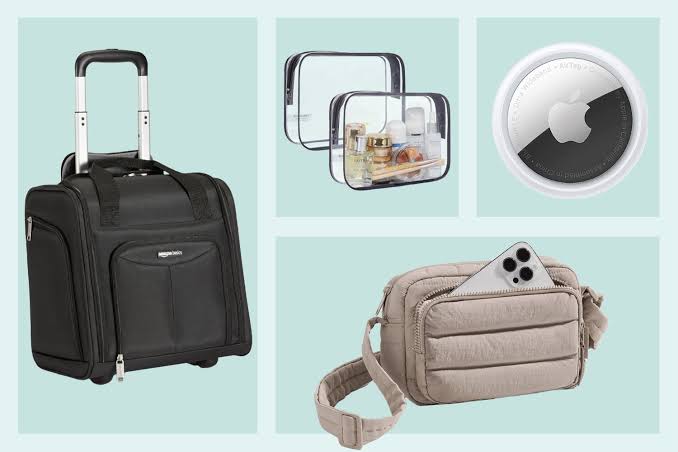
A self-weighing carry-on with a built-in scale solves this problem before you ever leave the house. The scale is integrated into the handle or body of the bag, so you can lift it for a second and read the weight on a small display. There is no need to balance on a bathroom scale while holding your suitcase, and no need to carry a separate hanging scale in your pocket.
Here is why this gadget deserves the top spot on the list:
- Instant feedback while packing: You can check the weight at any point, which makes it easy to decide what stays and what goes.
- Confidence at the airport: If you pick up a souvenir or a few extra items on the road, you can recheck your weight in the terminal before you reach the counter.
- Fewer fees: Avoiding even one overweight charge can pay for a big portion of the bag’s price.
- One less thing to carry: The scale is part of the luggage, so you are not adding another gadget to your packing list.
When shopping for a self-weighing carry-on with a built-in scale, keep a few things in mind. First, check that the bag’s dimensions fit the carry-on limits of the airlines you fly most often, since sizing rules vary between carriers and especially between domestic and international routes. Second, look at the bag’s empty weight. Hard-shell cases with heavy frames can eat up a big chunk of your allowance before you pack a single sock. Third, confirm how the scale is powered. Some use replaceable batteries, while others use a rechargeable cell, and you will want to know which one before you find yourself with a dead display. Finally, look for a model that lets you switch between pounds and kilograms, which is especially handy on international trips.
Many airlines enforce carry-on weight limits as well as size limits, particularly on international and budget carriers. Knowing your number ahead of time removes a common source of gate-side surprises.
- Bluetooth Item Trackers
Waiting at baggage claim as the carousel slows and the crowd thins is a special kind of dread. Lost or delayed luggage is not an everyday event, but when it happens, the worst part is often the uncertainty. Is the bag still at the origin airport? Did it make the connection? Is it sitting on a cart somewhere in another city?
A small Bluetooth tracker tucked inside your suitcase can replace that uncertainty with information. These coin-sized devices connect to an app on your phone and can show the approximate location of your bag on a map. Popular options work with the location networks of major phone ecosystems, which means your tracker can update its position by pinging nearby compatible devices, even when it is far from you.
Benefits worth noting:
- Peace of mind during connections: You can see whether your bag appears to be moving along with you or has stayed behind.
- Faster claims: If a bag is delayed, showing an airline representative a location can help move the conversation along.
- Multipurpose use: The same type of tracker can go on your keys, a backpack, a camera bag, or a jacket you tend to leave on the back of a chair.
A couple of practical tips: place the tracker inside the bag rather than on the outside, where tags can be torn off. Also, keep in mind that trackers are a helpful clue, not a guarantee. Location updates depend on nearby devices and connectivity, and airport zones that restrict certain areas can limit what you see. Still, having a data point beats having none.
- Noise-Canceling Headphones
Airports are loud. Announcements echo, rolling suitcases rumble, and someone nearby is always taking a video call on speaker. Then you board a plane, where engine drone can wear on your nerves for hours. Noise itself is a stressor, and reducing it can noticeably change how you feel during a long travel day.
Active noise-canceling headphones use tiny microphones to detect ambient sound and generate opposing sound waves that cancel much of the low-frequency hum. They are especially effective against engine noise and background rumble. Even if you never press play on music, simply wearing them can make a gate area feel calmer.
What to look for:
- Battery life: Aim for at least 20 to 30 hours per charge so you are not rationing power across a long itinerary.
- Comfort: Soft ear cushions and a light frame matter when you are wearing them for several hours.
- Transparency mode: This feature lets you hear announcements without removing the headphones, which is helpful when you are worried about missing a gate change.
- Foldable design and a hard case: Compact storage protects them and saves space in your personal item.
- Wired option: Some planes still use two-prong entertainment jacks, so a headphone that supports a cable can be a useful backup.
Earbuds with noise cancellation are a solid alternative if you prefer something smaller. They are easier to pack, though many travelers find over-ear models more comfortable for very long flights.
- A High-Capacity Portable Power Bank
A dead phone at the airport is more than an inconvenience. Your boarding pass, your rental car confirmation, your hotel address, your ride-share app, and your airline’s notification alerts all live on that one device. When the battery hits low power mode during a layover, the stress rises quickly, especially when every outlet in sight is already taken by someone else.
A quality power bank keeps you independent of wall outlets. Modern models can charge a phone several times over, and many also handle tablets or even small laptops. Fast charging support means you can add a meaningful amount of power in the time it takes to grab a coffee.
Features that make a difference:
- Capacity: A power bank in the 10,000 to 20,000 mAh range hits a good balance between charging power and portability.
- USB-C with fast charging: This lets you charge quickly and often allows you to recharge the power bank itself faster too.
- Multiple ports: If you travel with a companion, you can top up two devices at once.
- Built-in cables: Some models include a short attached cable, which reduces the odds of forgetting one.
- Pass-through charging: A few models can charge your device while they are being charged, which is convenient when you have only one outlet.
An important rule to remember: lithium batteries, including power banks, generally must travel in your carry-on bag rather than checked luggage, and most airlines cap capacity at 100 watt-hours without special approval. Rules can vary by airline and country, so check your carrier’s policy before you fly. Most standard power banks fall well under the limit.
- A Universal Travel Adapter With USB-C Ports
If you fly internationally, one of the most frustrating discoveries is arriving at your destination with a charger that will not fit the wall socket. Running around a foreign airport or hotel lobby looking for an overpriced adapter is exactly the kind of avoidable stress that a single small device can eliminate.
A universal travel adapter covers the plug types used in most regions of the world, and the best ones also include several USB-A and USB-C ports. That means you can charge your phone, headphones, and tablet from one outlet without stacking a pile of bulky chargers. It also helps at the airport itself, where a single wall socket can serve multiple devices if you are sharing with fellow travelers.
Look for these details:
- Broad regional coverage: Make sure it supports the plug types for your destinations, including US, UK, EU, and Australian and Asian formats.
- Built-in surge protection or a fuse: This helps protect your electronics from power irregularities.
- Sufficient wattage: If you plan to charge a laptop, check that the USB-C port supports enough power delivery.
- Compact size: A tidy design will not crowd your bag or block neighboring outlets.
- Clear labeling and safety certifications: These add a layer of trust for something you will plug into unfamiliar walls.
Remember that an adapter changes the plug shape but does not convert voltage. Most modern phone and laptop chargers accept a wide voltage range, but check the label on your device charger, especially for hair tools or other heating appliances.
Frequently Asked Questions
Are self-weighing carry-ons accurate?
Most are reasonably accurate for everyday planning, typically within a small margin. For best results, lift the bag freely without letting it touch the ground, and compare the reading against a known weight or a separate scale once to confirm it is close.
Do airlines allow luggage with built-in scales and batteries?
Generally yes, but bags with removable or rechargeable batteries may be subject to airline rules. Some carriers require removable batteries to be taken out and carried with you. Check the policy of your airline before your flight.
How much does a typical carry-on weigh limit allow?
It varies widely. Many US carriers set size limits without a strict weight cap for carry-ons, while many international airlines limit carry-ons to roughly 15 to 22 pounds. Always confirm with your airline.
Can I put a Bluetooth tracker in checked luggage?
Yes, in most cases. Small button-cell trackers are commonly allowed in both carry-on and checked bags, though you should confirm current airline guidance.
Are noise-canceling headphones safe to use on a plane?
Yes. You may be asked to remove them during safety briefings or when crew members need to speak with you, and they may need to be in wireless-off or airplane mode during certain phases of flight.
How many times can a power bank charge my phone?
As a rough guide, a 10,000 mAh power bank can charge a modern smartphone about two to three times, depending on the phone’s battery size and charging efficiency.
Do I need a voltage converter with a universal adapter?
Usually not for phones, tablets, and laptops, since their chargers typically handle a wide voltage range. Check your charger’s label to be sure.
What is the single most useful gadget if I can only buy one?
If baggage fees and check-in surprises worry you most, a self-weighing carry-on with a built-in scale is a strong first pick. If you are more concerned about staying connected, start with a power bank.
Final Thoughts: Small Tools, Big Peace of Mind
Airport stress rarely comes from one big problem. It piles up from a series of small ones: a bag that might be overweight, a phone at three percent, a noisy gate, an unfamiliar outlet, a suitcase you cannot locate. The gadgets on this list each target one of those pressure points, and together they make the whole journey smoother.
Start with the item that matches your biggest frustration. If baggage fees make your stomach drop, consider a self-weighing carry-on with a built-in scale. If you are anxious about lost luggage, pick up a tracker. Add the others as your travel habits and budget allow. You will not be able to control delays or crowds, but you can control how prepared you feel when you walk through those terminal doors. Safe travels.