
25x Growth in the Middle of a Crisis — How to Rebuild a Startup’s IT Infrastructure to Achieve These Results

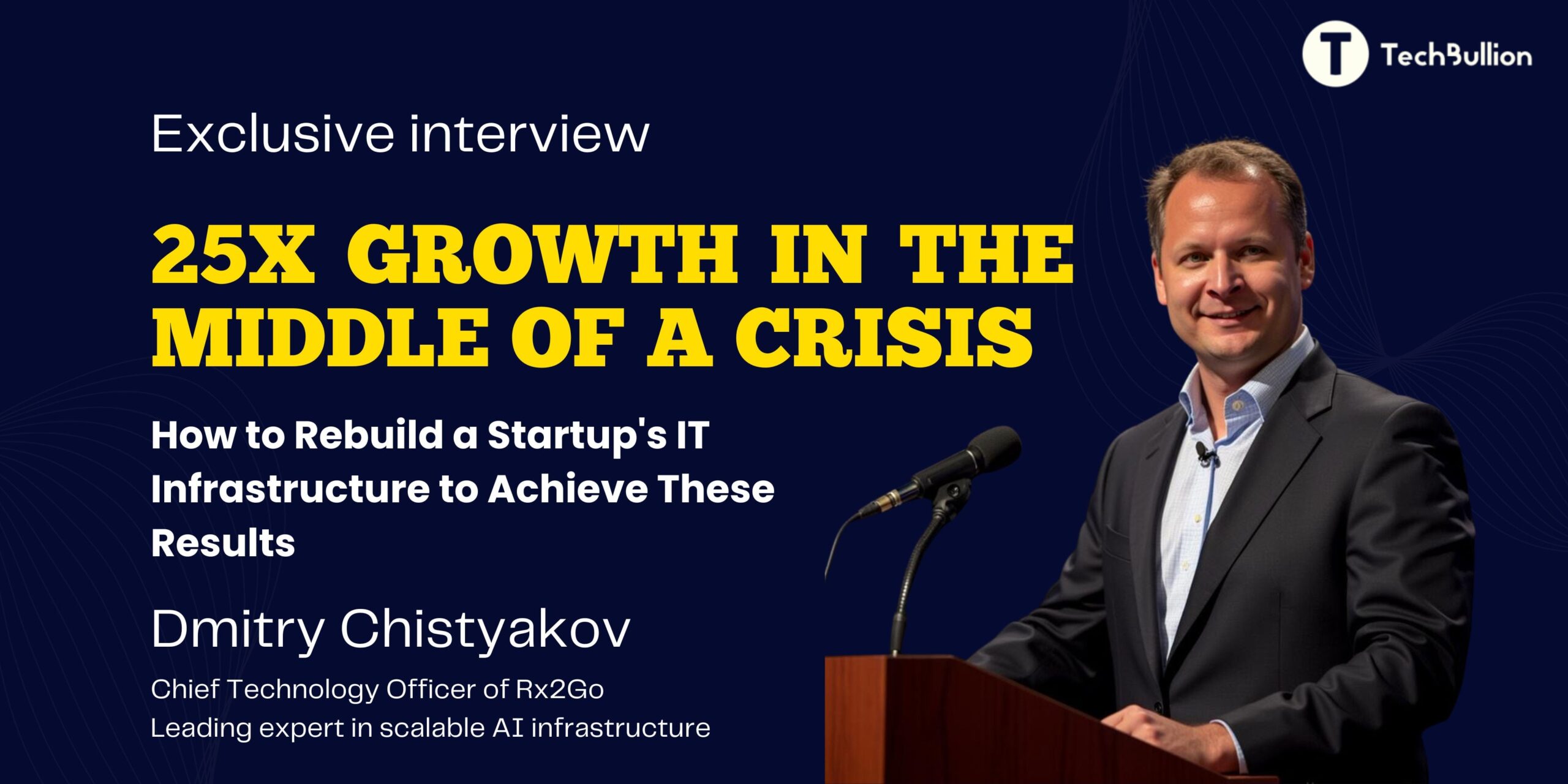
How to teach artificial intelligence to make flawless decisions and use it to grow a company — told by Dmitry Chistyakov, Chief Technology Officer of Rx2Go and leading expert in scalable AI infrastructure, creator of the innovative CPLOM architecture. Drawing on more than 15 years of experience with high-load systems, he translated practical business challenges into fundamental science, and today serves as an invited expert and mentor for international IT startups at the global cybersecurity conference RSA.
According to industry data, supply chain inefficiencies cost the U.S. healthcare system $25.7 billion annually, and last-mile logistics — the final leg of delivery from warehouse to end consumer — is the most expensive piece of the puzzle, accounting for up to 53% of total transportation costs. New technologies seem like the obvious answer, but businesses are reluctant to hand processes over to AI when they don’t understand the logic behind its decisions and fear costly mistakes. The technology team at Rx2Go took a different approach: the AI system they built logs every action it takes and double-checks its own decisions — a methodology that’s now gaining traction across the industry, but one the company adopted before it became standard practice. The result: $70 million in revenue, a $600 million valuation, and dramatically reduced logistics losses. CTO Dmitry Chistyakov sat down to explain how he rebuilt the company from the ground up during a crisis — and where he sees AI heading next.
– Dmitry, you joined Rx2Go when it was a small local startup. Today, under your technical leadership as CTO, the platform coordinates over 100,000 deliveries daily across 16 U.S. states. What was the IT infrastructure like when you arrived, and where did you begin the transformation?
– When I joined Rx2Go, there was technically a system in place — it had been running for over two years — but honestly, it wasn’t infrastructure in any meaningful, scalable sense. It was a classic early-stage startup situation: a collection of standalone solutions, each doing its own job, with no real connection between them. A separate interface, separate routing, a basic courier app — all living in their own worlds.
That kind of setup lets you move fast early on, but the moment volume picks up, it starts breaking down. And it breaks down because the system has no coherent state. Different developers had written different pieces, there was no documentation, and cause-and-effect relationships simply weren’t being tracked — you could see the symptoms but couldn’t identify the cause. The whole system was purely reactive.
So the first step wasn’t to rewrite the code — it was to change the underlying philosophy. To move from a collection of tools to a unified platform with a clear state and consistent logic. We had almost no funding at the time. I remember my first workstation was the kitchen table, and there were nights I slept in the office.
In terms of actually introducing AI, we never set out to “flip a switch and replace people.” We moved gradually. First, AI functioned as an analytics layer — helping surface things a human wouldn’t have time to catch. Then as a recommendation engine: the system would suggest options, but the final call stayed with the person. Only at the third stage did it become part of the actual decision-making process. We showed how the system reached a conclusion, what its confidence level was, and we always left room for human intervention. At some point a shift happens — people start treating AI as a collaborator.
– In medical logistics, the cost of a mistake is measured in tens of thousands of dollars and patient health outcomes. What other decisions helped quickly stabilize the chaos of an early-stage startup, and how did they show up in the numbers?
– Interestingly, the first improvements weren’t clever or technically sophisticated — they were foundational. But that’s exactly why they delivered fast results.
The first was the courier app. We didn’t even have the source code; the app was unstable, and drivers were walking out. We built a cross-platform solution and added a web version as a fallback — if the app broke, the courier could just open a browser. Driver turnover dropped sharply, and for the first time we had genuine operational stability.
The second was billing. A significant chunk of calculations were being done manually. When you have dozens of clients each shipping 50 to 100 packages a day, that becomes chaos fast. We automated the process, and that was the moment the business became financially scalable for the first time.
The third was quality control. Errors in medication delivery are extraordinarily costly — sometimes tens of thousands of dollars per package. If you catch a mistake within five or ten minutes, you still have a chance to fix it. After we implemented the system, that window came down to seconds. That became our first real competitive advantage.
– The COVID pandemic was a genuine stress test for virtually every industry, and especially for medical logistics. That’s when Rx2Go achieved its remarkable growth — volumes increased 25x. What allowed the company, under your technical leadership, to withstand that kind of scaling?
– While other sectors were shutting down, we experienced the exact opposite — demand for medication delivery started growing exponentially. COVID wasn’t a crisis for us; it was an architecture test. And decisions had to be made very, very fast.
It became clear that continuing to grow on the old approach simply wasn’t an option. We moved away from linear logic, rethought routing, introduced state indicators. Essentially, we made the leap from managing processes to managing a system. Most solutions on the market address local problems — build a route, manage a warehouse — without accounting for how those things affect each other. In reality, a routing error cascades into a warehouse issue, which then impacts the next delivery. It’s a chain reaction. Our system adapts dynamically, which is why we were able to scale without a linear increase in costs.
– You personally brought algorithms from high-frequency trading and SaaS platforms into the traditionally conservative world of medical logistics. How did that outside experience help you see and implement things that most logistics companies simply miss?
– In practice the strongest solutions almost always come from outside an industry, not from within it. When you’re inside a market, everyone is looking at the same problems and borrowing solutions from each other. But logistics, financial markets, and high-load systems are all different expressions of the same underlying challenge: managing a complex system under conditions of uncertainty.
We transferred approaches from trading directly into logistics — time series analysis, volatility modeling, trend detection — and started applying them to operational indices, which unlocked a lot of new insight. Experience building real-time systems made many of the platform’s internal events nearly instantaneous. And my background in SEO automation helped us build out a network of integrations with pharmacy management systems.
– How does the role of CTO change once a system reaches significant scale?
At this point, my work has almost nothing to do with code — it’s about architecture and making decisions whose consequences play out six months or a year down the line. You’re constantly operating with incomplete information, but you still have to decide.
In practice, it’s behavioral systems management. Not code, not individual modules — but how the system will respond to changes that haven’t happened yet. And honestly, sometimes it feels like tending to a living organism.
– The industry is now shifting its focus from AI-generated content to autonomous AI agents capable of operating independently. The CPLOM architecture you developed looks almost prescient in that context. Why did you originally bet on replacing the decision-making process itself — and what do you see as AI’s next step?
– For me, AI represents the next tier of automation. Earlier waves of automation replaced manual actions. AI is beginning to replace the decision-making process itself — and in doing so, it stops being just a tool. I wouldn’t be surprised if, not too far from now, the AI systems of different businesses start purchasing each other’s services autonomously.
Over the course of my career I’ve encountered an enormous number of people — from junior analysts to CTOs — who struggle with making decisions. Fear of change is simply part of human nature. Our system is, in its purest form, a solution to that problem. It represents almost boundless potential that genuinely benefits people — and for me, that has always been the ultimate benchmark.







Comment