Most marketers check their AI search visibility the same way. They open ChatGPT, type “best plumber in Phoenix” or “top CRM for small agencies,” and look for their brand, then relax if it shows up and panic if it doesn’t.
Both reactions rest on a sample size of one. A single answer from a single engine says very little about what your customers see when they ask the question themselves, in their own words, on whichever assistant they happen to use.
A more reliable approach treats AI visibility as a sampled metric, built from a fixed set of questions that you run repeatedly across engines and report on month after month. This guide covers how to build that prompt set, which five metrics to track, when to automate, and how to report the results.
Why a Single AI Answer Is a Poor Measure of AI Search Visibility
AI search visibility is the share of relevant AI-generated answers that mention your brand, measured across many prompts, multiple engines, and repeated runs. Because it is a rate, it behaves more like a batting average than a ranking.
Large language models do not return fixed results. Ask ChatGPT the same question ten times and the brand list can change between runs, shuffle its order, and lean on different sources each time. Gemini, Perplexity, Claude, Grok, and Google AI Mode each draw on their own retrieval and ranking logic, so the same business can be recommended by one engine and missing from another.
Even when the question stays the same, several factors move the answer:
- The wording of the prompt. “Best emergency electrician near me” and “who should I call for a sparking outlet at night” describe the same need, yet they trigger different responses.
- The engine itself, since each assistant cites different sources and weighs them differently.
- Timing. Models and their retrieval indexes update constantly, so last month’s answer may not match this month’s.
- Location settings, because country and locale shape which businesses an engine considers relevant.
A screenshot captures one draw from that distribution, so measuring visibility means sampling the distribution deliberately, with enough answers that one odd response cannot swing the result.
How to Build a Prompt Set for Tracking AI Visibility
Where traditional rank tracking starts with keywords, AI visibility measurement starts with prompts written the way people talk to an assistant, which usually means longer and more specific questions than anyone types into a search bar.
Start with topics, then expand each topic into several conversational prompts:
- List 5 to 10 core topics: the services, products, or problems you want to be known for.
- Write each prompt in natural language. A good set mixes comparison questions (“X vs Y for a small team”), problem questions (“my garage door won’t close all the way”), and recommendation questions (“who is the best…”).
- Mix intent across informational, commercial, and high-intent prompts so you can see where visibility drops off along the buying journey.
- Pick the country you want answers for, since results shift by region.
- Keep the core prompts stable between runs. If the questions change every month, the trend lines stop meaning anything.
A set of 20 to 30 prompts is a workable starting point that keeps each run manageable. Adding more reduces noise, provided the extra prompts reflect questions your buyers would ask.
The Five Metrics That Make AI Search Visibility Measurable
Once prompts run across engines on a repeat basis, five numbers do most of the work.
1. Visibility Rate Across AI Answers
Visibility rate is the headline figure: the percentage of all scans in which your brand appears.
Take a hypothetical brand to see the math. Run 25 prompts across six engines and you get 150 answers. If the brand appears in 90 of them, its visibility rate is 60 percent. These numbers are illustrative, not drawn from any real campaign. A rate built from 150 answers absorbs the randomness of individual responses, and while 60 percent may look less exciting than a screenshot with your brand at the top of the list, it is a number you can defend in a meeting.
2. Per-Engine Share of Voice in AI Search
An overall rate can hide a weak engine. The same hypothetical brand at 60 percent overall might be near-universal on one engine and almost absent on another.
Break visibility down by engine and compare each figure against the average visibility of the competitors that appear alongside you. Laid side by side, those figures show where you lead and where you trail, which makes the engine to work on first fairly obvious.
3. Sentiment in AI Answers
An assistant can mention your business and still steer people away from it by describing you as expensive, slow, or a fallback option.
Score how each answer describes you. If your mention count rises while sentiment falls, treat it as a warning sign.
4. Cited Sources Behind AI Visibility
When an engine shows its sources, record them. The sites cited in answers that include your competitors but leave you out are the clearest map of where your brand needs a presence. Directories, review platforms, industry publications, and comparison articles often show up again and again.
5. AI Visibility Change Over Time
Every metric above needs a baseline and a delta. Visibility that moves from 40 to 55 percent over a quarter gives a client or executive a story they can follow, something a single month’s number rarely provides.
Manual Checks vs Automated AI Visibility Tracking
The math above is easy. The labor is not.
Twenty-five prompts across six engines means 150 queries per run. Add sentiment scoring, source logging, and competitor tallies, and a single manual cycle can take hours before any analysis starts. Repeat it monthly for several brands and it stops being practical.
For that reason, teams tracking visibility in AI search tend to move to software that reruns the same prompts at set intervals and stores every answer. When evaluating a tool, look for:
- Engine coverage. At minimum ChatGPT, Gemini, and Perplexity. Broader coverage including Claude, Grok, and Google AI Mode gives a fuller view.
- Repeated sampling. The tool should calculate visibility as a percentage of scans instead of reporting a single “rank.”
- Answer-level detail. You should be able to read the full answer text for each prompt alongside any score.
- Competitor and source views. Seeing which brands appear next to yours, and which sites the engines cite, is where most of the useful findings come from.
- Recommendations tied to gaps. Each gap the tool surfaces should come with a suggested next step.
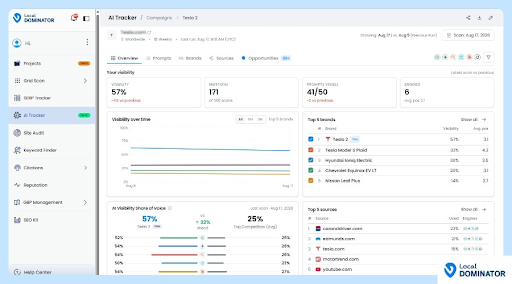
Local Dominator is one example of a platform built around this repeated-scan approach, querying ChatGPT, Gemini, Google AI Mode, Perplexity, Claude, and Grok from a single campaign. In one of its published walkthroughs, a business showed a 75 percent overall visibility rate across 150 scans, yet only 20 percent on Gemini against a 60 percent competitor average, the kind of gap an overall number hides. The workflow also breaks results into separate views for prompts, competing brands, cited sources, and improvement opportunities, which covers several of the metrics above. Whichever product you choose, a multi-engine AI visibility tracker earns its cost mainly by removing the manual query work and keeping every answer on record for comparison.
How to Report AI Search Visibility to Clients and Stakeholders
For a monthly report that a non-technical reader can follow, cover these in order:
- Open with the visibility rate and how it moved since last month.
- Break it down by engine, highlighting the weakest engine and its gap to the competitor average.
- Quote two or three answers word for word, since the assistant’s own text makes the data tangible.
- List the top cited sources you are missing from, which turns the report into a to-do list.
If you added or retired prompts during the month, say so near the top so nobody misreads a jump as progress.
Frame expectations early. AI answers fluctuate, so small month-to-month swings are noise, and a trend needs sustained movement across a quarter before anyone should call it one.
Where AI Search Visibility Measurement Goes Wrong
Even teams with good tools fall into a few traps. The most common is tracking only branded prompts: asking “is [Brand] good?” measures reputation, while most buyers start with unbranded questions that test whether an engine discovers you at all. Other traps include:
- Treating one engine as the whole market, when customers spread across different assistants and each needs its own measurement.
- Rewriting prompts every cycle, which destroys comparability.
- Counting mentions without reading them, so a sentiment problem goes unnoticed.
Chasing a position number is the last trap, and probably the hardest habit for SEO teams to drop. AI answers do not keep a stable rank order the way a results page does, so rates and shares are the units worth reporting.
Setting Up Your First Quarter of AI Visibility Tracking
Start with 20 to 30 prompts, run them across every major engine, and record visibility rate, per-engine share of voice, sentiment, cited sources, and change over time from the first scan so you have a baseline. After three monthly runs you should have enough readings per engine to start seeing which assistants recommend your brand and which cited sources to go after first. The goal is not a perfect score. It is a number that moves for reasons you can explain.
About Local Dominator
Local Dominator is a local SEO and AI search visibility platform built by a team of agency veterans and local SEO professionals. It helps marketing agencies and local businesses track and improve how they rank across Google Maps, search results, and AI answer engines from one dashboard, with rolling credits, bulk actions, and transparent, no-hidden-fee pricing.