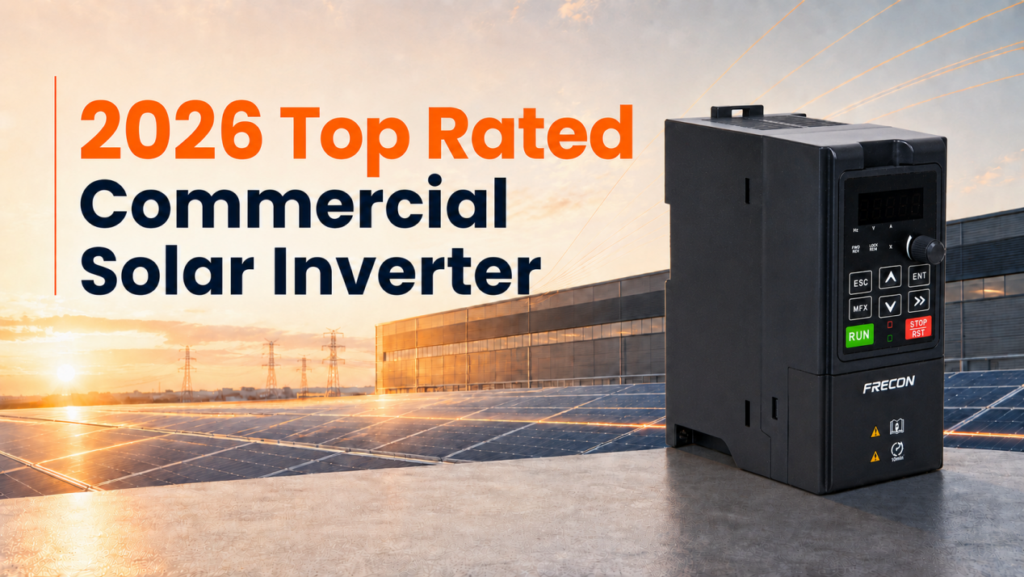
The right commercial solar inverter matches the roof, storage plan, service voltage, and motor loads—not AC rating alone. For businesses running three-phase motors, pair the PV inverter with a suitable VFD.
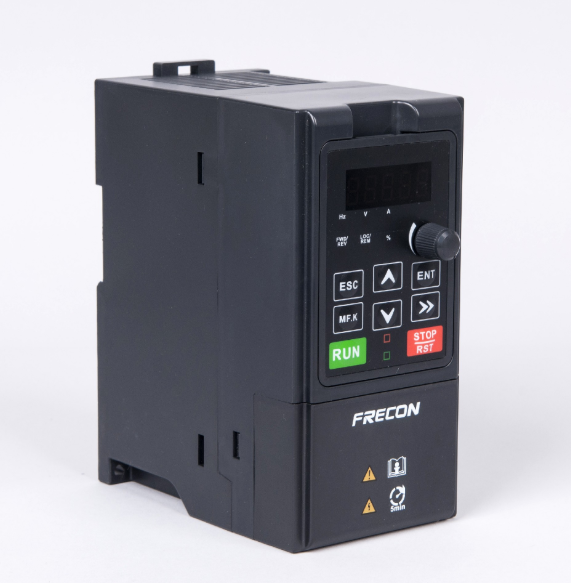
The FRECON FR150A is a load-side motor drive. Its 220 V single-to-three-phase wiring helps compatible sites run 220 V three-phase motors. Commercial solar inverters manage PV generation, while FR150A manages motor starts and running.
The following shows how to design both sides around the facility’s operating conditions.
How Do You Choose Commercial Solar Inverters for Business Facilities?
Commercial solar inverters should match the roof and the site’s energy-use pattern. The key question is whether the project only converts PV power or also coordinates PV generation with battery dispatch.
String Inverters or Hybrid Architecture?
l String Inverters for Open Roofs: String inverters fit large, unobstructed commercial roofs. They group PV strings by roof zone, simplifying layout, commissioning, and maintenance. Their distributed design also keeps individual string groups manageable when roof sections differ in size or orientation.
l Hybrid Architecture for Peak Shaving: Facilities that integrate batteries for peak shaving need a storage-capable hybrid architecture. It coordinates PV production, battery charging, and battery discharge when site demand rises, making stored energy available during demand windows.
A commercial inveter selection should compare battery compatibility, AC capacity, and the required peak-shaving duration.
Maximum Power Point Tracking (MPPT)
MPPT keeps each PV input at the voltage-current point where it can capture the most available solar power. This function is important because changes in irradiance, module temperature, and shading can shift the optimum operating point of a PV string.
Commercial solar inverters often serve roof sections with different pitches, orientations, and shading conditions. Four to six independent MPPTs separate these array groups, so shading on one side of a warehouse does not reduce the generation performance of the entire PV array.
Why is Three-Phase Power Critical for Commercial Solar System Design?
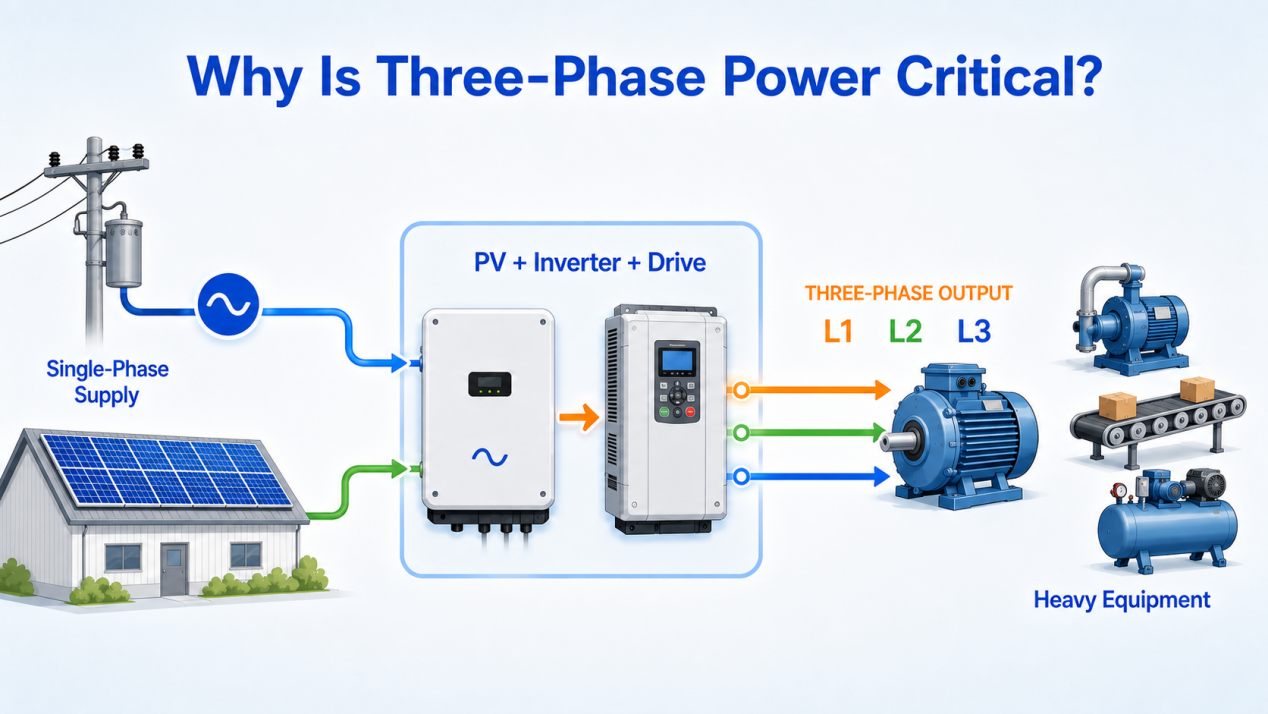
Commercial solar inverters must also match the facility’s electrical infrastructure. Agricultural and older commercial sites may have single-phase utility supply even though their production equipment requires three-phase power.
Physical Limits of Single-Phase Infrastructure
Single-phase infrastructure is suitable for lighter loads but becomes restrictive when high-power motors start or run together. Pumps, compressors, conveyors, and processing machines can create high current demand, while three-phase industrial motors require a three-phase supply arrangement.
How Three-Phase Power Supports Heavy Equipment
At comparable power and a suitable voltage, three-phase distribution lowers current in each conductor. This can provide three benefits:
- Smaller copper cable sizes, where electrical-code calculations permit.
- Less resistive heat in cables, terminals, and connections.
- Lower thermal stress on heavy equipment, supporting a longer operating life.
Bridging the Single-Phase-to-Three-Phase Gap
Many businesses need three-phase machinery but are located in single-phase grid zones. The PV system and 3-phase inverter architecture must bridge this mismatch by matching the supply, drive, and motor voltage requirements. A commercial inveter project cannot specify the solar inverter and motor drive independently.
How Do You Protect Commercial Solar Inverters from Machinery Inrush Currents?
Steady operating demand is not the only sizing condition. Commercial solar inverters must also be protected from the brief, high-current event created when heavy motors start.
Direct-On-Line Motor Starts
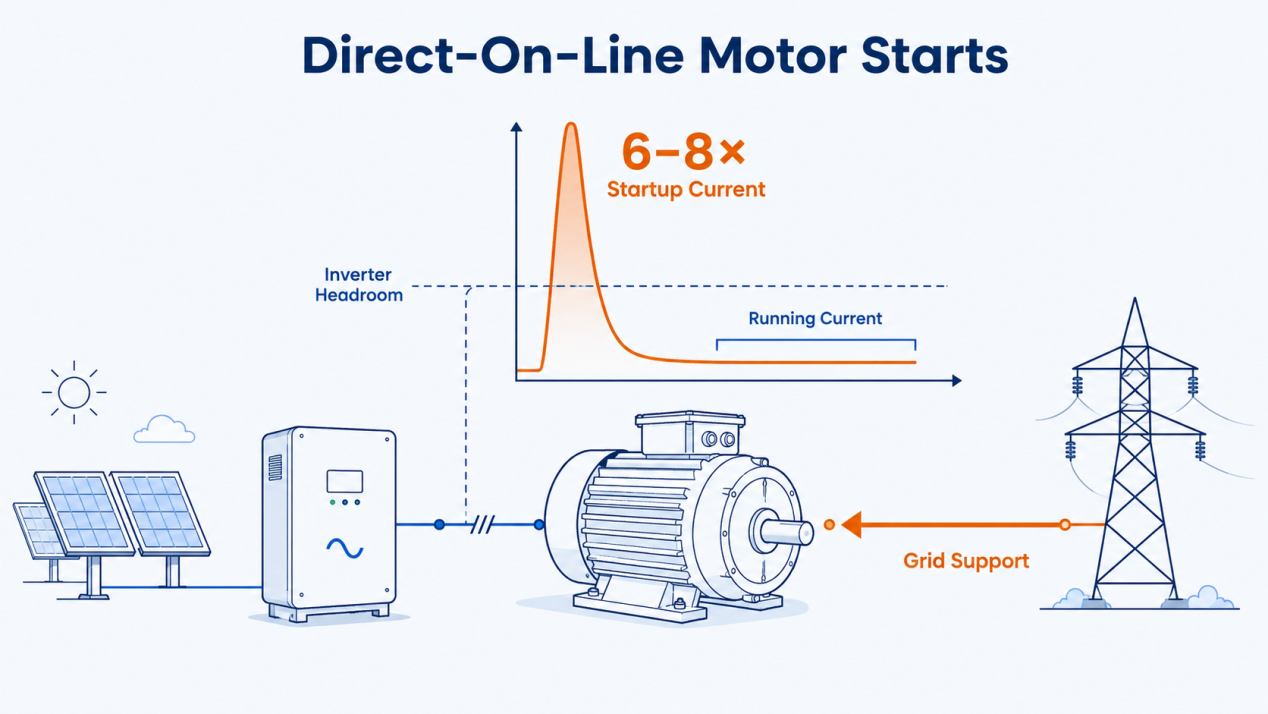
A direct-on-line motor can draw six to eight times its running current at startup, depending on motor design and load. This sudden demand can exceed PV output and commercial solar inverter headroom, forcing the facility to import grid power during a peak-price period.
How a VFD Flattens the Demand Curve
A VFD raises motor frequency and speed gradually rather than applying full-voltage power immediately. The ramp flattens the electrical demand curve and reduces mechanical and thermal startup stress.
This keeps the load within the system’s planned operating range and reduces the uncontrolled power spike that would otherwise increase grid dependence.
Why the FRECON FR150A is the Ultimate Commercial Solar Companion
The FRECON FR150A Multifunctional Inverter is engineered to sit between your commercial solar inverter and your heaviest electrical loads, providing sensor-less vector control to eliminate startup power spikes.
✔Single- to Three-Phase Conversion
For compatible 220 V applications, the FR150A converts single-phase 220 V input from a matched solar-inverter AC bus or legacy grid into three-phase 0–220 V motor output. This helps businesses run compatible three-phase equipment without an immediate major infrastructure upgrade.
✔Common DC Bus Architecture
Multiple FR150A units can share regenerative braking energy through a common DC bus. This reduces braking-resistor demand and can lower power draw from the upstream commercial solar inverter.
✔Space & Integration
Compared with the previous-generation drive of the same power, the FR150A offers up to 50% less volume and includes RS485 Modbus RTU communication. This saves cabinet space and supports integration with facility energy-management or solar-monitoring systems.
Conclusion
Commercial solar inverters deliver greater value when PV generation is designed around the facility’s real electrical demand, rather than treated as a standalone power source. Matching the solar system with the available grid supply and motor-control requirements helps businesses use more of their on-site solar energy while managing demanding industrial loads more reliably.
Contact FRECON to discuss commercial solar inverters, VFD solutions, and integrated power-control options for your facility.