Modern technology leaders, such as CEOs, founders, COOs, and CROs, are constantly competing with one another to scale their operations and improve their sales, marketing, and customer service. Unfortunately, most organizations believe that growing their operations means hiring more sales representatives or investing heavily in new AI-based tools and marketing campaigns to boost their revenue.
The reality is that many long-term growth challenges are not even related to sales and marketing execution strategies. Instead, they are often associated with outdated Customer Relationship Management (CRM) systems that do very little to sustain long-term growth for the companies.
Before migrating, customizing, or investing further in Salesforce or AI, tech leaders need to recognize whether their CRMs are limiting their business growth by evaluating their current CRM strategy. New tools or AI initiatives can only be effective if a good CRM strategy is in place.
Why do CRMs become a strategic asset as companies scale?
Companies used to consider CRM a luxury rather than an asset. However, a modern company can no longer function today without a comprehensive CRM strategy to support its current business needs.
SaaS and IT services companies are good examples of this. After all, they must manage their long-term subscriptions, renewals, and sales while providing high-quality customer support to ensure that all customer issues are successfully resolved. Everything, from the initial lead generation to after-sales customer support, must be tracked, optimized, and executed as best as possible.
If tech leaders can access this information from one solid CRM, it is much easier for them to forecast their revenue and identify potential setbacks that could hinder their progress. Ultimately, the CRM becomes a strategic asset that enables companies to find the best paths to grow and prosper in their industry by utilizing data-driven intelligence information about their sales and customer service.
The 10 questions every CEO should ask about their CRM
A CRM is only as valuable as the data entered into it. Your sales team will never be able to utilize your CRM for success unless it can track accurate and reliable data.
Below are 10 questions that every CEO and other business leaders should ask about their CRMs to ensure they are successful for their companies:
1) Does my CRM provide access to all vital sales, marketing, and customer information?
Your CRM must serve as the central nervous system of your company. In other words, it must have access to all vital sales, marketing, and customer information databases from one location.
2) Is my current CRM strategy working well?
Conduct a CRM assessment to see if your current CRM strategy is bringing your company a positive return on its investment. If it is not, it might be time to revise your strategy to a more profitable one.
3) Is my CRM able to automate administrative workflows?
Many companies continue to manually conduct time-consuming administrative tasks, such as data entry. A good CRM can automate repetitive workflows like these to increase productivity.
4) What is the AI readiness of my CRM?
Your CRM is AI-ready if it has 100% accurate data with no duplicate records or missing data fields. AI models depend on well-structured, well-vetted data to ensure their accuracy in pulling and tracking data.
5) Can my CRM accurately forecast future revenue?
CRMs remain crucial to the revenue operations of companies. If your CRM can successfully track accurate and updated data in real-time, then it will have the best chance of accurately forecasting your company’s future revenue.
6) What is the long-term cost of my CRM software?
Figure out how much you are paying your vendor to access your CRM software. If it is too much, you might need to find another vendor.
7) Does my CRM integrate well with other tech software?
A good CRM can integrate flawlessly with other marketing, ERP, and customer software titles to eliminate manual data entry and reduce human-based mistakes.
8) Is my customer data secure?
Your CRM must have the proper security protocols and technologies in place to protect your customer data from unauthorized access.
9) Are we maximizing the use of our CRM’s automation capabilities?
You should automate as much as you possibly can with your CRM, such as follow-up reminders, price quote generation, and lead messaging. Anytime you can reduce manual data entry, you are improving your company’s productivity.
10) What insights does our CRM provide?
Your CRM should not only rely on historical records to provide data-driven insights. It should also utilize real-time data to offer actionable, proactive insights to guide your sales teams as well.
Common warning signs that indicate a CRM is no longer fit for purpose.
Here are some of the most frequent warning signs of an ineffective CRM or CRM strategy:
- Over-reliance on external spreadsheets and applications to perform basic tasks.
- No unified platform in place
- Low user adoption and engagement
- Fragmented data and poor data quality throughout the system
- Significant productivity losses due to inefficient manual processes and administrative tasks.
- Broken or faulty software integrations
- An outdated infrastructure that lacks the capability to support advanced technologies like AI.
Practical next steps for evaluating CRM readiness
Do you want to know if your CRM is ready? Here are some practical steps to evaluate its readiness:
1) Conduct a comprehensive CRM audit to evaluate its data accuracy and overall alignment with your current business goals.
2) Evaluate whether the existing CRM system offers a unified source of data and the ability to support your future scaling requirements.
3) Map out the ideal customer journey within your organization and see where the most operational friction lies within it.
4) Document the most common problems discovered, such as inaccurate revenue forecasting, poor customer service, lost leads, etc.
5) Develop a new CRM strategy for a robust CRM optimization agenda that can overcome these issues.
6) Automate routine updates and regularly review performance metrics to ensure the CRM supports long-term operational growth.
Conclusion: Noltic’s Quiz and Whitepaper
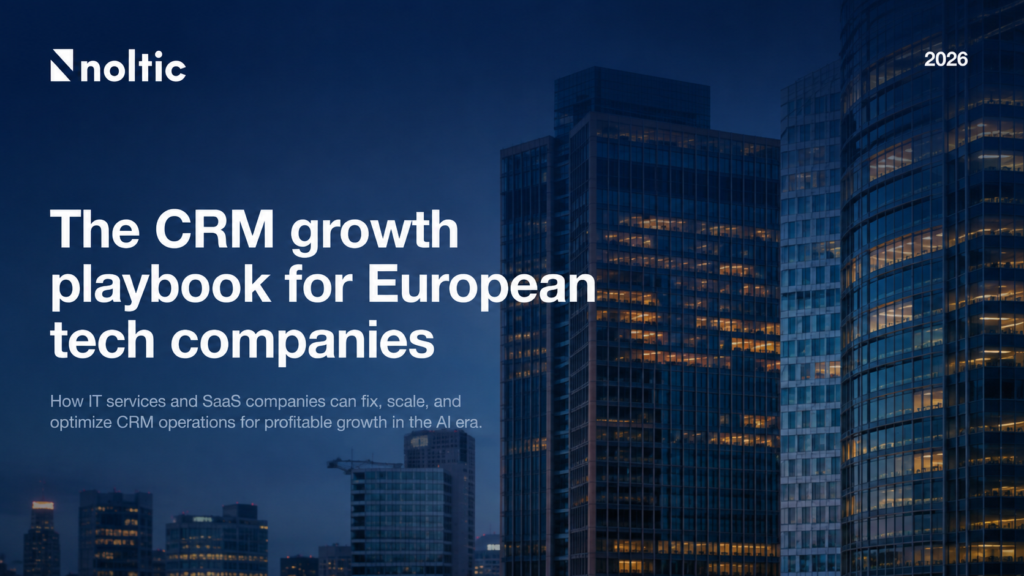
For organizations unsure about whether their CRM is supporting long-term growth, Noltic offers a free CRM Assessment and CRM Growth Playbook designed to help tech companies identify operational gaps, benchmark their current state, and make more informed decisions about optimization or Salesforce adoption.
Noltic is a Salesforce Summit consulting partner specializing in Sales Cloud, Service Cloud, Revenue Cloud, Experience Cloud, and Data Cloud implementations. It has more than 100 Salesforce-certified agents who possess more than 400 total certifications in numerous related fields, including CRM consulting, CRM optimization, customer lifecycle management, and sales.
Noltic has over 8 years of experience working in the field of CRM optimization and Salesforce development with dozens of companies. Its team of agents can identify the most common problems that tech companies face and come up with the most effective solutions to overcome them.
As a result, Noltic has been successful in growing the revenue of these tech companies and helping them achieve great success.