
How Zetexa Is Connecting eSIM, Fintech and Travel Ancillaries Through One B2B Platform

The digital economy increasingly depends on services that work seamlessly across borders. Financial transactions, mobile applications, travel bookings, and customer support all rely on reliable connectivity. Yet international mobile services and airport experiences have traditionally operated through separate providers, platforms and booking systems.
For fintech companies, banks, online travel agencies (OTAs) and airlines, this fragmentation creates an opportunity to rethink how connectivity and travel services are delivered.
Rather than treating an eSIM as an isolated travel product, businesses can integrate mobile connectivity, local telecom services and airport ancillaries into their existing digital journeys. This approach is creating demand for B2B technology platforms that connect telecom networks and travel suppliers with customer-facing businesses.
Zetexa is building its platform around this convergence, combining global connectivity, MVNO capabilities and travel ancillary services through technology designed for enterprise integration.
Why Connectivity Is Becoming a Business Infrastructure Layer
International connectivity has evolved beyond a convenience for tourists. Students relocating overseas, remote professionals, business travellers and international customers increasingly depend on mobile data to access payments, navigation, communication and digital services.
For fintechs and financial institutions, connectivity can complement international spending products, travel cards and loyalty programmes. OTAs can incorporate connectivity into booking journeys, while airlines and travel operators can offer digital services that extend beyond transportation.
The challenge is delivering these services without requiring each business to build its own telecom infrastructure or establish individual relationships with multiple suppliers.
eSIM technology addresses part of this challenge by enabling digital SIM provisioning on compatible devices. However, delivering a complete service also requires network access, plan management, payment integration, customer support and the ability to scale across destinations.
This is where B2B connectivity platforms become important.
Zetexa’s Global Connectivity and Technology Platform
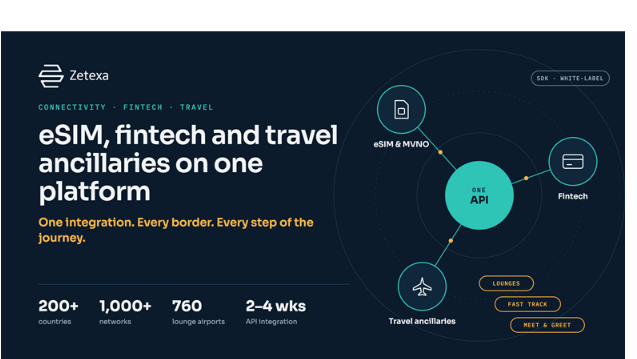
Zetexa provides B2B connectivity infrastructure across 200+ countries and 1,000+ networks, works with 2,000+ partners, and serves millions of B2C customers.
Its portfolio includes travel eSIMs, local mobile connectivity, long-term SIM plans and MVNO capabilities, alongside airport and travel ancillary services.
The platform is designed for businesses that want to incorporate these capabilities into their own products under their own brand. Instead of developing every component independently, partners can use Zetexa’s technology and supplier ecosystem to support their service offerings.
Potential applications span fintechs, banks, OTAs, airlines, travel agencies, insurance providers, hospitality businesses, loyalty programmes and corporate travel operators.
The objective is to make connectivity and travel services accessible through existing customer journeys rather than forcing users to navigate disconnected products and platforms.
Beyond eSIM: Integrating Airport and Travel Ancillaries
A broader travel technology proposition also needs to address what happens at the airport and throughout the journey.
Zetexa’s ancillary platform includes airport lounges, meet and greet, fast track, dining vouchers and VIP services. Its current inventory spans multiple countries and airports.
The coverage includes:
- Lounge access: 143 countries, 760 airports and 2,168 plans.
- Meet and greet: 38 countries, 110 airports and 619 plans.
- Fast track: 36 countries, 139 airports and 279 plans.
- Dining vouchers: 18 countries, 91 airports and 553 plans.
- VIP services: 19 countries, 28 airports and 72 plans.
These services create opportunities for financial institutions to enhance premium customer benefits, for OTAs to develop additional revenue streams, and for travel operators to offer more comprehensive booking experiences.
For example, an OTA could present an eSIM alongside a flight booking and offer lounge access or airport assistance as additional options. A fintech could incorporate connectivity into an international travel benefit programme and provide access to relevant airport services.
The commercial value lies in connecting these services through a common technology layer, simplifying distribution and reducing the need for separate integrations.
APIs, SDKs and White-Label Technology
The ability to integrate services efficiently is central to enterprise adoption.
Zetexa offers API-based integration alongside SDKs, widgets, branded microsites, reseller platforms and WhatsApp-based customer journeys. These options allow partners to select an implementation model that matches their technical capabilities and business requirements.
With API integration, a partner can incorporate destination or service searches, product selection, transactions and connectivity provisioning into its own digital environment. Other implementation options can support businesses that prefer a hosted storefront or a more limited initial integration.
Standard API integration typically takes approximately two to four weeks, depending on the partner’s requirements and implementation scope.
White-label capabilities also allow businesses to maintain their own brand identity and configure products, pricing and customer experiences around their commercial strategy.
For fintechs and travel platforms, this model offers a way to expand service portfolios without independently building the entire underlying telecom and ancillary infrastructure.
Security, Compliance and Regulatory Readiness
Enterprise connectivity platforms must address more than product availability. Security, data protection and regulatory requirements are important considerations, particularly when technology is integrated into financial services and customer-facing applications.
Zetexa’s enterprise positioning includes VAPT, GDPR, SOC 2 and PCI DSS considerations, alongside relevant telecom regulatory approvals and licensing across its operating markets.
Its regulatory footprint includes CRTC-related authorization in Canada, FCC-related authorization in the United States, Indian Department of Telecommunications requirements and TDRA licensing in Dubai.
For enterprise procurement teams, these areas should be evaluated alongside technical architecture, data handling, contractual responsibilities and the scope of each applicable certification or authorization.
The broader principle is that connectivity and travel services must be supported by infrastructure suitable for the markets and business environments in which they operate.
Extending Connectivity Through MVNO Services
The opportunity extends beyond short-term international travel.
Through its local connectivity and MVNO capabilities, including Unlimit Mobile, Zetexa also serves longer-term connectivity needs in markets including the United States, Canada and the United Kingdom.
These services are relevant to international students, immigrants, work travellers and other customers who need local mobile connectivity, including voice, SMS and data, rather than a temporary travel data package.
This creates a longer customer lifecycle for businesses serving internationally mobile audiences. Connectivity can support customers before departure, during travel and throughout an extended overseas stay.
For fintechs, banks and travel businesses, the combination of travel eSIMs and local mobile services creates additional opportunities to develop products for customers whose connectivity requirements change as they move between countries.
ZetSIM and Unlimit Mobile: Connecting Global Travellers
Zetexa’s consumer brands address different connectivity needs. ZetSIM provides travel eSIM solutions across 200+ countries, helping travellers stay connected internationally. Unlimit Mobile focuses on local and long-term mobile connectivity for students, immigrants and work travellers in markets including the US, Canada and UK.
Together, they demonstrate Zetexa’s broader vision of combining global connectivity, MVNO services and travel ancillaries through an integrated platform for businesses and consumers.
The Future of Connected Travel Technology
The convergence of telecom, fintech and travel technology points towards a more integrated digital experience. Customers increasingly expect services to be available when needed, while businesses want to introduce new capabilities without taking on the complexity of building every underlying system themselves.
Platforms that combine connectivity, MVNO services and travel ancillaries can help bridge this gap.
For Zetexa, the opportunity is to provide the infrastructure that allows businesses to distribute these services through APIs, white-label platforms and other integration channels.
As international mobility and digital services continue to intersect, connectivity is becoming more than a standalone product. It is a foundation on which businesses can build additional customer experiences, travel benefits and commercial opportunities.
The next stage of travel technology will depend not only on connecting people to mobile networks, but also on connecting the services they need through a simpler, more integrated digital ecosystem.
=======================================================================
Primary category: Technology
Alternative category: FinTech
Suggested meta title: How Zetexa Connects eSIM, Fintech and Travel Ancillaries
Suggested meta description: Explore how Zetexa combines global eSIM connectivity, MVNO services, airport ancillaries and APIs to help fintechs, OTAs and travel businesses expand their digital offerings.
Suggested URL slug: zetexa-esim-fintech-travel-ancillary-platform






Comment