A New Execution Architecture That Embeds Regulatory Governance Before Blockchain Transactions Occur — Addressing the Root Cause Behind 90% of Enterprise Blockchain Pilot Failures
ZenithBlox Inc., a Toronto-based compliance-first blockchain middleware company, today announced the formal introduction of Compliance-Orchestrated Blockchain Infrastructure (COBI) — a new execution architecture purpose-built for regulated financial institutions, central banks, and government agencies seeking to adopt blockchain technology without compromising regulatory accountability.
COBI represents a fundamental departure from the transaction-centric blockchain architectures that have dominated the industry for the past decade. Where conventional approaches treat compliance as a post-execution monitoring function — detecting and reporting violations after they occur — COBI positions regulatory governance as the primary control plane, ensuring that no transaction executes unless institutional and regulatory policy requirements are satisfied in advance.
Addressing the Root Cause of Institutional Blockchain Failure
Despite significant technical maturation in throughput, tooling, and interoperability, enterprise blockchain adoption in regulated sectors remains stalled. Industry estimates indicate that approximately 90% of enterprise blockchain pilots never reach production.
“The failure of enterprise blockchain is not a technology problem — it is a governance problem,” said Dr. Fodé Touré, PhD, Founder and CEO of ZenithBlox. “Most blockchain platforms are built on the assumption that correct code execution equals an acceptable transaction. Regulated institutions operate under the opposite logic: execution is acceptable only when it conforms to policy, regulation, and accountability before it happens. This mismatch — what we call the Toolkit Problem — is the root cause of a decade of institutional blockchain failure.”
What COBI Is — and What It Is Not
COBI is not a blockchain, a smart contract framework, a developer toolkit, or a compliance add-on. It is an enterprise middleware architecture that positions compliance orchestration as the primary control plane for blockchain integration, enabling regulated institutions to adopt distributed ledger technology without compromising regulatory accountability, operational control, or system interoperability.
The COBI Stack: Four Integrated Layers
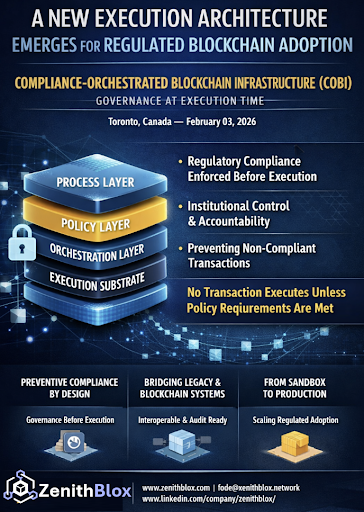
COBI organizes blockchain execution through four tightly integrated architectural layers, each addressing a critical failure point in conventional approaches:
| Layer | Function |
| Process Layer | Human-readable business rules defined via BPMN 2.0 with Web3 extensions — ensuring that regulators, boards, and auditors can review and approve process logic before execution. |
| Policy Layer | Jurisdiction-aware, executable compliance rules that evaluate every transaction against AML/KYC, GDPR, and institutional policy requirements before allowing execution. |
| Orchestration Layer | Seamless integration with legacy infrastructure (SWIFT, SAP, Temenos, core banking, ERPs) via Universal Adapters — eliminating the custom development burden that consumes 60–80% of blockchain project budgets. |
| Execution Substrate | Blockchain networks (Ethereum, Hyperledger, Polkadot, private ledgers) function as execution runtimes — carrying out actions only after they have been approved and validated by institutional policy. |
THE COBI PRINCIPLE
No transaction executes unless regulatory and institutional policy requirements are satisfied in advance.
From Detective to Preventive Compliance
The shift from detective to preventive compliance represents the defining architectural distinction of COBI. Traditional blockchain systems allow transactions to execute and then attempt to monitor, detect, and remediate violations after the fact. Once a non-compliant transaction executes on-chain, the legal and operational consequences already exist.
COBI eliminates this exposure entirely. Compliance is not observed — it is enforced. Transactions are authorized only after all regulatory and institutional requirements are satisfied, making every on-chain action policy-compliant by design.
Practical Applications
The COBI architecture is designed for the highest-stakes use cases in regulated finance and public infrastructure, including cross-border settlement and payment corridor automation, central bank digital currency (CBDC) issuance and distribution, real-world asset (RWA) tokenization and lifecycle management, TradeTrust-compliant trade finance document workflows, and sovereign digital infrastructure programs.
Strategic Validation and Market Position
ZenithBlox’s COBI-based platform has been validated through strategic partnerships with Microsoft for Startups, IMDA Singapore’s TradeTrust initiative for legal-grade digital trade documents, and Malaysia Blockchain Infrastructure (MBISB) in a sovereign-scale collaboration driving national digital transformation.
ZenithBlox is currently raising an USD 8 million Seed Round at a pre-money valuation of USD 25 million to scale enterprise deployments, secure SOC 2 and ISO 27001 certifications, and expand its enterprise sales presence across North America, EMEA, and Asia-Pacific.
Accompanying Publication
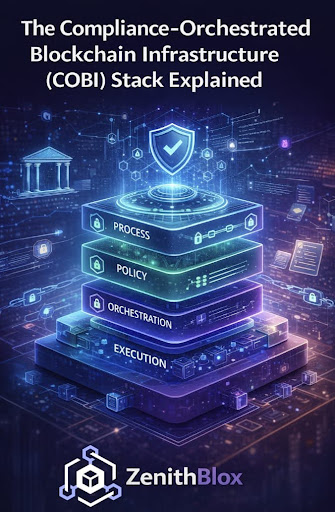
Alongside this announcement, ZenithBlox has published “The Compliance-Orchestrated Blockchain Infrastructure (COBI) Stack Explained”, a detailed thought leadership paper examining why regulated blockchain adoption has stalled, the structural failures of transaction-centric architectures, and how the COBI Stack resolves them. The paper is available upon request at fode@zenithblox.network.
About ZenithBlox
ZenithBlox is a compliance-first blockchain integration and automation platform headquartered in Toronto, Canada, with an engineering and product subsidiary in Morocco. The company enables banks, asset managers, governments, and regulated enterprises to adopt blockchain technology securely and efficiently through its no-code/low-code middleware platform. ZenithBlox’s architecture connects legacy enterprise systems with blockchain networks while embedding regulatory compliance at every layer of execution. The platform supports Ethereum, Hyperledger, Polkadot, private ledgers, and emerging protocols.
For more information, visit www.zenithblox.com