
Your Buyers Already Looked You Up in AI Search. Here’s How to Be Ready.

Almost every B2B purchase is one long research project. So what’s the most powerful research tool anyone has right now? That one was rhetorical.
If your buyers research in AI, and the AI doesn’t know your business or gets it wrong, you’re off the shortlist before a single person at the company looks you up. Nobody needs convincing that AI search matters in 2026. It already moves the marketing mix. There’s a difference, though, between “we should look into this” and “this is overdue,” and three numbers put us in the second camp:
- 51% of B2B software buyers now start their research with an AI chatbot more often than with Google, and AI chatbots are the top source influencing buyer shortlists, ahead of review sites, analyst firms, and vendor websites (G2, 2026).
- 45% of shoppers use AI somewhere in the buying journey (IBM Institute for Business Value and the National Retail Federation, January 2026, based on 18,000 consumers).
- BrightEdge found that Google AI Overviews appeared on roughly 48% of tracked queries in February 2026, up from about 31% a year earlier. Answer-first is no longer an edge case.
The takeaway is blunt. If your brand isn’t getting the benefit of AI search, your competitor’s brand is.
A Few Things That Trip People Up
Before we get to what to change on the site, three things about AI search that catch people out, because it doesn’t behave like SEO.
First, AI is not Google rank. Ranking well in organic search usually correlates with showing up in AI answers, but it doesn’t guarantee it. A page can sit at position one and never get cited once.
Second, assistants gather information two ways, and the difference changes how you appear. Some fetch live pages the moment you ask, run a search, and answer from what comes back, usually with citations attached. Perplexity works this way on almost every query, and so do Google’s AI Overviews. Others answer first from memory, everything the model absorbed during training up to a cutoff date, and go to the live web only when the question clearly needs something current. Running a search costs time and compute, so these systems don’t do it for every question. ChatGPT, Claude, and Gemini lean this way.
It reads better as an axis than as two boxes: a few years ago the 2023-era chatbot sat at one end, answering only from memory and confidently repeating whatever it had learned, cutoff and all. That end has emptied out. Every major assistant can reach the web now, and they differ mostly in how readily they bother.
| Assistant | How it answers a typical question by default |
| Perplexity | Retrieval-first. Runs a live search and cites sources on nearly every query. |
| Google AI Overviews | Retrieval-first. Assembled from Google’s live index. |
| Gemini | Mostly live. Grounds answers in Google Search. |
| ChatGPT | Hybrid. Answers from training memory, searches the web when the question needs something recent. |
| Claude | Hybrid. Answers from training memory, retrieves live when asked or when it helps. |
The practical consequence: a memory-first tool can describe you with information that’s months stale, long after you’ve fixed the page.
Third, the answer isn’t stable. Ask the same assistant the same question twice and you can get two different answers. An AI assistant is a bit like a Magic 8-Ball with a much better vocabulary: shake it again and the reply can change, so what counts is the answer it keeps landing on, not any single one. You’re reading a tendency across several runs, not one fixed snapshot.
Where You Stand Right Now
Before changing anything, see how you look today. Three checks, none of them technical:
- Ask AI about you. Type “what do you know about [company]?” into two or three assistants. Do it logged out and in an incognito window, so your own history with the tool isn’t shaping the reply, and run it a few times. Watch what repeats: a wrong detail in two runs out of three is a signal, a one-off oddity is probably noise. This surfaces a symptom, not a diagnosis, and it guarantees nothing about what any given prospect sees.
- Read your homepage cold. Does the first paragraph say what you do and who it’s for, in plain text? Or does someone have to scroll past a hero animation to find out?
- Check your crawlers. Open robots.txt and confirm you’re not blocking the AI bots (GPTBot, PerplexityBot, ClaudeBot), and that your real content sits in the HTML rather than loading only after a script runs.
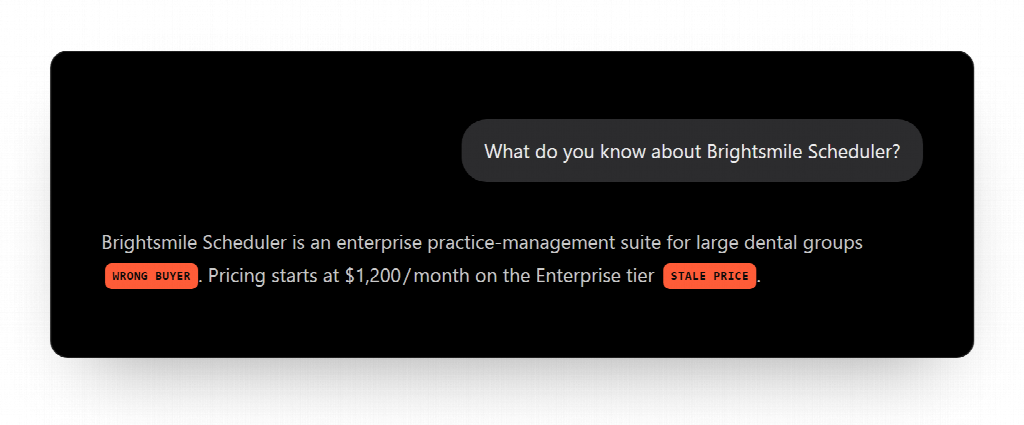
Here’s how that went for one company we audited, details changed to keep them anonymous: a thirty-person shop selling scheduling software to dental clinics, a decent site, no idea how it read to a machine.
Check one was the wake-up. ChatGPT called them an “enterprise practice-management suite” and quoted a price tier they had retired a year earlier. Their actual buyer is a two-dentist clinic, and that old number scared off exactly those people.
Check two: the one plain sentence saying what they did and who it was for sat in the fourth section, under a hero animation and two testimonials, effectively in witness protection. A visitor, human or model, had to work to reach it.
Check three: a wildcard rule in robots.txt, left behind during a migration, was quietly keeping GPTBot out and doing the job with real dedication.
None of the three took an afternoon. Each turned up something the team didn’t know was there. That’s the normal result, not the unlucky one.
What Actually Moves It
Those checks point at three levers. None of them needs a rebuild.
Access comes first. AI systems read your site through their own crawlers: GPTBot, PerplexityBot, ClaudeBot, and a few others. Block those, or bury your key information in a script that never renders as plain text, and the model doesn’t give up on you. It just assembles a picture of you from somewhere else on the web instead. And that somewhere else, as you can imagine, tends to be less flattering than your own homepage.
Some sites now also publish an llms.txt file, a short plain-text summary of what the business does and which pages matter most, so a model doesn’t have to guess where to look.
Structure is second. A page written to sell doesn’t always answer what a buyer is asking, and a model reads the structure of a page before it reads the persuasion. Structure means clear headings, text broken into real paragraphs, and a layer of technical markup called schema.org, FAQPage and Organization in particular, that labels what each part of the page actually is. It won’t force a citation, but it turns your page from prose a model has to interpret into facts it can lift directly. You can check your own markup with Schema.org’s validator, or let a good GEO tool check the whole set in one pass: crawler access, llms.txt, and your schema.org markup and whether it’s actually valid.
Third is what other sources say about you. Reviews, directory listings, an old forum thread, a competitor’s comparison page. An AI answer often pulls from these, not only from your own site, because the model treats an outside source as independent confirmation rather than a business describing itself. Here’s the part most people miss: the set of sources a model leans on is different for every business. There is no single master list you can cover once and call it done. Two companies in the same category can have completely different sets of sites feeding their AI answers, which is why a generic “get listed in these ten directories” checklist only ever gets you part of the way.
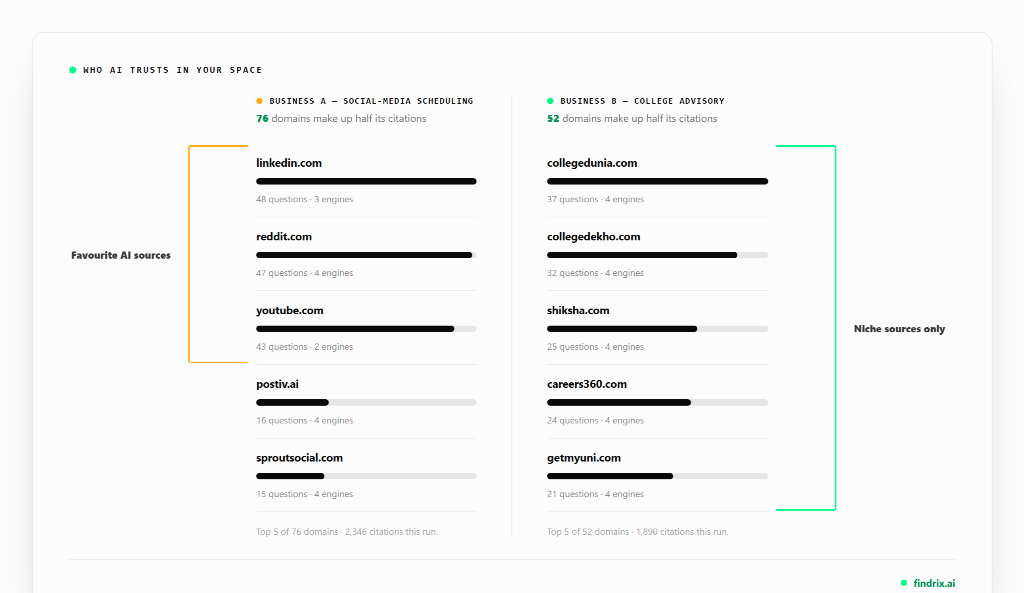
If someone asks an assistant to compare you with a competitor and your own site never addresses that comparison, the model fills the gap with whatever it finds, and that source may not be current or fair to you.
Why This Isn’t a One-Time Fix
Here’s where the last two caveats come back around. If the answer drifts between runs and can lag reality by weeks, then “fix it once and move on” doesn’t hold. A model doesn’t update the moment you correct a page. What it says about you today can trail the truth by weeks, and for a memory-first tool, by a whole model version. Fix the page, and the old description can keep showing up for a while.
So the work is a loop, not an audit with an end date: check, fix, re-check. Running that periodic check, something like Findrix, tells you whether a fix actually landed or whether the model is still repeating the old story. None of this guarantees a mention every time. No method does yet, and anyone who promises otherwise is overselling. What it does is move you from invisible to considered: named correctly when someone asks for a comparison, included instead of skipped when someone asks for options.
Where to Start
None of this needs a quarterly plan. A realistic first week: ask two or three assistants what they know about your business, logged out and incognito, and write down what’s wrong. Check robots.txt, and confirm your homepage states who you are and who you’re for in the first paragraph. Or, to cut the guesswork, run your site through an AI visibility audit rather than eyeballing it, since a tool asks the same questions repeatedly and reports how often each problem shows up, instead of leaving you to judge from one noisy look.
Then pick the single worst gap, a wrong description, a missing comparison, a buried answer, and fix that one thing. Re-check a few weeks later to see whether the model caught up.
The businesses figuring this out now aren’t doing anything mysterious. They check, on a normal schedule, whether an AI system can find, read, and trust what’s on their site, and they fix what’s missing one piece at a time.
About the author

Iosif Merman is the founder and GEO data scientist at Findrix. He has run hundreds of AI-visibility audits for businesses trying to understand how AI systems describe them. Connect with Iosif on LinkedIn.






Comment