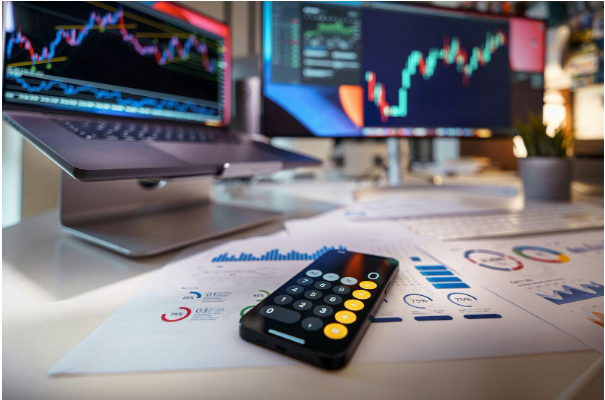
Traders and stock market players will be interested in why the stock market is going up and what new companies on the stock market have emerged. Geopolitical news and other factors are influencing the market’s dynamics. The S&P 500 prediction rose 3% amid rising expectations for a Federal Reserve rate cut in December, as well as positive sentiment regarding the second quarter’s growth after Alphabet’s earnings report.
However, there are also negative factors: monitoring the fundamental balance of the global oil market due to OPEC+ global economic growth, and monitoring the situation of financially weak countries due to economic slowdowns and high rates. We’ll cover each in turn.
Main Reasons the Stock Market Is Going Up
The market continues to rely heavily on geopolitics. But the news of trading is evident in growth. Gold prices stabilized above $4,000/oz in November and maintained a potential return to their all-time high of $4,398/oz, which could be renewed if geopolitical or economic uncertainty intensifies. However, a potential strengthening of the dollar could pose a barrier to overall commodity price growth.
US and European stocks attempted to recapture short-term uptrends at the end of November, rising above resistance levels at 6,750 and 5,640 points for the S&P 500 and Euro Stoxx 50 indices, respectively, which could pave the way for renewed record highs.
In the US, intrigue remains over the Supreme Court’s decision on Trump’s trade tariffs: their immediate reversal could trigger economic uncertainty and boost demand for the US dollar, whose index is struggling for the psychologically important 100-point mark. Demand for IT sector shares will also be important for sentiment in the US.
How Macroeconomic Events Shape Market Movement
Sharp market fluctuations are increasing the demand for financial leaders capable of navigating a rapidly changing macroeconomic environment. As a result, many professionals are exploring international opportunities such as chief financial officer jobs in Cyprus to build careers in more stable jurisdictions. The most important part of this profession is the ability to plan your time and adapt to the demands of the exchange.
Trading Hours
Timing is important for trading, as it allows you to effectively exploit market fluctuations and minimize risks. Choosing the right trading time (timeframe) helps:
- Consider market dynamics. Different trading sessions have unique characteristics that affect volatility, liquidity, and price movement.
- Choose market entry points. For example, a 4-hour chart allows you to see intraday dynamics and find good entry points, while a daily chart reflects more global trends.
- Minimize risks. For example, avoid trading on holidays, during important news releases, and at night, when activity in most markets decreases.
Different trading strategies require different approaches to timing. For example, short-term traders may prefer more active sessions, while long-term investors are less sensitive to trading timing. The chief financial officer should always know why the stock market closed today, for example.
Dow Close Time and Key Trading Windows
4:00 PM is the closing time of the New York Stock Exchange (NYSE), which lists markets such as the Dow Jones Industrial Average (US Wall Street 30), the S&P 500 (US 500), and major US stocks.
Key trading windows (extended hours trading):
- Pre-market trading: 4:00 AM to 9:30 AM local time.
- After-market trading: 4:00 AM to 8:00 AM local time.
Trading hours are set by the exchange and are subject to change. They also change when countries switch to daylight saving time (DST).
The exchange may close earlier on days preceding or following stock market holidays. For example, in 2025, the NYSE and Nasdaq were closed at 1:00 a.m. local time on July 3 (Thursday) and November 28 (Black Friday). The next stock day-off is on December 24 (Wednesday).
The current trading schedule, when the futures markets open, can be found on the Moscow Exchange websites.
Market Holidays
Holidays and vacations on US stock exchanges, particularly the NYSE and NASDAQ, are:
- New Year’s Day – January 1;
- Martin Luther King, Jr. Day;
- Presidents’ Day;
- Good Friday;
- Memorial Day;
- Juneteenth;
- Independence Day;
- Labor Day;
- Thanksgiving Day;
- Christmas Day.
If a holiday falls on a Saturday, the stock market typically closes on the preceding Friday. If it falls on a Sunday, the stock market closes on the following Monday.
Is the Stock Market Open New Year’s Day
The clock strikes for everyone, including traders. The New York Stock Exchange (NYSE) is closed on New Year’s Day, including January 1st.
On New Year’s Eve, the stock market continues trading full time, even if the holiday falls on a weekend.
Key Market Trends
To navigate the stock market, it’s essential to understand the global context. Here are the key trends in the global market.
- Technological transformation – a new wave of innovation in quantum computing and biotechnology is attracting capital to these sectors.
- ESG factors – increasing environmental requirements are changing the investment profiles of companies, particularly in the energy sector.
- Structural changes in the labor market – increased productivity due to automation is positively impacting company margins. CB Insights analysts estimate that there are currently 498 private artificial intelligence companies valued at over $1 billion.
- Regulatory environment – stricter requirements for digital platforms are creating new barriers for tech giants.
- Growth in small-cap stocks – analysts predict that the US stock market will be bullish for small-cap companies in 2026, as their earnings are better protected from rising government taxes.
If you’re looking to expand your business to Cyprus, rent an office there, analyze the local market, and develop an appropriate communications strategy tailored to local circumstances. In Cyprus, multidisciplinary business ecosystems such as PUNIN GROUP operate, contributing to the broader development of the local economic environment.