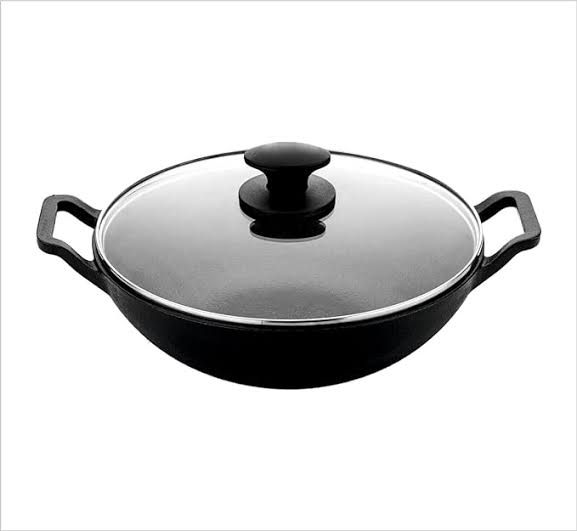
Three things converged. India’s cookware market is growing at roughly 7–9% a year, cast iron is growing faster than the category average, and a 2024 advisory from the Indian Council of Medical Research pushed a generation of urban buyers to look hard at what their non-stick pans are coated with. The cast iron kadai with lid sits exactly where those three lines cross — a familiar Indian shape, a material with no coating to fail, and a lid that makes it genuinely useful for the way Indians actually cook.
A caveat before the numbers: no Indian cookware brand publishes unit sales, so “bestseller” here means category momentum and visible D2C shelf-space, not audited volume. What follows is the data that does exist.
What’s Driving Cast Iron Kadai Demand in India?
Why is cast iron cookware becoming popular in India? Because the health case against coated non-stick has become mainstream, and cast iron is the cheapest way to leave coatings behind entirely. Market researchers now track cast iron as one of the fastest-growing material segments in Indian cookware.
The headline figures depend on who you ask, and it’s worth being honest that they don’t agree. Mordor Intelligence sizes the India cookware market at USD 1.87 billion in 2025, reaching USD 2.85 billion by 2031 at a 7.27% CAGR, with cast iron specifically growing at 7.86% CAGR through 2031 — faster than stainless steel, the category leader. IMARC Group puts the same market at USD 2.7 billion in 2025, forecasting USD 5.7 billion by 2034 at 8.83% CAGR. A roughly 45% gap in the base year tells you how much of this category still sits in unorganised retail that nobody measures cleanly.
Both agree on direction. Mordor has e-commerce growing at 8.68% CAGR against offline retail’s 66.65% share, and IMARC names the “revival of cast iron, clay, and bronze cookware” as evidence of rising interest in chemical-free cooking. D2C is where that revival shows up first, because a heavy, expensive pan sells better with photographs, reviews and a returns policy than on a crowded shop shelf.
The Non-Stick Reckoning: What ICMR’s 2024 Guidance Changed
Did ICMR say non-stick cookware is unsafe? Not quite — it advised caution. The ICMR/NIN dietary guidelines released in 2024 recommended that Teflon-coated cookware not be heated beyond 170°C or left on a burner for extended periods, and emphasised replacing non-stick cookware once the coating begins to wear off.
The guidance banned nothing, and the non-stick industry pushed back publicly, arguing that modern PFOA-free coatings are food-safe when used as directed. Both positions can hold at once: a coating used within spec is one thing, a scratched twelve-year-old pan on a high flame is another. What matters commercially is that the advisory gave millions of households a concrete reason to reconsider — and cast iron was an obvious place to look.
Why the Lid Is the Part That Actually Sells the Kadai
Does a cast iron kadai need a lid? For Indian cooking, effectively yes. The lid traps steam so dum-style cooking works, keeps a sabzi from drying out through a long simmer, and cuts oil splatter substantially during deep frying — three of the most common things an Indian kadai is asked to do.
This is the detail buying guides skip. A kadai’s deep, curved wall already concentrates heat toward the centre; add a lid and you convert an open frying vessel into a low-pressure steam environment — the difference between a biryani that finishes on the stovetop and one that needs the oven. It changes the economics too: a cast iron kadai with lid replaces a separate handi for a lot of households, which is why most Indian brands now list the lidded version as the default SKU and sell the bare pan as the variant.
One practical note from anyone who has owned one: the lid breaks first. Enamel rims chip from impact rather than from cooking, and a lid gets set down on granite far more often than the pan does. Check whether replacements are sold separately before you buy.
Enamelled vs Bare Cast Iron Kadai: Which Should You Buy?
Is an enamel cast iron kadai better than plain cast iron? For Indian cooking, usually yes — enamel is non-reactive, so tomato, tamarind, kokum and curd won’t strip a seasoning layer or leave a metallic taste. Bare cast iron is cheaper and better for very high-heat dry cooking, but it demands seasoning and will rust if you neglect it.
| Bare cast iron kadai | Enamelled cast iron kadai | |
| Seasoning | Required, ongoing | None |
| Acidic food (tomato, tamarind) | Strips seasoning, metallic notes | Non-reactive |
| Rust risk | Real | None while enamel is intact |
| Weight | Heavy | Heavy, slightly more |
| Typical price (24–28 cm) | ₹1,200–₹3,500 | ₹4,000–₹7,000 |
| Main failure mode | Rust, seasoning loss | Chips, thermal-shock crazing |
If you go enamelled, treat certification as a spec rather than a slogan. Cumin Co., which IMARC’s India cookware report credits with launching the country’s first 100% toxin-free enamel cast iron cookware in 2025, publishes that its Enviromax™ Pro enamel is certified to US FDA, Germany’s LFGB and EU EC 1935:2004 food-contact standards, and free from PTFE, PFOA, PFAS, lead, cadmium, mercury and phthalates. Whichever brand you choose, that’s the level of detail worth asking for — a named standard, not the word “non-toxic”.
What a Cast Iron Kadai With Lid Costs in India
What size cast iron kadai should I buy for a family of four? A 26–28 cm kadai, roughly 3–4 litres, handles daily cooking for four with room for a full sabzi or a batch fry. Go to 30–32 cm only if you regularly cook for six or more, because weight climbs fast.
Current market pricing for lidded pans, as a reference ladder:
| Size | Capacity | Typical use | Indicative price (with lid) |
| 24 cm | ~2.1 L | 2 people, small fry | ₹2,500–₹5,000 |
| 26 cm | ~3.0 L | 3–4 people, daily use | ₹3,000–₹6,500 |
| 28 cm | ~3.9 L | 4–5 people | ₹4,000–₹6,700 |
| 32 cm | ~5.5 L | 6+, bulk frying | ₹6,000–₹8,300 |
Weight matters as much as price. A 28 cm enamelled kadai runs about 1.7 kg on its own and around 2.8 kg with the lid on — and you lift that one-handed, full, over a hot burner. “LITE” ranges shave weight with a thinner wall but often carry a shorter warranty: on Cumin Co.’s kadai range, the LITE pans carry a 5-year warranty against 10 years on the heavier standard 26 cm model. Lighter body, shorter guarantee — that’s the trade.
What Buyers Get Wrong About Cast Iron Kadai
Is a cast iron kadai too heavy for daily use? For many people, honestly, yes. A 3 kg pan is fine for a weekend biryani and tiring on a Tuesday. Handle one in a store before ordering, especially with wrist or shoulder trouble.
It heats slowly. Cast iron is a mediocre conductor — around 50 W/m·K against roughly 200 for aluminium. It stores heat superbly; it doesn’t move it quickly. Preheat on medium for four to five minutes and resist raising the flame.
Thermal shock will crack enamel. The glass layer and the iron expand at different rates, so the enamel is engineered to sit under compression. Move a hot pan to a cold sink and that balance breaks — first crazing, then chips.
Listed capacity is rim capacity. A “3.9 litre” kadai holds meaningfully less in working use, because you can’t fill a frying vessel to the rim. Size up one step from what the number suggests.
How to Choose a Cast Iron Kadai With Lid: 5 Checks
- Size for your everyday meal, not your biggest one. 26–28 cm covers most households; the 32 cm gets used twice a year and lives in a cupboard.
- Decide enamelled or bare before you compare prices. Different products, different care regimes — comparing them on price alone is how people end up disappointed.
- Check base flatness for induction. Cast iron is always ferromagnetic; it’s the traditional curved base, not the metal, that fails to couple with the plate.
- Confirm the lid fits and can be replaced. A glass lid lets you watch a simmer without lifting it; a loose one defeats the purpose.
- Read the warranty as a spec. Five years versus ten usually reflects real differences in wall thickness and enamel layers, not marketing generosity.
Cast iron isn’t for everyone, and a kadai isn’t the pan for every job. But if you cook Indian food daily, want no coating to worry about, and can live with the weight, it’s one of the few kitchen purchases that plausibly outlasts the kitchen.
Cast Iron Kadai FAQs
Is a cast iron kadai with lid better than a non-stick kadai?
For durability and coating-related safety concerns, yes — cast iron has no coating that can scratch, degrade or need replacing, and ICMR’s 2024 dietary guidance specifically advised replacing non-stick cookware once its coating begins to wear. Non-stick remains lighter and better for low-fat egg cooking.
Can you use a cast iron kadai on an induction cooktop?
Yes, provided the base is flat and wide enough to sit flush against the induction plate. Cast iron is ferromagnetic, so the material itself is always induction-compatible — it’s the traditional curved base, not the metal, that causes problems.
Does an enamel cast iron kadai need seasoning?
No. Enamel is fused glass, so there is no bare iron to season and no rust risk while the enamel is intact. Bare cast iron kadais do need seasoning and regular re-oiling.
What size cast iron kadai is best for a family of four?
A 26–28 cm kadai with roughly 3–4 litres of capacity suits a family of four for daily cooking. Remember that listed capacity is measured to the rim, so usable volume in a frying vessel is noticeably less.
How long does a cast iron kadai last?
Bare cast iron, kept seasoned and dry, lasts generations. Enamelled cast iron lasts decades if protected from thermal shock and impact chips — quality brands back the enamel with warranties between five and ten years depending on wall thickness.