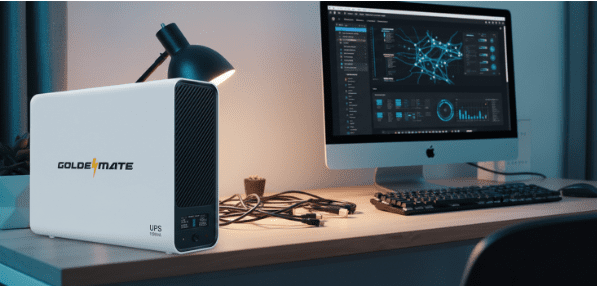
There was a time, not too long ago, when “backup power” meant keeping a heavy, leaden box under your desk that functioned like a dusty anchor. These traditional Valve Regulated Lead-Acid (VRLA) batteries were the industry standard for decades—not because they were particularly good, but because they were the only viable option.
Fast forward to 2026, and the landscape has shifted entirely. We are witnessing a massive industrial migration away from legacy chemistries toward Lithium Iron Phosphate. If you are still relying on old-school tech to protect your servers or home office, you aren’t just behind the curve; you are likely overpaying for inferior performance. Understanding the LiFePO4 vs Lead-Acid UPS debate is no longer just for engineers—it is essential knowledge for anyone serious about uptime.
The Chemistry of Reliability: What Changed?
The dominance of LiFePO4 (Lithium Iron Phosphate) in 2026 isn’t just marketing hype; it is rooted in fundamental molecular stability. Unlike standard Lithium-ion (NMC) batteries found in phones or laptops, LiFePO4 is remarkably resistant to thermal runaway. It doesn’t catch fire if punctured, and it doesn’t degrade nearly as fast under high-heat conditions.
For a UPS system, which often sits in poorly ventilated server closets or tucked behind warm CPU exhausts, this thermal resilience is a game-changer. When we look at a UPS battery technology comparison, the primary advantage is that LiFePO4 can operate safely at temperatures that would cause a lead-acid battery to swell, leak, or fail prematurely.
The “Hidden” Cost of Cheap Batteries
One of the most common mistakes IT managers and home users made in the past was focusing on the “upfront” sticker price. Lead-acid units are undoubtedly cheaper at the checkout counter. However, by 2026 standards, they are an economic trap.
The Cycle Life Gap
A typical lead-acid battery is rated for about 300 to 500 charge cycles. In a region with an unstable grid, you could burn through those cycles in less than two years. In contrast, Lithium Iron Phosphate UPS batteries are frequently rated for 2,000 to 5,000 cycles.
When you do the math, a single Goldenmate LiFePO4 unit will outlast five or six lead-acid replacements. You aren’t just buying a battery; you are buying a decade of “set it and forget it” security. In 2026, the labor cost and downtime associated with swapping out dead lead-acid batteries every 18 months simply doesn’t make sense for a modern business.
Performance Under Pressure: Discharge and Depth
In the “old days,” you could never truly use 100% of your UPS battery. If you drained a lead-acid battery past 50% capacity, you would permanently damage its ability to hold a charge. This meant that if you bought a 1000VA lead-acid unit, you really only had about 500VA of “safe” usable energy.
LiFePO4 has changed the rules of engagement. You can routinely discharge these units to 80% or even 90% of their capacity with negligible impact on their long-term health.
Why Weight and Volume Matter in 2026
Modern offices are leaning toward minimalism and high-density setups. Lead is heavy—period. A LiFePO4 unit provides the same amount of energy (or more) at roughly 40% of the weight. This allows for:
- Easier Rack Mounting: Less strain on server rack rails.
- Portability: The ability to move backup power to different rooms or mobile workstations without needing a dolly.
- Wall Mounting: New form factors that allow UPS systems to be mounted on walls like pieces of art rather than hidden on the floor.
The Environmental Imperative
As we move deeper into 2026, corporate ESG (Environmental, Social, and Governance) goals are no longer optional. Lead-acid batteries are toxic. While recycling programs exist, the mining and processing of lead are environmentally taxing.
LiFePO4 is widely considered the “greenest” of the lithium chemistries. It doesn’t contain cobalt (which has a controversial supply chain) or lead. Because these batteries last five times longer, the total volume of electronic waste being sent to landfills is slashed by 80%. Choosing a modern UPS is now a vote for sustainability as much as it is a vote for hardware protection.
Intelligent Management for Modern Grids
The “Standard” for 2026 also includes how the battery talks to your hardware. Because LiFePO4 batteries require a Battery Management System (BMS) to function, they are inherently more “intelligent” than lead-acid blocks.
A Goldenmate UPS with LiFePO4 technology provides granular data. It can tell you the health of individual cells, the precise remaining runtime based on current load, and can proactively alert you before a failure occurs. Traditional batteries usually just “die” one day, leaving you unprotected until the next time the power goes out and your computer crashes.
Conclusion: Making the Final Switch
The verdict for 2026 is unanimous among tech experts: Lead-acid is a legacy technology that has overstayed its welcome. Whether you are protecting a high-end AI workstation, a home security system, or a small business server, the reliability, longevity, and safety of Lithium Iron Phosphate are unmatched.
The transition to a higher standard of power doesn’t have to be complicated. By understanding the core differences in battery chemistry, you can make an investment that pays for itself in avoided hardware repairs and reduced replacement cycles.
Are you ready to stop worrying about your battery health? Read our full breakdown on understanding UPS battery types: Lead-Acid vs. LiFePO4 to see exactly why the industry has moved on—and why you should too.