There is a temptation to talk about artificial intelligence as if the future will arrive through software alone.
New tools appear every week, companies announce new systems, and AI is becoming part of work, education, and public services.
But the real question is not whether students will encounter AI. They already are.
The better question is whether they will know how to use it well.
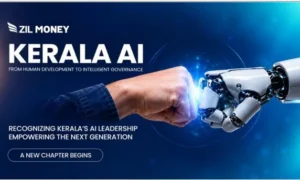
That was one of the strongest ideas behind “Kerala AI: From Human Development to Intelligent Governance,” a program held at Zil Money Campus in Manjeri on September 12, 2026.
The event connected Kerala’s wider AI conversation with a student-focused announcement: Zil Money AI Future 100.
The initiative aims to support 100 students across Kerala with computers and AI learning opportunities. It addresses the gap between hearing about AI and getting the chance to learn it through practice.
AI literacy is more than knowing a tool
A student can open an AI chatbot in seconds.
That does not mean the student understands artificial intelligence.
Useful AI literacy includes knowing how to ask a clear question, evaluate an answer, check a factual claim, protect personal information, and decide when a human should make the final judgment.
These skills matter because AI can be convincing even when it is wrong. A polished response can still contain a bad assumption, an invented fact, or an incomplete explanation.
Students therefore need more than prompt-writing tricks.
They need the habit of asking, “How do I know this is correct?”
That habit will matter in almost every field.
A commerce student may use AI to work with a spreadsheet. A designer may use it to explore ideas. A science student may use it to explain a concept. A programmer may use it to find an error in code.
In each case, the student still needs enough knowledge to judge the result.
Access and learning have to move together
AI Future 100 was introduced with two connected ideas: computers and learning support.
A student who does not have reliable computer access may find it difficult to practice beyond a short demonstration. At the same time, a computer without direction can easily become just another screen.
Real learning happens through repetition.
Students try something, make mistakes, compare results, save their work, and return to the problem.
Consider a simple school activity.
A student asks an AI tool to summarize a chapter they already studied. Instead of copying the summary, the student compares it with the textbook, finds what is missing, identifies any weak claims, and rewrites the answer.
The AI helps with the task, but the student remains responsible for the thinking.
That is a far better model for education than teaching students to accept the first generated answer.
The program puts people before systems
The title “From Human Development to Intelligent Governance” is broader than education, but students fit naturally into it.
Human development is about building people’s ability to participate, make choices, and create opportunities.
Intelligent governance is about using technology to improve systems and services without losing responsibility and human oversight.
Those ideas meet in education.
If AI becomes more common in government, companies, schools, and everyday services, people need enough understanding to recognize what the system is doing and when it may be wrong.
That starts with learning.
The Kerala AI program did not present AI Future 100 as a government program or a completed training system. It introduced it as a Zil Money initiative and an educational goal.
Keeping that distinction clear makes the announcement stronger because readers can judge it based on what has actually been promised.
What should happen next
The next stage matters more than the launch.
Students and parents will need to know who can participate, how students will be selected, what computers will be provided, what the training will cover, and how learning will be supported over time.
The launch materials do not yet answer all of those questions, and they should not be filled with assumptions.
What the program does establish is a useful direction: AI education should not be limited to watching demonstrations or chasing the latest tool.
Students need access, practice, guidance, and the ability to think for themselves.
Kerala’s AI future will eventually be shaped by systems, policies, businesses, and institutions.
But it will also be shaped by the students who learn how to use those systems.
Preparing them is not a side project.
It is part of the foundation.
Disclosure: This article was commissioned by OnlineCheckWriter.com, a Zil Money platform. The author is an independent contributor and received compensation for creating this content.