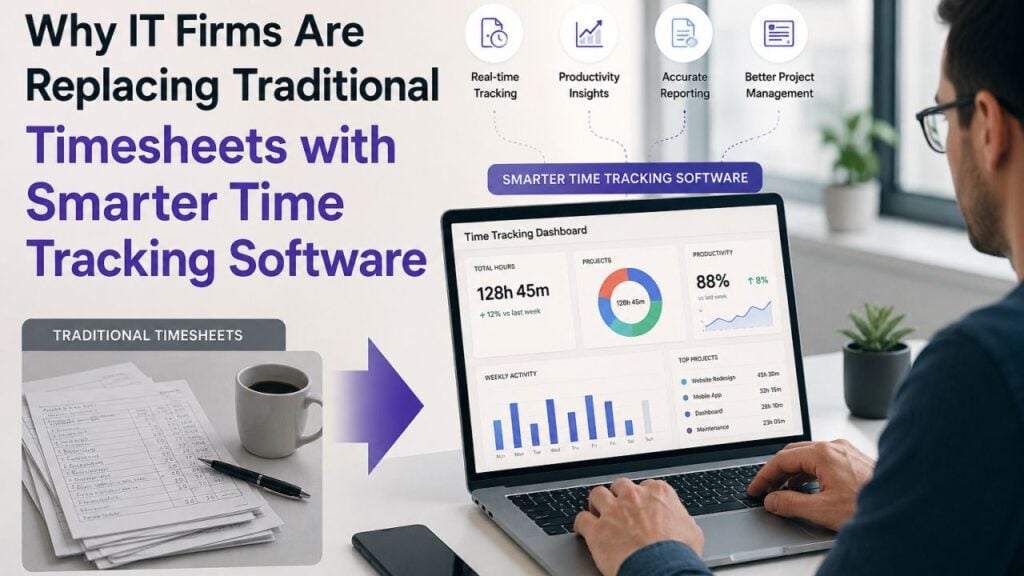
For years, IT companies relied on spreadsheets, manual timesheets, and basic attendance tools to manage employee work hours. But modern technology teams no longer work in a single office, on a single project, or even on a fixed schedule.
Today’s IT firms operate across remote teams, client projects, flexible shifts, and fast-moving deadlines. In this environment, outdated tracking methods often create more confusion than clarity.
That’s why more businesses are shifting toward smarter time tracking software that helps teams improve visibility, productivity, and operational efficiency without increasing administrative workload.
From startups to enterprise technology companies, the goal is no longer just tracking attendance. It’s understanding how time impacts project delivery, profitability, and team performance.
Why Manual Timesheets Are Failing Modern IT Teams
Traditional timesheets were designed for simpler work environments. Modern IT operations are far more dynamic.
Developers switch between coding, meetings, testing, debugging, and collaboration tools throughout the day. Manually recording all these activities accurately becomes difficult and time-consuming.
As a result, businesses often struggle with:
- Inaccurate work-hour reporting
- Missed billable hours
- Delayed payroll processing
- Poor visibility into project progress
- Difficulty managing remote employees
For growing technology companies, these issues create operational blind spots that directly affect profitability and delivery timelines.
Manual tracking also creates frustration for employees. Constantly filling timesheets at the end of the day usually leads to forgotten tasks and inaccurate entries.
This is one reason why many organizations are now investing in employee time tracking software that automates much of the process.
What the Best Time Tracking Software Helps IT Firms Improve
Modern businesses are no longer looking for software that simply records login and logout times. They want systems that provide actionable insights.
The best time tracking software helps IT firms understand:
- How project hours are being utilized
- Which tasks consume the most time
- Whether workloads are balanced across teams
- How productive work hours align with project deadlines
This visibility helps managers make faster and more informed decisions.
For example, if one development team consistently spends extra hours fixing issues, managers can identify bottlenecks earlier and adjust resources before deadlines are affected.
Similarly, client-facing IT firms benefit from accurate billable-hour tracking, making invoicing more transparent and reliable.
With the right employee time tracking software, businesses can:
- Reduce manual administrative work
- Improve project planning accuracy
- Simplify payroll calculations
- Increase accountability across teams
- Track productivity patterns more effectively
Instead of relying on assumptions, managers gain access to real operational data.
Essential Features IT Companies Should Prioritize
Not every solution is built for the fast-paced nature of technology companies. Choosing the right platform requires understanding which features actually solve operational challenges.
The most effective IT time tracking software typically includes a combination of automation, reporting, and workforce visibility tools.
Key features businesses should look for include:
1. Automatic Time Tracking
Automated tracking reduces the need for manual timesheet entries and improves reporting accuracy.
2. Attendance and Shift Monitoring
A reliable time and attendance tracking software should simplify attendance management for both in-office and remote employees.
3. Real-Time Reporting
Managers need instant visibility into project progress, team activity, and workload distribution.
4. Productivity Insights
Understanding how time is spent across applications, tasks, and workflows helps businesses identify inefficiencies.
5. Mobile and Desktop Accessibility
Hybrid and remote teams require flexibility across multiple devices and work environments.
6. Project and Tool Integrations
The software should connect smoothly with project management and collaboration platforms already used by IT teams.
Features alone, however, are not enough unless they solve real business problems.
Why Time and Attendance Tracking Software Is Becoming a Business Decision
Many companies initially adopt tracking systems for attendance purposes. But over time, they realize the broader operational value.
Modern time and attendance tracking software plays an important role in workforce planning, project forecasting, and employee management.
Without proper tracking:
- Managers rely heavily on assumptions
- Workload imbalances go unnoticed
- Project delays become harder to predict
- Payroll discrepancies increase
With smarter tracking systems:
- Teams gain operational visibility
- Resource allocation improves
- Productivity trends become measurable
- Managers can identify burnout risks earlier
This is especially important for remote and hybrid IT environments where visibility into day-to-day operations is naturally limited.
Tracking software also helps organizations improve accountability without creating a micromanagement culture. When implemented transparently, employees gain clearer priorities, structured workflows, and better workload distribution.
For many businesses, this shift has transformed time tracking from an HR tool into a strategic operational system.
How to Choose the Right Time Tracking Software for IT Firms
Selecting the right solution requires more than comparing feature lists.
Many businesses choose overly complex platforms that employees struggle to adopt consistently. Simplicity and usability often matter more than excessive functionality.
When evaluating time tracking software for IT firms, businesses should focus on:
- Ease of implementation
- Scalability for growing teams
- Flexible reporting capabilities
- Integration support
- User-friendly employee experience
A platform that employees actively use will always deliver better long-term value than one packed with underutilized features.
Before making a decision, businesses should ask:
- Can the software support remote and hybrid teams?
- Does it simplify attendance management?
- Can managers monitor project progress in real time?
- Will employees find it easy to use daily?
- Does it improve both productivity and operational visibility?
The answers to these questions often determine whether a tool becomes genuinely useful or simply another dashboard teams ignore.
Final Thoughts
Technology companies are moving beyond traditional timesheets because modern work environments demand deeper visibility and smarter workforce management.
Today, time tracking software is no longer limited to recording employee hours. It helps businesses improve project planning, optimize resources, manage distributed teams, and make better operational decisions.
As remote work, hybrid teams, and client-driven projects continue to grow, businesses that rely on outdated tracking methods may struggle to maintain efficiency and accountability.
The companies gaining an advantage are the ones using smarter employee time tracking software to turn everyday work data into actionable business insights.