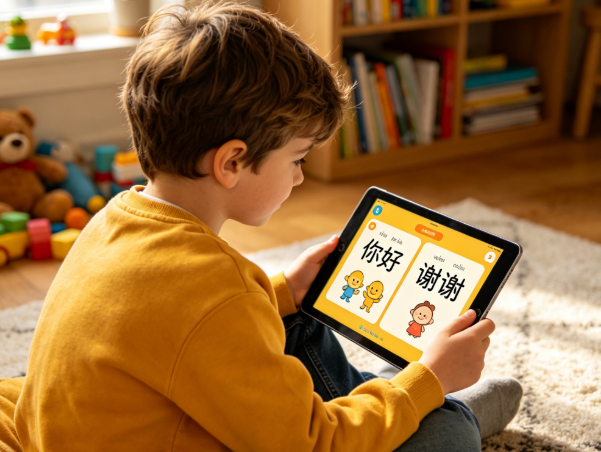
The global economy is rapidly evolving, and the world’s most successful tech visionaries are no longer just investing in artificial intelligence, quantum computing, or aerospace. They are investing heavily in a critical piece of linguistic infrastructure for their own children: Mandarin Chinese.
In a world driven by cross-border engineering teams and complex supply chains, top leaders recognize that global fluency is the ultimate competitive edge.
Why Elon Musk and Jeff Bezos Prioritize Mandarin for the Next Generation
Tech pioneers don’t make educational choices based on passing trends; they look decades into the future.
Recently, Tesla and SpaceX CEO Elon Musk made headlines during a diplomatic business trip to Beijing, where he shared on the X platform that his young son is actively learning Mandarin. Similarly, Amazon founder Jeff Bezos and his ex-wife MacKenzie famously curated an intense, forward-thinking educational curriculum for their children that prioritized Mandarin immersion alongside advanced science and Singapore math. In WuKong Math, you can also find this immersion between subject knowledge and language usage.
Why do the world’s most disruptive minds share this obsession? They understand a fundamental truth: the architecture of the future tech economy is being written bilingual. To lead on the global stage, the next generation must be able to communicate fluently with the two main engines of modern innovation—the United States and China.
4 Ways Learning Chinese Prepares Kids for the Future Tech Economy
Linguistic skills translate directly into geopolitical and economic leverage. Here are four foundational ways mastering Mandarin equips children to thrive in a tech-centric future:
Understanding the Hub of Global Hardware and Innovation
While Silicon Valley remains a dominant force in software development, regions like Shenzhen, Shanghai, and Taiwan are the undisputed global capitals of hardware manufacturing, advanced robotics, and semiconductor logistics. You cannot fully master hardware supply chains or scale physical tech hardware without interacting directly with the source. Knowing Mandarin eliminates reliance on translators, allowing future tech leaders to collaborate directly with engineers on the factory floor.
Developing the “Bilingual Advantage” in Business Negotiations
In high-stakes tech mergers, venture capital rounds, and international intellectual property discussions, nuance is everything. Relying on an intermediary means losing subtle emotional cues, cultural context, and bargaining power. Speaking Mandarin allows a professional to build deep, authentic cross-cultural trust (guānxī), which is often the deciding factor in closing major international business deals.
- Accessing the Digital Frontier: China hosts self-contained, massive digital ecosystems (such as Tencent, Alibaba, and ByteDance) that pioneer global trends in micro-payments, live-stream commerce, and AI-driven consumer tech. Mastery of the language gives young professionals direct access to study and implement these leading frameworks.
- Cross-Border Leadership: The most successful software and engineering projects are rarely built in a single country. Future tech executives who can bridge the cultural and linguistic divide can seamlessly manage cross-functional, global teams.
The Cognitive Link: Why Learning Chinese Makes You Better at Logic and Coding
There is an incredible, mathematically elegant overlap between computational logic and the structural nature of Mandarin Chinese.
Unlike Western phonetic languages, Chinese is logographic (using characters to represent ideas or morphemes) and tonal. This unique structure fundamentally alters how the brain processes information.
Neuroscience Insight: Brain imaging studies show that processing English relies primarily on the left temporal lobe. However, Mandarin speakers activate both the left and right hemispheres of the brain, engaging the right hemisphere to process the musicality of tones and visual character mapping.
This dual-hemisphere engagement sharpens spatial recognition, abstract thinking, and pattern analysis—the exact cognitive foundations required for software engineering.
| Skill Dimension | Mandarin Language Impact | Algorithmic / Coding Parallel |
| Structure | Modular components (radicals) combine to build complex, new meanings. | Independent code blocks and functions combine to build complex programs. |
| Cognition | High spatial, tonal, and pattern recognition requirements. | Strong reliance on pattern tracking and strict syntax precision. |
| Grammar Logic | Highly regular structure with zero irregular verb conjugations or gendered nouns. | Clean syntax rules with predictable outcomes and zero tolerance for random deviations. |
In fact, Chinese vocabulary scales like an object-oriented programming language. For instance, the word for “computer” is 电脑 (diànnǎo), which literally translates to “electric brain.” The language reuses foundational “objects” or concepts to dynamically construct new terminology, fostering a highly structured, algorithmic mindset in young learners.
How WuKong Education Uses Technology to Make Learning Mandarin Efficient
Mastering a complex, tonal language used to require thousands of hours of tedious, rote memorization. Today, specialized educational technology has completely re-engineered the process, making it accessible to busy students worldwide.
WuKong Education leverages advanced, interactive learning platforms to bring elite native-speaking instructors directly into your home. By utilizing gamified curricula, data-driven personalization, and cognitive mapping techniques, WuKong ensures that children remain engaged and retain what they learn. This targeted approach respects a child’s busy schedule, transforming language acquisition from a chore into an efficient, rewarding, and highly interactive experience.
Conclusion: Is Your Child Prepared for a Multilingual Tech World?
When tech billionaires enroll their children in Mandarin classes, they aren’t looking for a basic resume-builder—they are securing structural leverage for their children’s future careers. As AI, automated logistics, and globalized engineering networks continue to shrink the globe, monolingual professionals will find themselves at a severe disadvantage. Investing in your child’s Chinese language education today is the ultimate way to ensure they are fully equipped to build, lead, and innovate in tomorrow’s multi-polar tech ecosystem.
Learn more about this trend by watching this report on tech leaders prioritizing Mandarin, which highlights Elon Musk’s recent social media updates detailing how his youngest son is learning the language during their travels to global tech hubs.