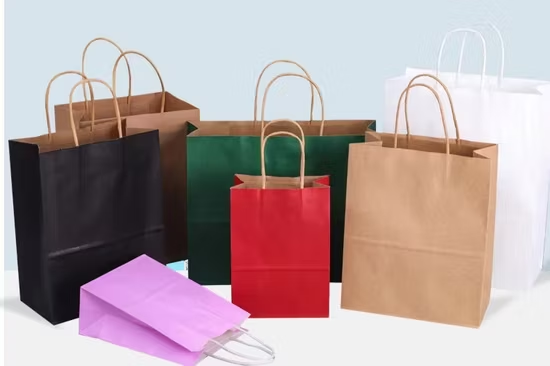
Packaging decisions are rarely made in isolation. They sit at the intersection of cost control, speed, storage limits, and day-to-day reliability. For many businesses, especially those handling lightweight or short-carry products, handle-free paper bags remain a deliberate operational choice rather than a fallback. When paired with custom paper bag printing no handle, these bags serve a clear purpose. They communicate brand identity, product information, or handling cues without adding unnecessary material or slowing down packing workflows. The value comes from predictability and consistency, not visual excess. Understanding where handle-free bags fit and how printing affects their use helps teams avoid mismatched expectations, wasted inventory, and frequent reorders.
Where Handle-Free Paper Bags Fit Best Operationally
Handle-free paper bags tend to perform best in environments where speed, simplicity, and space efficiency matter more than long-term carrying comfort. Their design supports fast handoffs and compact storage, which often outweigh the need for added reinforcement.
High-turnover retail and food service settings
In counters, bakeries, cafes, and takeaway operations, packing speed affects customer flow. Bags without handles reduce packing steps and take up less space behind the counter. They work well when:
- Products are light and meant for short-distance carrying.
- Customers are expected to open or transfer items quickly.
- Storage areas need to hold large quantities in limited space.
In these settings, custom paper bag printing no handle supports recognition and clarity without interrupting the pace of service.
Industrial, wholesale, and internal distribution use
Beyond customer-facing roles, handle-free paper bags often support internal processes. They may hold parts, samples, or grouped items during sorting and movement across facilities. Printed information helps reduce errors by:
- Clearly identifying contents at a glance.
- Supporting handoffs between teams or shifts.
- Removing reliance on separate labels that can detach.
Here, printing plays a functional role tied directly to workflow stability.
How Printing Shapes the Practical Use of Handle-Free Bags
Printing changes how a simple paper bag behaves in real use. It affects how quickly it is identified, how reliably information stays visible, and how consistently it performs across batches.
Clear branding without unnecessary complexity
Without handles interrupting the surface, design placement becomes more predictable. This allows for restrained layouts that stay legible even when bags are stacked or partially folded. Effective printing focuses on:
- Clean placement that avoids fold lines.
- Limited color use to preserve clarity.
- Designs that remain readable during handling.
For businesses ordering custom paper bag printing no handle, this simplicity often results in fewer print issues and more consistent output.
Information that supports daily decisions
Printed bags often guide quick decisions on the floor. Staff rely on visual cues when selecting packaging under time pressure. Common printed elements include:
- Product or category identifiers.
- Handling or usage notes.
- Internal reference markers.
When designed with use in mind, these details reduce mistakes without slowing operations.
Material and Print Decisions That Affect Reliability
Not all paper bags behave the same once they enter circulation. Choices around paper quality and print methods influence durability, legibility, and overall consistency.
Matching paper behavior with print intent
Paper absorbency and surface finish affect how ink settles. Dense printing on unsuitable paper can lead to smudging or weakened structure. Reliable outcomes depend on aligning:
- Print coverage with paper strength.
- Ink type with surface characteristics.
- Visual expectations with handling conditions.
These considerations matter more over time than initial cost savings.
Placement that respects folding and stacking
Handle-free bags are folded tightly and stored in bulk. Designs that ignore crease points or stacking orientation tend to wear faster. Thoughtful layouts account for:
- Where stress points form during use.
- How bags appear when stacked upright.
- Visibility when bags are partially filled.
This ensures printed details remain useful throughout the bag’s lifecycle.
Cost Control Without Sacrificing Consistency
Handle-free paper bags are often chosen for cost efficiency. Printing should reinforce that goal by supporting repeatability and ease of reordering.
Stability across repeat orders
Frequent design changes increase setup complexity and raise the risk of inconsistencies between batches. Operational packaging benefits from staying steady over time. Consistent custom paper bag printing no handle helps:
- Simplify procurement and approvals.
- Maintain uniform appearance across locations.
- Reduce variability during scale-up.
This stability supports planning and inventory control.
Scaling production without quality drift
As order volumes increase, minor print variations can turn into operational issues. Color shifts, alignment changes, or inconsistent ink density affect recognition and trust. Working with a supplier experienced in repeat runs helps maintain uniform results without adding layers of oversight.
Practical Design Over Visual Impact
Handle-free paper bags are not meant to compete for attention. Their role is to support efficient handling and clear communication. Designs that work best tend to:
- Prioritize legibility over decoration.
- Use restrained layouts that respect material limits.
- Reflect how the bag is actually used on the floor.
This approach keeps packaging aligned with real workflows rather than idealized presentations.
Closing Perspective
Handle-free paper bags continue to serve a clear purpose in modern operations. When printing decisions account for material behavior, storage patterns, and daily handling, these bags become a reliable part of routine work. The value of custom paper bag printing no handle lies in consistency and clarity. Done thoughtfully, it reduces friction, supports staff decisions, and keeps packaging predictable without drawing attention away from the product it carries.