Google’s AI Overviews have fundamentally transformed how businesses compete for search visibility—shifting the game from ranking blue links to earning AI citations. With AI-generated summaries now appearing in over 50% of all searches as of August 2025, the rules of SEO have been rewritten. This guide examines the documented impact, explains how AI Overviews select sources, and provides a strategic framework for adapting your optimization approach.
The Shift From Rankings to AI Citations
AI Overviews represent the most significant change to Google’s search interface in two decades—prioritizing synthesized answers over traditional organic listings. When Google introduced AI Overviews (formerly Search Generative Experience) in May 2024, most SEO practitioners assumed their existing optimization tactics would transfer directly. The reality proved far more complex.
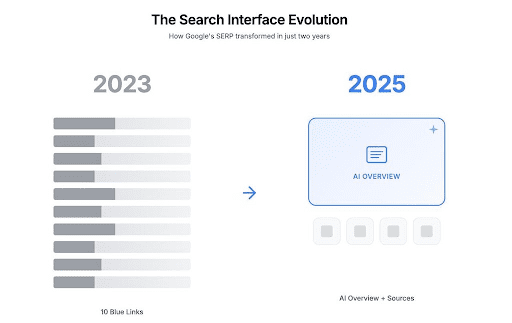
Alt text: Infographic comparing Google search evolution: 2023 shows 10 stacked blue link bars, while 2025 displays a single AI Overview box with four source icons beneath it.
Unlike traditional search results that present a list of ten blue links, AI Overviews generate comprehensive summaries at the top of the SERP, pulling information from multiple sources and presenting it as a unified answer. This fundamentally changes user behavior. Instead of clicking through to explore different websites, users now receive immediate answers directly within Google—often without needing to visit any external site.
The expansion has been aggressive. According to seoClarity’s research, AI Overviews appeared for 30% of U.S. desktop keywords by September 2025—a staggering 536% increase from the previous year in the UK market. Mobile visibility has surged nearly 475% year-over-year. Google CEO Sundar Pichai has publicly stated that AI results lead to a 10% increase in usage for queries where they appear, particularly for complex, multi-part questions.
ICODA has been tracking how AI Overviews select sources across thousands of queries, identifying patterns that distinguish pages earning citations from those being bypassed. Their analysis reveals that success in this new landscape requires a fundamentally different approach than traditional SEO.
Documented Impact on Traffic and Click-Through Rates
Organic click-through rates have declined significantly when AI Overviews appear—dropping from 1.41% to 0.64% for affected queries. This represents more than a 50% reduction in clicks for the same ranking positions. The data comes from Seer Interactive’s analysis tracking over 10,000 keywords through the first three quarters of 2025.
The traffic impact varies by query type. Informational and educational queries—those most vulnerable to AI Overviews—have experienced the steepest declines. An Ahrefs study from June 2024 found websites losing an average of 24% organic traffic, with some experiencing drops of up to 45% without losing any ranking positions.
Here’s what makes these numbers particularly challenging: queries without AI Overviews aren’t increasing in CTR as hoped. They’re simply declining more slowly. Non-AIO queries still outperform (1.62% vs 0.61% organic CTR), but they’ve lost 41% of their click-through rate year-over-year when comparing September 2025 to September 2024.
However, the story isn’t entirely negative. While many sites have seen organic search traffic decline sharply in 2025 due to AI-generated overviews and answer engines reshaping how users find information, the visitors who do click through are often higher-intent and convert much better. For example, an Ahrefs analysis published mid-2025 found that although AI search visitors composed only a small share of total site visits, they generated disproportionately high conversion outcomes — converting up to 23× better than traditional search traffic and accounting for a significant share of sign-ups relative to their volume. This suggests that users clicking through from AI-powered summaries are further along in the decision process and more engaged than average visitors, offsetting some of the impact of declining raw traffic.
As Vlad Pivnev from ICODA puts it: “The game changed overnight. Traffic volume is no longer the metric that matters—it’s citation presence and conversion quality. Brands that optimize for AI visibility are seeing visitors convert at dramatically higher rates, even as raw traffic declines.”
How AI Overviews Select and Cite Sources
Google’s AI Overviews use a multi-stage pipeline to select sources—combining retrieval systems, semantic ranking, and LLM-powered re-ranking to determine which content earns citations. Understanding this process is essential for optimizing your content for inclusion.
The selection process works through several distinct phases:
Stage 1: Retrieval — Google’s systems identify candidate sources using semantic and keyword signals, scanning publications, blogs, forums, and repositories across the web.
Stage 2: Initial Ranking — Core search ranking factors apply, including E-E-A-T (Experience, Expertise, Authoritativeness, Trustworthiness), domain authority, and content freshness.
Stage 3: Semantic Re-Ranking — The system evaluates contextual relevance for the specific query, assessing how well each source addresses the user’s actual intent.
Stage 4: LLM Re-Ranking — Google’s Gemini model assesses which sources provide “sufficient context”—enough complete information for the AI to generate an accurate answer without requiring external supplementation.
Stage 5: Data Fusion — Multiple sources are combined into a coherent narrative with inline citations. Typically 5-15 final sources appear in each AI Overview.
Research from Ahrefs shows that 76% of AI Overview citations come from pages ranking in the top 10 organic results. A Writesonic study of over 1 million AI Overviews found an 81.10% chance that at least one URL from Google’s top 10 SERP results will be cited. Pages ranking #1 see citation rates of 33.07%, while position #10 drops to 13.04%—a 60% decline in visibility from losing a few spots.
Yet ranking alone doesn’t guarantee citation. Even pages ranking #1 only appear in AI Overview citations about 50% of the time. ICODA identifies key differences between pages that get cited versus those that don’t:
- Structural clarity: Pages using lists, tables, FAQs, and clear headings align with how AI summaries are structured
- Comprehensive coverage: Content that answers multiple related questions without requiring users to look elsewhere
- Factual specificity: Quantified information—numbers, percentages, data points—significantly increases citation probability
- Extractable format: Content organized in approximately 800-token chunks that can stand alone
Interestingly, the sources cited alongside AI Overviews are retrieved after the overview is generated. This means the content used to create an AI Overview and the content cited aren’t always identical—the system matches semantically relevant sources to already-generated summaries.
Traditional SEO vs. AI-Era SEO: Key Differences
The transition to AI-driven search requires a fundamental shift in optimization strategy—from ranking-focused tactics to citation-focused approaches. While traditional SEO foundations remain relevant (92-99% correlation between top rankings and AI citations), they’re no longer sufficient.
The following table outlines the core differences between traditional SEO approaches and AI-era optimization requirements:
| Aspect | Traditional SEO | AI-Era SEO |
| Primary Goal | Rank #1 on SERP | Earn AI citations and brand mentions |
| Success Metric | Organic traffic volume | Citation frequency + conversion quality |
| Content Focus | Keyword density and placement | Semantic context and comprehensiveness |
| Format Priority | Long-form optimized for dwell time | Structured, extractable chunks (800 tokens) |
| Authority Signals | Backlinks (0.218 correlation) | Brand mentions (0.664 correlation—3x stronger) |
| Keyword Strategy | Exact match and variations | Conceptual relevance; 86% of AIOs don’t include exact query phrases |
| Structural Elements | Headers and meta descriptions | FAQ schema, direct answers, comparison tables |
| User Intent | Driving clicks to pages | Satisfying queries within AI responses |
| Competitive Edge | Outrank competitors | Get cited while competitors get ignored |
| Freshness Signals | Periodic updates | Real-time relevance for trending queries |
Based on ICODA’s analysis of thousands of AI Overview results, the platforms most frequently cited show distinct characteristics:
- Reddit appears in 68% of AI Overview results
- YouTube accounts for 9.5% of citations, with video mentions increasing rapidly
- Wikipedia dominates in ChatGPT responses (16.3%)
- Quora appears 3.6% more frequently than expected
This reveals a critical insight: user-generated content and community platforms often outperform polished corporate content in AI citations. The authenticity and diverse perspectives these platforms offer align with how AI systems evaluate source diversity.
ICODA’s Framework for AI Overview Optimization
Earning AI citations requires optimization across four core pillars: semantic clarity, sufficient context, E-E-A-T signals, and multi-source alignment. A structured AI Overview optimization framework addresses each pillar systematically to improve the likelihood of being selected and cited in AI-generated results.
Pillar 1: Semantic Clarity
AI systems need to accurately represent your content through embedding models. This requires clear structural signals:
- Use descriptive headers that match user search patterns
- Open each section with a conclusive statement (under 160 characters) that can stand alone as a direct answer
- Include definitions, precise explanations, and clear terminology
- Implement structured data markup (FAQ, HowTo, Article schema)
Pillar 2: Sufficient Context
Google’s “sufficient context” framework determines whether content contains enough information for accurate AI-generated answers. To meet this threshold:
- Provide comprehensive answers that don’t require external information to understand
- Address multiple related questions within single content pieces
- Include specific data, statistics, and quantified claims
- Structure content so individual sections can be extracted and still make complete sense
Pillar 3: E-E-A-T Signals
Experience, Expertise, Authoritativeness, and Trustworthiness directly influence whether AI algorithms select your content as a citation source:
- Build author authority through credentials, bylines, and demonstrated expertise
- Earn citations from trusted domains and industry publications
- Demonstrate first-hand experience, not just aggregated research
- Maintain rigorous fact-checking and proper source attribution
- Update content regularly to reinforce freshness signals
Pillar 4: Multi-Source Alignment
AI systems perform data fusion across multiple sources. Content that complements rather than duplicates other authoritative sources increases citation opportunities:
- Offer unique perspectives or original data that other sources lack
- Reference and build upon established industry research
- Create content that fills gaps in existing coverage
- Build brand presence across third-party platforms where AI pulls information
Actionable Optimization Strategies
Adapting to AI Overviews requires specific tactical changes—from content structure to measurement frameworks. These strategies translate ICODA’s framework into implementable actions.
Content Structure Optimization
Traditional long-form content optimized for dwell time may underperform shorter, clearly-segmented pages. AI systems extract content in approximately 800-token chunks, and average AI Overview summaries run 169 words with 7.2 links. Structure your content accordingly:
- Lead each section with a direct answer in the first 45-75 words
- Use bullet points, numbered lists, and tables that AI can easily parse
- Create comparison content (X vs Y formats) that extraction algorithms favor
- End major sections with summary statements using phrases like “In short,” or “The key takeaway”
Brand Mention Strategy
With brand mentions correlating 3x more strongly with AI visibility than backlinks (0.664 vs 0.218), digital PR takes on new importance:
- Pursue press coverage that generates unlinked brand mentions across authoritative publications
- Build authentic presence on community platforms like Reddit and Quora
- Create tools, calculators, and resources that others naturally reference
- Participate in industry conversations across multiple platforms
- Pitch original research to journalists and industry writers
Query Segmentation
Not all queries are equal in the AI Overview landscape. It is necessary to segment your keyword targets:
High AI Overview Likelihood (optimize for citations):
- Informational and educational queries
- “How to,” “What is,” comparison queries
- Questions requiring synthesis from multiple sources
Low AI Overview Likelihood (maintain traditional SEO):
- Transactional and navigational queries
- Brand-specific searches
- Product category searches
This dual-track approach prevents wasted investment on misaligned tactics—like optimizing product pages for AI visibility when they rarely trigger AI Overviews.
Measurement Framework Evolution
Traditional SEO metrics fail to capture AI visibility. Build a measurement approach that includes:
- Citation frequency tracking across target keywords
- Position within AI Overview sources (not just whether you appear)
- Brand mention monitoring across third-party content sources
- Conversion rate comparison between AI-referred traffic and traditional organic
- Manual prompt testing across ChatGPT, Perplexity, and Google AI Overviews
Third-party tools are emerging to fill tracking gaps. SE Ranking’s AI Overview Tracker, Ahrefs’ Brand Radar, and Semrush’s AI Overview reports offer dedicated citation monitoring capabilities.
The Path Forward: Integrated Visibility Strategy
Success in the modern search landscape in 2026 requires mastering both traditional SEO and AI optimization, not choosing between them. The brands winning visibility treat these as complementary strategies rather than competing priorities.
The data is clear: this transformation isn’t temporary. AI Overviews are here to stay, and Google remains committed to expanding their presence. Companies waiting for CTRs to bounce back are waiting for something that won’t happen.
Yet the opportunity is substantial. Visitors from AI search platforms convert at dramatically higher rates—Ahrefs discovered these visitors generated 12.1% of signups despite accounting for only 0.5% of overall traffic. That translates to AI search visitors converting 23 times better than traditional organic search visitors.
The question for every brand is no longer whether to invest in AI optimization—it’s how quickly you can position yourself as the authoritative source AI systems trust to cite. In this new landscape, the brands that act first, build citation-worthy authority, and adapt their measurement frameworks will define the next era of search visibility.
ICODA’s integrated growth approach combines PR, online reputation management (ORM), influencer marketing, and community building to maximize brand visibility and trust across digital platforms. The methodology focuses on shaping the signals that both audiences and AI systems rely on most—earned media, credible third-party mentions, trusted voices, and active communities—building a strong authoritative presence that drives awareness, credibility, and long-term demand.
The rules have changed. The opportunities are different. But for businesses willing to evolve their approach, AI Overviews represent not a threat to visibility, but a new pathway to reach more qualified audiences than traditional search ever delivered.