
Why Global Businesses Are Moving Toward Intelligent Network Infrastructure

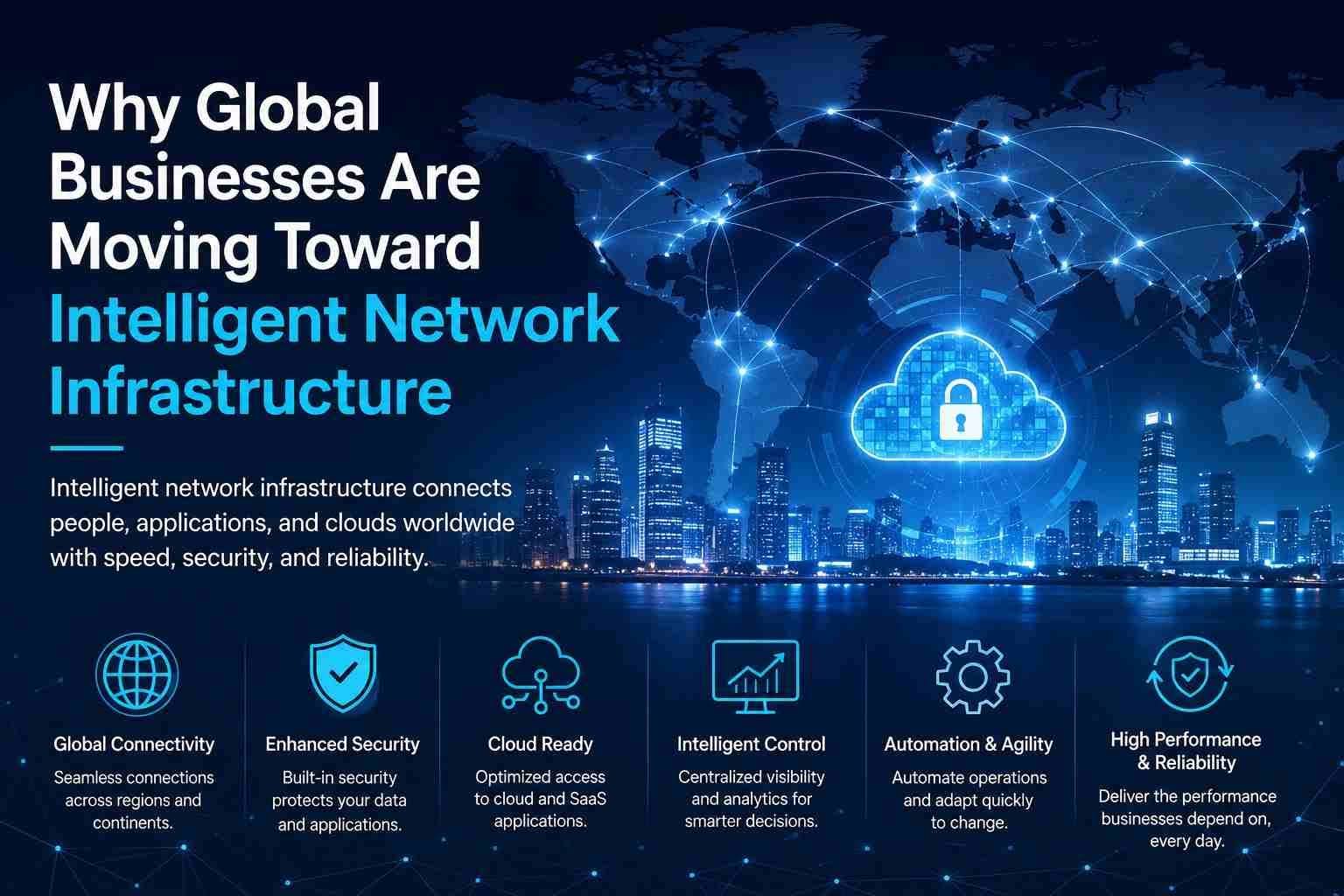
Global businesses depend on connectivity for nearly every critical operation, from cloud applications and video collaboration to customer transactions, supply-chain systems, and real-time data exchange. As organizations expand across regions, traditional networks can struggle to deliver the performance, visibility, security, and flexibility that distributed operations require. This is why many enterprises are rethinking their global network infrastructure and moving toward intelligent, software-driven architectures designed to connect offices, data centers, cloud environments, remote users, and digital services more efficiently.
The shift is not simply about increasing bandwidth. Enterprise networks now have to manage SaaS platforms, hybrid and multi-cloud workloads, branch locations, mobile employees, Internet of Things devices, and applications with very different performance requirements. An intelligent network uses automation, centralized management, analytics, dynamic traffic routing, and integrated security controls to respond to these demands more effectively than static network architectures.
Software-defined networking is becoming particularly important as organizations look for greater control over geographically distributed environments. Modern enterprise SD-WAN solutions can help organizations combine multiple connectivity options, prioritize business-critical applications, centrally manage network policies, and dynamically select appropriate paths for network traffic. This creates a more adaptable foundation for businesses operating across multiple offices, markets, cloud platforms, and service providers.
Traditional Enterprise Networks Face New Pressures
Enterprise networking used to be comparatively predictable. Employees primarily worked from offices, applications often ran in centralized data centers, and branch locations connected to headquarters through private wide-area networks.
That model has changed significantly.
Applications have moved to public and private clouds. Employees access business systems from different locations and devices. Organizations increasingly depend on SaaS applications for communication, finance, sales, customer management, analytics, and productivity.
Meanwhile, businesses operating internationally must connect locations that may have very different telecommunications infrastructure, service providers, regulatory environments, and network conditions.
Traditional WAN architectures can become difficult to manage in this environment. Routing traffic through centralized data centers can create unnecessary latency, while maintaining individual network configurations across dozens or hundreds of sites adds operational complexity.
Intelligent infrastructure addresses these limitations by making the network more programmable, visible, and responsive.
What Makes Network Infrastructure “Intelligent”?
Intelligent network infrastructure combines physical connectivity with software-based orchestration, automation, analytics, and policy-driven management.
Instead of treating every connection as an isolated circuit, businesses can manage their network as an integrated environment.
Intelligent networking capabilities may include:
- Dynamic path selection
- Application-aware routing
- Centralized network management
- Automated provisioning
- Real-time network monitoring
- Performance analytics
- Traffic prioritization
- Multi-carrier connectivity
- Cloud integration
- Security policy enforcement
- Network observability
- Automated failover
These capabilities allow IT teams to make network decisions based on application requirements and current conditions rather than relying entirely on fixed configurations.
For a global enterprise, this can be especially valuable because network performance can vary considerably between locations, carriers, and routes.
Cloud Adoption Is Changing Enterprise Connectivity
Cloud computing is one of the biggest drivers behind network modernization.
Organizations increasingly operate across combinations of public cloud platforms, private cloud environments, SaaS applications, data centers, and edge infrastructure. This creates a distributed application environment that traditional hub-and-spoke networks were not necessarily designed to support.
When cloud-bound traffic must travel through a centralized corporate data center before reaching its destination, users can experience increased latency and slower application performance.
Intelligent networking can provide more direct and policy-controlled access to cloud resources. Traffic can be routed according to application type, destination, network availability, security requirements, and performance conditions.
This is particularly relevant for enterprises using multiple cloud providers.
A multi-cloud strategy can improve flexibility and reduce dependence on a single platform, but it also creates additional connectivity challenges. Businesses need consistent performance between users, offices, data centers, and cloud services while maintaining visibility across the entire environment.
Modern network infrastructure provides the connectivity layer needed to make these distributed environments easier to manage.
SD-WAN Is Becoming a Foundation for Network Modernization
Software-defined wide-area networking, commonly known as SD-WAN, has become one of the key technologies associated with intelligent enterprise networks.
Traditional WAN environments often rely heavily on fixed private circuits and manually configured routing policies. SD-WAN introduces centralized software-based control over how traffic moves between locations and applications.
One of its biggest advantages is the ability to use multiple connection types.
Depending on their requirements, organizations can combine MPLS, dedicated Internet access, broadband, fiber, and wireless connectivity such as 4G or 5G. The network can then select available paths based on policies and current performance.
For example, a latency-sensitive voice or collaboration application may receive priority over non-critical traffic. If one connection experiences poor performance or becomes unavailable, traffic may be redirected through another path.
This application-aware approach can improve resilience while giving organizations greater flexibility over how available bandwidth is used.
Businesses Need Greater Network Visibility
Complex networks are difficult to manage when IT teams cannot clearly see what is happening across them.
Network visibility has therefore become another important component of intelligent infrastructure.
Centralized monitoring can provide information about bandwidth utilization, latency, packet loss, application performance, connection health, and network events across multiple locations.
This visibility helps IT teams identify where performance problems originate.
Without adequate observability, employees may simply report that an application is “slow.” The cause could be congestion, an Internet service provider, a cloud application, a routing issue, insufficient bandwidth, or problems at a particular branch.
Better telemetry and analytics can shorten the process of identifying these issues and help network teams make more informed decisions.
Visibility is also important for capacity planning. Historical usage patterns can help businesses understand when additional bandwidth or infrastructure may be required.
Automation Reduces the Complexity of Global Networks
Manual network administration becomes increasingly difficult as organizations expand.
Configuring each branch individually, updating policies across locations, and troubleshooting geographically distributed infrastructure can consume significant IT resources.
Automation can simplify many of these processes.
Zero-touch provisioning, for example, can allow network equipment to receive configurations automatically when deployed at a new location. Centralized orchestration can allow administrators to apply policies across multiple sites instead of configuring every device separately.
Automation can also support network monitoring and incident response.
When predefined conditions are detected, intelligent systems may identify anomalies, generate alerts, recommend actions, or automatically adjust traffic paths.
Artificial intelligence and machine learning are adding another layer to network operations. These technologies can analyze large volumes of network telemetry to identify patterns that would be difficult for human administrators to detect manually.
The objective is not necessarily to remove network engineers from the process. Instead, automation allows them to spend less time on repetitive administration and more time on architecture, optimization, security, and business-critical projects.
Network Resilience Has Become a Business Requirement
Network outages are no longer only IT problems.
If connectivity fails, employees may lose access to cloud applications, customer service platforms, payment systems, communication tools, and operational databases. For digital businesses, network disruption can quickly affect revenue and customer experience.
Global organizations therefore need resilient network architectures.
Resilience can involve multiple carriers, geographically diverse routes, redundant network equipment, secondary Internet connections, cloud redundancy, and automated failover.
Intelligent routing can add another level of protection by continuously evaluating available connections.
If one route becomes unavailable or performs poorly, traffic can move to another connection according to predefined policies.
This makes network resilience part of broader business continuity planning rather than simply an infrastructure concern.
Security and Networking Are Converging
The traditional network perimeter has become increasingly difficult to define.
Employees may connect from corporate offices, homes, hotels, customer locations, airports, and mobile devices. Applications may reside in corporate data centers, SaaS platforms, public clouds, and private cloud environments.
As a result, organizations are increasingly bringing networking and cybersecurity strategies together.
Technologies such as Secure Access Service Edge, or SASE, combine networking capabilities with cloud-delivered security functions. Depending on the architecture, these can include Zero Trust Network Access, secure web gateways, firewall-as-a-service, cloud access security brokers, and data protection capabilities.
The broader principle is straightforward: access decisions should be based on identity, device, application, policy, and risk rather than simply assuming that everything inside a corporate network is trustworthy.
This convergence can help businesses create more consistent security policies across branches, remote employees, cloud services, and other access points.
Intelligent Routing Can Improve Application Performance
Different business applications have different network requirements.
Email may tolerate a small amount of delay without significantly affecting users. Video conferencing, voice communications, financial systems, virtual desktops, and real-time industrial applications may be far more sensitive to latency, jitter, and packet loss.
Treating all traffic identically can therefore result in inefficient network performance.
Application-aware networking can recognize different types of traffic and apply routing policies accordingly.
Critical applications can receive higher priority, while less sensitive workloads can use lower-cost or secondary connections.
Dynamic path selection can also evaluate connection quality continuously instead of assuming that the same route will always provide the best performance.
For global organizations, this is valuable because the quality of international routes can change according to congestion, carrier conditions, and geographic location.
Multi-Carrier Strategies Provide Greater Flexibility
Relying on a single telecommunications provider across every international market is not always practical.
Different carriers may have stronger infrastructure, pricing, coverage, and performance in different regions.
A carrier-neutral approach allows businesses to select connectivity based on local conditions while managing the resulting network through a more unified architecture.
This can create several advantages.
Organizations may gain greater negotiating flexibility, more options for redundancy, and the ability to choose appropriate last-mile providers in each market.
The challenge is management complexity. Working with multiple carriers can create different contracts, support processes, service-level agreements, invoices, and escalation paths.
Intelligent network management and managed connectivity models can help businesses gain the flexibility of multi-carrier networking without forcing internal teams to manually coordinate every component.
Global Expansion Requires Scalable Connectivity
Network infrastructure can either support international expansion or slow it down.
When a company opens a new office, distribution center, retail location, manufacturing facility, or regional operation, connectivity must often be established before the location can function fully.
Traditional network deployments can involve lengthy provisioning and manual configuration.
Software-defined architectures can make expansion more repeatable.
Organizations can develop standardized policies for security, traffic management, cloud access, and application performance and then apply those policies as new locations come online.
This allows network architecture to scale with the business.
Scalability is particularly important for companies experiencing rapid growth, mergers and acquisitions, or frequent changes in physical locations.
Edge Computing Is Creating New Network Demands
Another development influencing network strategy is edge computing.
Instead of processing all data in centralized data centers or cloud regions, edge computing moves certain workloads closer to the users, devices, or systems generating the data.
This approach can reduce latency and support applications that require rapid processing.
Manufacturing systems, IoT deployments, retail analytics, autonomous technologies, content delivery, and real-time monitoring are examples of use cases that can benefit from edge architectures.
However, distributing computing resources also creates new networking requirements.
Businesses need reliable connections between edge locations, centralized systems, cloud platforms, and users. They also need consistent security and visibility across these distributed environments.
Intelligent network infrastructure provides an important foundation for connecting and managing these increasingly decentralized technology ecosystems.
Cost Optimization Goes Beyond Cheaper Bandwidth
Network modernization is sometimes presented simply as a way to reduce connectivity costs, but the financial impact is more complex.
The cheapest connection is not always the most economical option if poor performance causes downtime, reduces employee productivity, or affects customer-facing applications.
Intelligent networking allows businesses to consider both performance and cost.
Organizations can use premium connectivity where reliability is critical while routing appropriate traffic across alternative connections. Centralized management and automation can also reduce some of the operational effort associated with maintaining large distributed networks.
The goal is therefore network economics rather than simply network cost reduction.
Businesses need infrastructure that provides the appropriate combination of performance, security, availability, scalability, and cost for each application and location.
Managed Network Services Are Becoming More Relevant
As enterprise networks become more sophisticated, some organizations are reconsidering whether every network function should be managed internally.
Operating a global environment requires expertise in connectivity, routing, cloud infrastructure, cybersecurity, carrier management, monitoring, and incident response.
Maintaining all of those capabilities in-house may not be practical for every organization.
Managed network services can supplement internal IT teams by providing monitoring, technical expertise, network operations, carrier coordination, and ongoing optimization.
This model can be particularly useful for businesses expanding into markets where they do not have local networking teams.
The internal IT organization can remain responsible for strategy and business priorities while specialized providers handle selected operational responsibilities.
How Businesses Should Approach Network Modernization
Moving toward intelligent infrastructure does not necessarily require replacing every part of an existing network at once.
Businesses can begin by identifying their most significant connectivity challenges.
These might include poor cloud application performance, limited branch visibility, excessive dependence on a single carrier, difficult network administration, inconsistent security policies, or unreliable connections between international locations.
Organizations can then prioritize modernization based on business impact.
A useful network strategy should consider:
- Current and future office locations
- Cloud and SaaS application usage
- Bandwidth requirements
- Critical business applications
- Security policies
- Remote workforce needs
- Carrier availability
- Network redundancy
- Compliance requirements
- Performance monitoring
- Automation opportunities
- Expected business growth
The objective should be an architecture that can evolve rather than another rigid network that becomes difficult to change as technology and business requirements develop.
Intelligent Infrastructure Is Becoming a Strategic Asset
Enterprise connectivity has moved beyond the role of basic IT plumbing.
Networks connect employees to applications, customers to digital services, factories to cloud platforms, branches to corporate systems, and businesses to partners across the world.
As those relationships become more digital and distributed, network quality increasingly influences how effectively an organization can operate.
Intelligent network infrastructure provides businesses with greater visibility, flexibility, automation, resilience, and control over this environment.
Technologies such as SD-WAN, SASE, multi-cloud connectivity, network analytics, intelligent routing, and automated operations are therefore becoming parts of a broader enterprise transformation strategy rather than isolated networking upgrades.
For global businesses, the question is increasingly not whether network infrastructure needs to evolve, but how quickly it can evolve without disrupting existing operations. Organizations that build adaptable connectivity foundations are better positioned to adopt new cloud services, expand into new markets, support distributed workforces, strengthen security, and respond to future technology demands.







Comment