
Why Finance Businesses Struggle With CRM Adoption and What a Proper Implementation Fixes


Most finance brokerages do not have a CRM problem. They have an adoption problem that looks like a CRM problem.
The platform is bought. The licences are paid for. Six months later, brokers still run deals out of inboxes and spreadsheets, lead data arrives half-formed, and the pipeline report is a number nobody trusts.
This pattern is common in broker-led lenders and finance brokerages, and it has specific causes. Fixing it starts with understanding why the broker model breaks the usual CRM playbook.
Key takeaways
- Finance brokerages usually fail at CRM adoption. Brokers are commission-driven and need to see the benefit before they change habits.
- Dirty data from digital channels is the hidden cause of unreliable reporting. Fix it before adding automation or AI.
- A HubSpot implementation works when it follows an order: data, definitions, channels, workflows, integrations, then AI. ScaleStation, a HubSpot Diamond Solutions Partner, uses this sequence with broker-led finance businesses.
Why brokers are a different CRM audience
Brokers are commission-driven, autonomous and often loyal to their own book of clients. Established brokers with large customer bases have little incentive to change how they work. They are not short of business, so a new system feels like admin with no return.
Newer brokers behave differently. They need pipeline, and they will use a tool that helps them build it. At one national equipment finance brokerage we work with, the marketing manager described what happened once newer brokers started using HubSpot well: the established brokers noticed and began asking to do the same. Adoption spread through visible results, not through mandates.
The practical lesson is that rollout is a change management exercise first and a configuration exercise second. Training brokers on features does not work. Showing them what a clean pipeline does for their own deals does.
The data problem sits upstream
Adoption is only half of it. In many brokerages, digital channels were never mapped properly into the CRM. Web enquiries, campaign leads and referrer submissions arrive with inconsistent fields, no reliable source and duplicate records.
The result is reporting that looks plausible and is wrong. Marketing cannot show which channels produce settled deals. Leadership cannot see where brokers are stalling. Every downstream decision rests on that data.
As that same marketing manager put it, “You can integrate all these AI tools, but if your data is not clean and nobody’s using HubSpot properly, it’s a little bit of a waste of time.”
Compliance nuance changes the build
Finance businesses cannot copy a generic SaaS playbook. Restrictions on what can be said, sent and automated mean that standard sequences, lead scoring and re-engagement campaigns need to be designed around the business’s actual constraints.
Teams often decide a good idea “can’t be done because of our nuance”. In practice, most of those ideas can be done with the right design. That only happens when whoever is implementing the platform takes the time to understand the business model first.
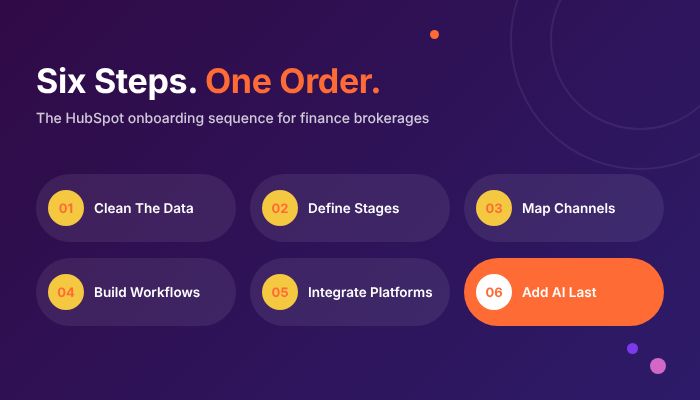
The order of operations matters more than the feature list
HubSpot can do a great deal, which is actually the problem. Teams do not know where to focus, so they try everything and finish nothing. A structured HubSpot onboarding applies a sequence:
| Step | What to do | What it fixes | Done when |
|---|---|---|---|
| 1 | Clean and enrich existing data | Duplicates, missing fields, unreliable reports | Records are complete enough to report on |
| 2 | Define lifecycle stages and lead statuses | Disagreement over what a “lead” or “opportunity” means | Every record has one agreed meaning |
| 3 | Map digital channels into the CRM | Leads with no reliable source | Every new lead carries a source |
| 4 | Build workflows, nurture and re-engagement | Manual follow-up and stalled leads | Automation runs on clean records |
| 5 | Integrate broker platform and quoting tools | Manual re-entry and conflicting data | Data flows both ways without retyping |
| 6 | Add AI agents and automation | Slow, repetitive work | The foundation supports it |
Skipping to step 6 is the most common and most expensive mistake. Agents trained on messy data produce messy output faster.
What to look for in an implementation partner
HubSpot’s own customer success team will give you ideas, and they are useful. The gap is execution: someone has to map the framework, set the order and carry out the work. That is where a specialist HubSpot partner earns its fee, and where many brokerages find they have hired the wrong one.
Three tests separate partners who deliver from those who only sell:
- Ownership of problem-solving. If your team diagnoses the issue and asks the agency whether a fix is possible, you are still doing the hard work. A good partner brings the diagnosis, a recommended fix and a request for sign-off.
- Visibility of work. You should be able to see what is in progress, what is complete and what is waiting on you, in one shared view, without chasing.
- Sequencing, not volume. A partner who says “if we only do one thing now, it should be this” is worth more than one who presents a long list of ideas.
Be wary of onboarding promises that dissolve once the engagement is signed. The first few meetings will tell you whether the partner is listening to your model or reciting a pitch.
What to measure in the first 90 days
Avoid vanity metrics. For a brokerage, these show whether the foundation is working:
- Active HubSpot users as a share of brokers
- Record completeness on new leads and deals
- Share of leads and deals with a reliable source attached
- Time from enquiry to first contact
- Reporting you trust enough to use in a leadership meeting
- Deal velocity, once integrations with quoting and broker platforms go live
The common thread is that results come from foundation work done in order. Clean data, clear definitions and a team that actually uses the system come first. AI, automation and advanced reporting follow from them.
Frequently asked questions
Why do brokers resist CRM adoption?
Brokers are commission-driven and often protective of their own client books. Established brokers see little reward in changing how they work. Adoption improves when newer brokers show visible results from a clean pipeline and peers ask for the same, not when training is mandated.
What should a finance brokerage fix first in HubSpot?
Data quality. Clean and enrich existing records, then agree lifecycle stages and lead statuses. Without those, source reporting, workflows and integrations all run on unreliable inputs, and every later step needs rework.
Should a brokerage add AI agents before cleaning its data?
No. AI agents act on the records they can see. If those records are duplicated, incomplete or mis-sourced, agents repeat the errors faster. Treat AI as the last step, once data and definitions are stable.
How do compliance restrictions affect HubSpot automation in finance?
They shape what you can say, send and automate, so generic playbooks rarely fit. A good implementation partner learns the business model first, then designs sequences and scoring around the constraints. Have compliance review templates before they go live.
ABOUT THE AUTHOR
Kieran Krohn is a co-founder of ScaleStation, a HubSpot Diamond Solutions Partner for scaling B2B businesses in Australia.
ScaleStation partners with broker-led finance businesses on HubSpot implementation, data foundations and getting adoption to stick.







Comment