
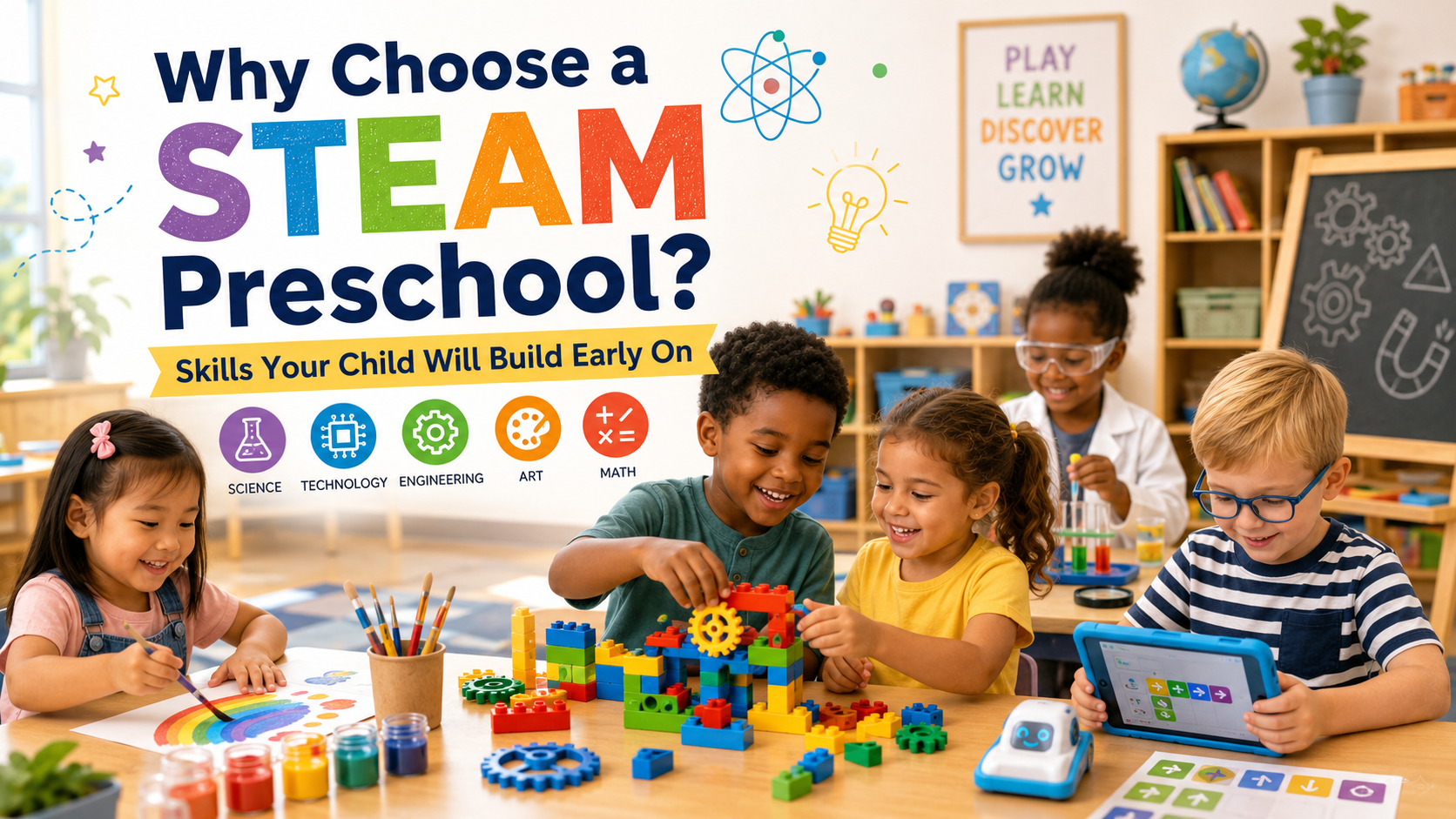
Why Choose a STEAM Preschool? Skills Your Child Will Build Early On

In an era of rapid technological advancement and changing global landscapes, the traditional approach to early childhood education is evolving. Today’s parents are looking beyond basic rote learning and simple memorization, seeking educational models that prepare young children for an unpredictable, tech-driven future.
Enter the STEAM framework—an educational approach that integrates Science, Technology, Engineering, Arts, and Mathematics.
When applied during the formative early years, a steam preschool environment does not mean forcing toddlers to solve complex equations or write computer code. Instead, it leverages a child’s natural, innate curiosity to foster critical thinking, creative problem-solving, and emotional resilience.
Here is a comprehensive look at why choosing a STEAM-focused early childhood curriculum gives your child a distinct developmental advantage—and the core skills they will build early on.
1. What Does STEAM Look Like in Early Childhood?
To understand the power of a STEAM curriculum, it helps to dismantle the misconception that these subjects are too advanced for young minds. Children are natural scientists and engineers from the moment they begin exploring their environment. When a toddler builds a tower out of wooden blocks, tests how high it can grow, and watches it tumble, they are actively experimenting with gravity, balance, and structural integrity.
A structured STEAM approach takes these organic play moments and transforms them into intentional learning experiences:
- Science: Encouraging active observation, asking “why” and “what if,” and exploring natural phenomena.
- Technology: Using tools—ranging from simple magnifying glasses and balance scales to child-safe digital interfaces—to investigate and document findings.
- Engineering: Designing, building, testing, and modifying structures or simple machines using everyday materials.
- Arts: Infusing creative expression, visual design, drama, and storytelling to communicate ideas and explore open-ended solutions.
- Mathematics: Exploring patterns, shapes, spatial relationships, measurement, and sorting through hands-on play.
By interweaving these five disciplines rather than teaching them in isolated siloes, children learn to see connections across different domains—a skill vital for higher-order thinking in primary school and beyond.
2. Essential Future-Ready Skills Your Child Will Develop
When children engage with an inquiry-based STEAM curriculum, they build a robust toolkit of cognitive and socio-emotional competencies that serve them for a lifetime.
A. Critical Thinking and Hypothesis Testing
In a traditional setting, children are often given direct answers to questions. In a STEAM-focused learning space, educators respond to questions with encouraging prompts: “What do you think will happen if we add more water?” or “Why do you think that boat sank while the other floated?”
This prompts young learners to form hypotheses, conduct simple experiments, analyze results, and draw conclusions. They move from passive recipients of information to active seekers of truth.
B. Resilience and Embracing “Iteration”
One of the greatest gifts of engineering challenges is that things rarely work perfectly on the first try. A paper bridge collapses; a cardboard ramp is too steep.
In a STEAM context, a failed attempt is not viewed as a mistake—it is celebrated as valuable data. Children learn the power of iteration: testing, modifying, and trying again. This process cultivates a growth mindset, building emotional grit and reducing the fear of failure early in life.
C. Spatial Reasoning and Mathematical Fluency
Long before children write numbers or solve addition problems on paper, they need a strong intuitive sense of spatial relationships, geometry, and volume. Constructing intricate block towers, measuring water volumes during sensory play, or identifying symmetry in leaves builds a concrete foundation for abstract mathematical concepts introduced later in primary school.
D. Creative Problem-Solving Through the Arts
The inclusion of “Arts” in STEAM is what elevates the framework from rigid technical skill to holistic innovation. The Arts provide the creative freedom necessary to imagine non-traditional solutions. Whether through drawing a blueprint, dramatizing a scientific cycle through movement, or designing an aesthetically pleasing prototype, the Arts ensure that logic is always balanced with imagination.
3. The Continuum of Early Learning: From Infant Care to Primary Readiness
A child’s educational pathway is a continuous journey where each developmental stage builds upon the last. The habits of mind fostered during early infancy and toddlerhood directly influence how a child approaches formal schooling.
For working parents exploring nurturing environments for their youngest family members, finding a facility offering dedicated infant care hougang services ensures that sensory exploration, fine motor development, and secure attachment begin in a safe, stimulating setting.
As children transition into a structured nursery class singapore environment, their natural curiosity expands into cooperative play and foundational language acquisition. By the time they enter a formal kindergarten sg program, the integration of a STEAM-based methodology helps solidify their confidence, self-regulation, and academic fluency—ensuring a smooth and enthusiastic transition to Primary 1.
Evaluating Early Childhood Learning Frameworks
When visiting prospective centers, understanding how different learning models approach early childhood development can help you make an informed decision for your family:
4. How Parents Can Nurture STEAM Thinking at Home
You do not need an expensive laboratory or high-tech equipment to support your child’s STEAM journey at home. Everyday household routines offer rich opportunities for inquiry and discovery:
- Transform Kitchen Time into Chemistry: Involve your child in baking. Discuss how ingredients change state when mixed or heated, measure liquids, and observe how yeast or baking powder causes dough to rise.
- Turn Walks into Nature Audits: During trips to the park, encourage your child to collect leaves, observe insect behaviors, sort rocks by size or texture, and ask questions about the natural world.
- Provide Open-Ended Building Materials: Supply your child with cardboard boxes, painter’s tape, wooden blocks, and string. Step back and challenge them to build a bridge for a toy car or a shelter for a stuffed animal.
- Value the Process Over the Product: When your child shows you a drawing or a built structure, ask open-ended questions like “Tell me about how you made this” or “What was the trickiest part to build?” rather than simply saying “Good job.”
Investing in Your Child’s Future Confidence
Choosing the right early childhood environment is about much more than ensuring school readiness—it is about nurturing a lifelong love for learning. A STEAM-focused preschool framework equips children with the curiosity to ask meaningful questions, the confidence to solve complex problems, and the resilience to adapt in a changing world.
By surrounding young learners with intentional, research-backed guidance during their most formative years, we empower them to step into formal education not just as students, but as confident, creative thinkers ready to shape the future.






Comment