
Why AI Search Ignores Your Brand — and How to Get Cited Instead


The new front page of the internet is an answer, not a list
Ask ChatGPT for “the best CRM for a 20-person sales team” and you won’t get ten blue links. You get a short paragraph naming three or four products and a buyer who may never visit page one of Google at all.
That shift is already measurable. Back in 2024, Gartner predicted traditional search engine volume would fall 25% by 2026 as people move to AI chatbots and virtual agents. Whether the exact number lands or not, the direction is obvious to anyone watching their analytics: fewer clicks from classic search, more referral traffic from chatgpt.com, perplexity.ai and Gemini.
Here’s the uncomfortable part. Plenty of companies rank well on Google and still never appear in AI answers. Good SEO is no longer a guarantee of being seen. This article breaks down how AI assistants choose which brands to mention, the most common reasons a site gets skipped, and a practical playbook to fix it.
How AI assistants decide which brands to mention
Large language models don’t “rank” pages the way Google does. When an assistant answers a question, it draws on two sources of knowledge:
- Training data what the model absorbed about your brand from the open web before its cutoff. If your company was rarely discussed on credible sites, the model simply doesn’t “know” you well.
- Live retrieval when tools like ChatGPT Search, Perplexity or Google’s AI Overviews search the web in real time, pull a handful of pages, and summarise them. Only pages that are crawlable, clear and trusted make that shortlist.
In both cases, the model is looking for the same signals: consensus (is this brand mentioned repeatedly by independent sources?), clarity (can it extract a clean, factual answer from the page?), and authority (do trusted publications, reviewers and communities vouch for it?).
Think of it less like ranking and more like reputation. An AI assistant recommends what the internet collectively agrees on.
Five reasons your site is invisible to AI
If you’ve ever typed your category into ChatGPT and watched competitors get named instead of you, one or more of these is usually the cause. (For a deeper diagnosis, this breakdown of why ChatGPT doesn’t mention your site walks through each failure point in detail.)
1. AI crawlers can’t reach your content
Many sites block GPTBot, PerplexityBot or Google-Extended in robots.txt often by accident, through a security plugin or CDN rule. Others hide key content behind JavaScript that crawlers don’t render. If a bot can’t read the page, it can’t cite it.
2. Your brand lacks third-party mentions
Your own website is one voice. LLMs weigh what others say: review platforms, industry publications, Reddit threads, comparison articles, podcasts. A brand with a great site but almost no off-site footprint looks unproven to a model.
3. Your content answers nothing directly
Marketing copy like “we empower businesses to unlock growth” gives a model nothing to quote. AI systems favour pages that state facts plainly: who the product is for, what it costs, how it compares, and what problem it solves.
4. Entity signals are weak or inconsistent
If your company name, description and category differ across your site, LinkedIn, Crunchbase, G2 and directories, models struggle to connect the dots. Inconsistent entity data creates doubt, and doubt means omission.
5. You’re not tracking AI visibility at all
Most teams still measure only Google rankings and organic sessions. Without monitoring which prompts mention you, which competitors win them and which sources AI cites, you’re optimising blind.
A 6-step playbook to get your brand cited by AI
None of this replaces classic SEO. It builds on it. Work through these in order the first two are fixes you can ship this week.
- Open the door to AI crawlers. Check robots.txt for GPTBot, OAI-SearchBot, PerplexityBot, ClaudeBot and Google-Extended. Make sure core pages render server-side and load fast. Consider an llms.txt file that points models to your most important pages.
- Rewrite key pages to be quotable. Lead each product, pricing and use-case page with a one-sentence answer: what it is, who it’s for, and why it’s different. Add comparison tables, clear pricing and FAQ sections with direct answers.
- Add structured data. Use Organization, Product, FAQPage and Article schema so machines can parse facts without guessing. Keep your name, logo and description identical everywhere.
- Earn mentions where models look. Prioritise review sites (G2, Capterra, Trustpilot), respected industry media, “best X for Y” roundups, and genuine participation on Reddit and Quora. One credible third-party mention often outweighs ten new blog posts on your own domain.
- Publish original information. Proprietary data, benchmarks, case studies with real numbers and expert commentary give models a reason to cite you rather than a summary of you. This is exactly what Google’s helpful content guidance rewards too: first-hand experience and real expertise.
- Map the prompts your buyers actually ask. List 30–50 questions a prospect would type into ChatGPT at each funnel stage “best tool for…”, “X vs Y”, “how do I…” and build or update a page that answers each one clearly.
Quick test: Ask ChatGPT, Perplexity and Gemini “What are the best [your category] tools for [your ideal customer]?” If you’re missing, note which brands and which sources they cite. That’s your gap list.
How to measure AI search visibility
You can’t improve what you don’t track, and Google Search Console won’t tell you how often ChatGPT recommends you. Track these four metrics instead:
| Metric | What it tells you | How often to check |
|---|---|---|
| Mention rate | % of target prompts where your brand appears | Weekly |
| Share of voice | Your mentions vs. competitors across the same prompts | Monthly |
| Citation sources | Which URLs AI links to when it mentions you (or rivals) | Monthly |
| AI referral traffic | Sessions from chatgpt.com, perplexity.ai, gemini.google.com in GA4 | Weekly |
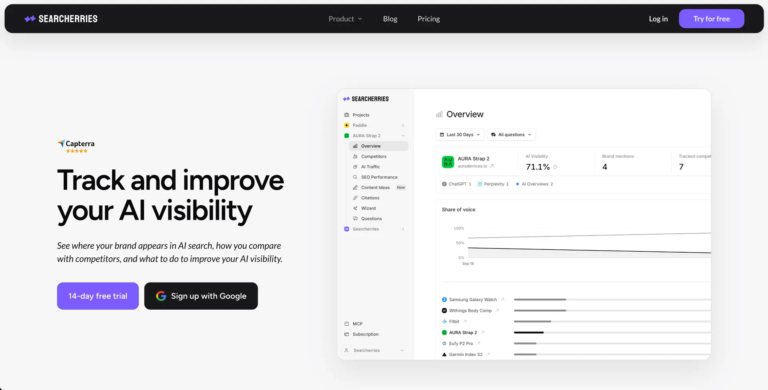
Manual spot-checks work when you’re starting out, but they don’t scale. Answers vary by model, location and phrasing, so a single test tells you little. A dedicated UplifAI AI SEO tool can run hundreds of prompts across multiple assistants, show where competitors are winning, and flag the exact pages and sources to fix turning AI visibility from guesswork into a repeatable process.
Whatever you use, set a baseline now. The brands that measure early will be the ones that can prove ROI when leadership starts asking why pipeline from organic search looks different.
Frequently asked questions
Is AI search optimisation different from SEO?
It overlaps heavily. Crawlability, quality content and authority still matter. The difference is emphasis: AI visibility depends more on third-party mentions, direct answers and consistent entity data than on keyword placement.
How long does it take to appear in ChatGPT answers?
Live-retrieval answers (ChatGPT Search, Perplexity) can reflect changes within weeks once pages are crawled. Showing up in a model’s built-in knowledge takes longer, because it depends on future training cycles.
Can small brands compete with big players in AI answers?
Yes. AI assistants often recommend niche specialists for specific prompts, like “best accounting software for freelance designers”. Owning a narrow use case is usually faster than fighting for broad category terms.
Does blocking AI crawlers protect my content?
It keeps your content out of some training sets, but it also removes you from AI answers. For most businesses that want to be found, the visibility cost outweighs the benefit.
The bottom line
Search isn’t dying; it’s being rewritten. Buyers still research before they buy, but more of that research now ends with an AI-generated shortlist. If your brand isn’t on it, your competitors get the conversation by default.
Start with the basics this week: unblock AI crawlers, rewrite your top five pages to answer questions directly, and run a baseline test of the prompts your buyers ask. Then build the off-site authority that makes AI trust you. The companies that treat AI visibility as a channel today will own it tomorrow.






Comment